
Red Hat Patents a Way to Feed Data Into a Virtual Machine Without the Host Seeing Inside
When you run a virtual machine in the cloud, the company hosting it can technically peek at its memory. Red Hat is patenting a driver design that closes that gap even when the host has to pass data in.
What Red Hat's confidential VM driver system actually does
Imagine renting a safe-deposit box at a bank, but the bank staff can still open it whenever they want. That's roughly the situation with most cloud virtual machines today: the company running the servers can, in principle, read the memory inside your VM.
Confidential computing is a newer approach that uses special hardware to lock the VM's memory so the host literally cannot read it. The catch is that the host still needs to hand data into the VM sometimes, and that handoff is a tricky security moment.
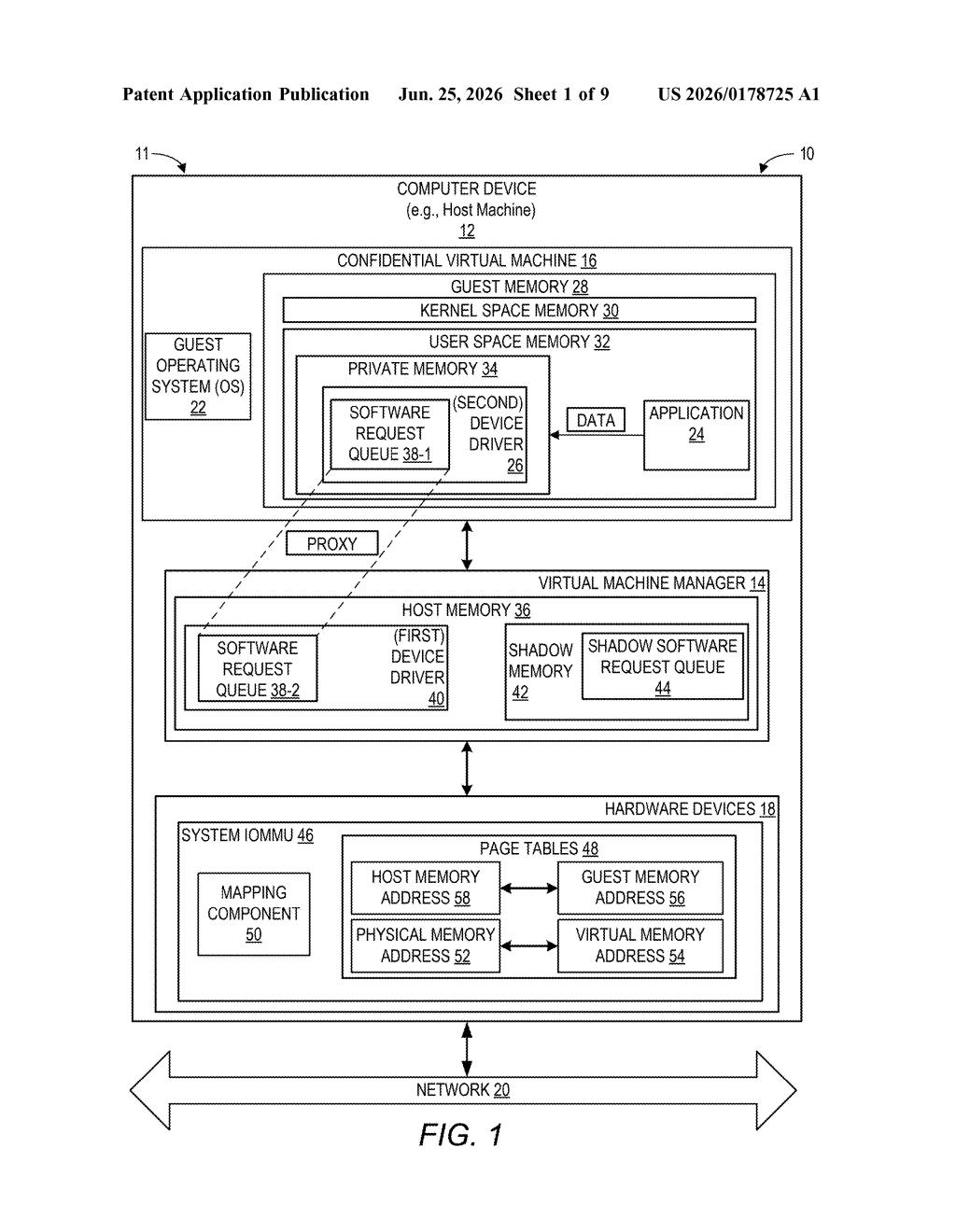
Red Hat's patent describes a two-driver system to handle that handoff safely. A driver on the host side passes data across a controlled channel. A driver running inside the VM's own private memory receives it and decides whether to accept it or block it based on a set of rules. The host never gets to see or write directly into the protected memory zone.
How the two-driver handoff keeps private memory sealed
The patent describes a split architecture involving two cooperating device drivers (small software components that manage how data flows between hardware and an operating system).
- A first driver runs inside the Virtual Machine Manager (VMM), the host-level software (like QEMU or a hypervisor) that creates and oversees virtual machines.
- A second driver runs inside the user space private memory of a confidential VM, a VM whose memory is encrypted and hardware-protected so that even the VMM cannot read or write it directly.
- The two drivers establish a communication channel between them.
When the VMM needs to pass data into the VM (say, a network packet or a storage block), it hands the data to the first driver, which sends it over the channel. The second driver, already inside the protected zone, receives it and then makes a decision: accept the data and write it into private memory, or reject it based on a criterion (a policy rule, an integrity check, or a filter).
The key point is that the VMM side never directly touches private memory. The gating logic lives inside the trust boundary, which is exactly where it needs to be for confidential computing to hold up under scrutiny.
What this means for cloud tenants who don't trust their host
Cloud security increasingly depends on confidential computing, where hardware like AMD SEV or Intel TDX encrypts a VM's memory at the chip level. The weak spot in most implementations has been the I/O path: data has to get in and out somehow, and that creates a window for a malicious or compromised host to inject bad data.
For enterprises running sensitive workloads (financial records, health data, encryption keys) on shared cloud infrastructure, a formally defined driver boundary like this matters. It gives security teams a clear place to audit what enters a protected VM, rather than trusting the entire host stack implicitly.
This is serious infrastructure work aimed at a real gap in confidential computing, not a speculative feature. The I/O path has always been the awkward exception in 'the host can't see your memory' guarantees, and this patent directly addresses it with a concrete architectural pattern. It won't make headlines outside of cloud security circles, but it's the kind of unglamorous plumbing that actually makes zero-trust cloud claims credible.
There are more where this came from
We read every patent application Big Tech publishes and send you the ones worth knowing. Plain English, free, every week.
Want this weekly breakdown for a company we don't cover? Patentlyze Pro →