
IBM Patents a Parallelizable Simulator for Dynamic Quantum Circuits
Running a quantum circuit simulation is slow and expensive — IBM's new patent tries to fix that by pre-computing and storing wave functions so repeated simulation runs don't have to start from scratch every time.
What IBM's quantum circuit simulator actually does
Imagine you're baking a complicated recipe and every time you want to try a slight variation, you have to restart from raw ingredients. That's essentially what quantum circuit simulators do today — every test run, called a "shot," recalculates everything from the beginning.
IBM's patent describes a system that stores intermediate wave functions (mathematical snapshots of a quantum system's state) so that simulation runs can branch off from a saved checkpoint rather than restarting cold. Think of it like save states in a video game — you don't replay the whole level each time you try a new strategy.
The payoff is that multiple simulation shots can run in parallel, branching from the same stored state. For researchers running thousands of test scenarios on a quantum circuit, this could cut simulation time significantly — and that matters a lot when real quantum hardware is still expensive and scarce.
How IBM stores wave functions to parallelize simulation shots
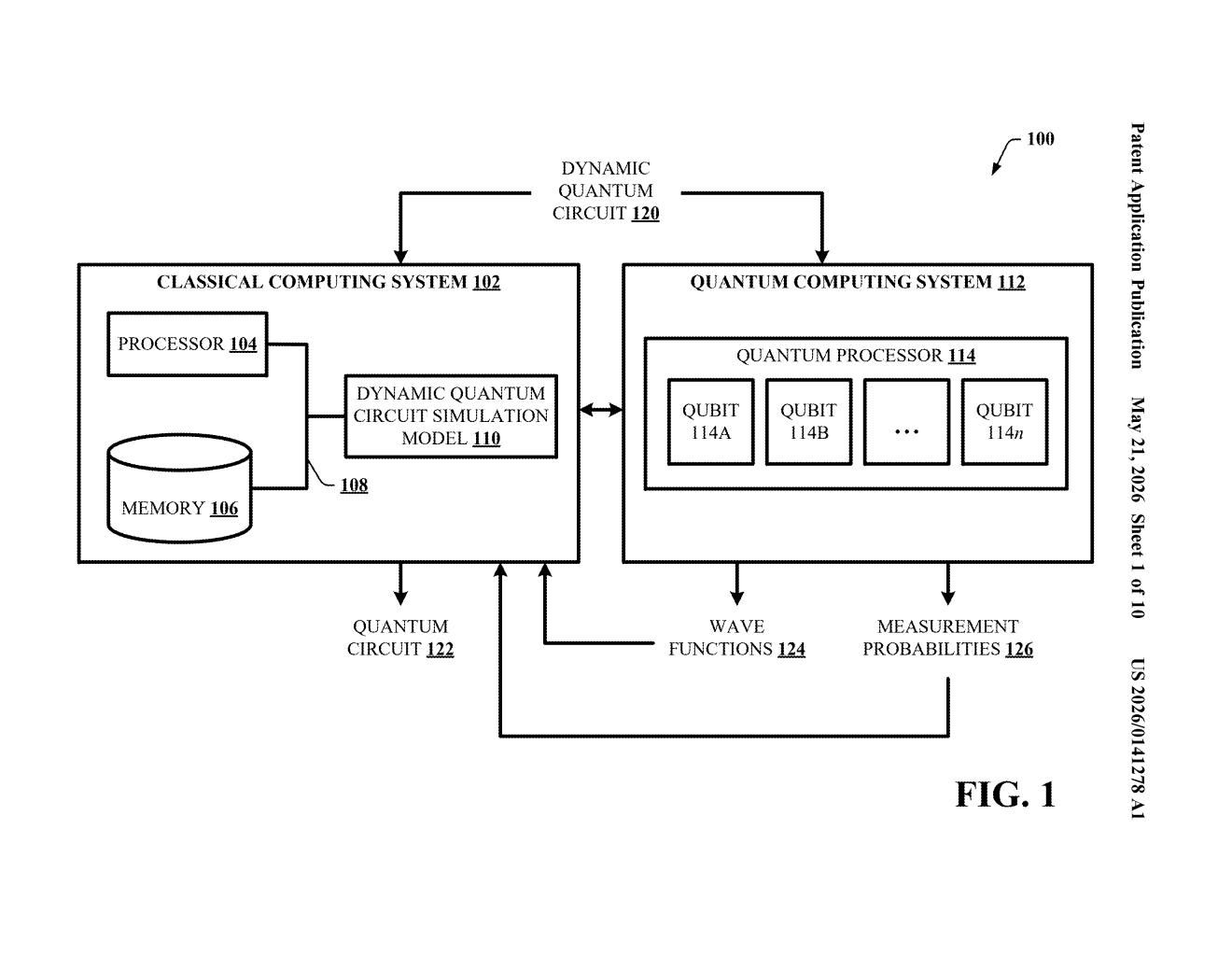
The patent describes a classical computing system that works alongside a quantum processor to simulate dynamic quantum circuits — circuits where measurement results mid-circuit can change what operations happen next (classical feedback loops inside a quantum program).
The core idea is a storage component that holds a set of wave functions corresponding to various points in the quantum system's evolution. A wave function is the mathematical object that fully describes the probability state of a quantum system — knowing it tells you everything about what outcomes are possible and how likely they are.
A simulation component then draws on those stored wave functions to execute one or more simulation shots. Rather than propagating through the entire circuit from the initial state each time, the simulator can jump to a relevant saved wave function and continue from there. This is especially useful for dynamic circuits because different measurement outcomes create branching execution paths — pre-storing the wave functions at branch points means each branch can be explored without redundant computation.
The architecture spans both classical and quantum computing resources, with the classical system handling storage and orchestration while the quantum processor handles gate execution and measurement.
What this means for quantum software development today
Most quantum algorithms need to be run hundreds or thousands of times (shots) to build up statistically meaningful results. Today's simulators — which run on classical hardware to test circuits before committing to expensive quantum hardware time — redo a lot of the same math on every shot. IBM's approach of caching wave functions at key checkpoints could make simulation meaningfully faster and cheaper, which accelerates the iterative development loop for quantum software engineers.
This is particularly relevant for dynamic quantum circuits, which are increasingly central to error correction and near-term quantum algorithms. If IBM's simulator handles branching execution paths more efficiently, it could make the tooling around quantum error correction research significantly more practical — a quiet but important infrastructure win.
This is unglamorous infrastructure work, but it's the kind of thing that actually moves quantum computing forward right now. The gap between 'we have quantum hardware' and 'we can usefully program it' is largely a software and tooling problem, and faster simulation is a direct lever on that. IBM is one of the few companies with both the hardware and the software stack to actually ship this.
Get our take in your Top Stories
Liked this breakdown? Add Patentlyze as a preferred source on Google, and our plain-English take shows up more often in your Top Stories the next time IBM patent news breaks.
There are more where this came from
We read every patent application Big Tech publishes and send you the ones worth knowing. Plain English, free, every week.
Want this weekly breakdown for a company we don't cover? Patentlyze Pro →