
Samsung Patents a Smart Ring That Reads a Finger Pressed Into Its Groove
Samsung is rethinking what a smart ring can sense, filing a patent for a ring with physical grooves on its outer surface that can detect when neighboring fingers press against it.
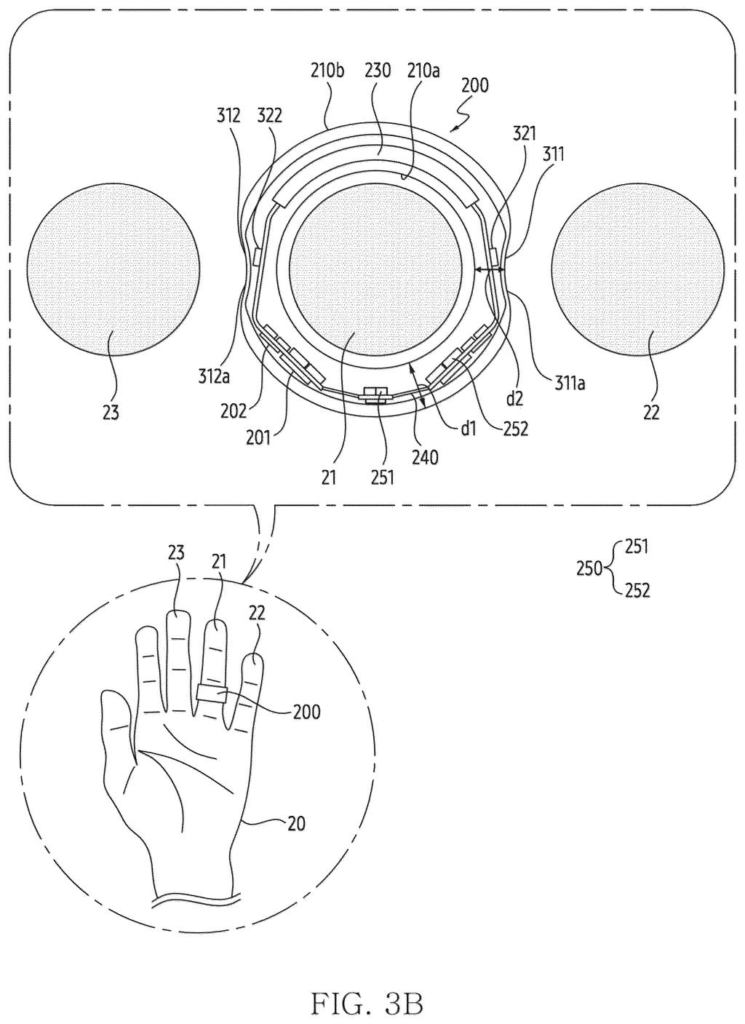
What Samsung's outer-groove ring sensor actually does
Picture putting on a ring and then naturally resting an adjacent finger against it. Samsung's patent is built around that exact moment. The ring has two small indentations carved into its outer surface, one on each side, sized so neighboring fingers naturally settle into them.
Inside each indentation sits a touch sensor. When your adjacent finger presses into a groove, the ring registers that contact. The basic idea is that your other fingers, not just the one wearing the ring, become part of the input system.
This could let you control music, answer calls, or trigger health readings by pressing a neighboring finger against the ring rather than tapping a phone screen. It is a more discreet way to interact with a wearable that is already too small for buttons.
How the grooves and sensors work together
The patent describes a finger-worn ring with a conventional ring-shaped inner surface that contacts the wearer's finger, plus a redesigned outer surface featuring two distinct grooves.
- First groove: recessed radially inward on one side of the ring, positioned to be naturally contacted by the finger on one side of the ring finger.
- Second groove: a matching groove on the opposite side, positioned for the finger on the other side.
- Touch sensors: one sensor embedded beneath each groove, capturing contact data when an adjacent finger presses in.
The sensors detect contact events, meaning they register when a neighboring finger is pressing, how much it presses, or patterns of pressing. The patent frames the grooves as sensing zones for "a second body part distinct from the first body part" wearing the ring, which is the legal way of saying it is picking up input from fingers that are not the one the ring sits on.
The geometry matters: by carving the grooves radially inward, Samsung gives adjacent fingers a natural landing spot, making accidental contact less likely and intentional contact more consistent.
What this means for Samsung Galaxy Ring
Samsung already sells the Galaxy Ring, a health-tracking ring that currently does passive sensing (heart rate, sleep, temperature) but has no meaningful input controls. A ring that can detect neighboring finger touches would open the door to gesture-based controls without adding physical buttons, which would compromise the ring's waterproofing and clean aesthetics.
For you as a wearer, this could mean skipping a song or accepting a call with a subtle finger squeeze rather than pulling out your phone. It also suggests Samsung is thinking about the Galaxy Ring as an interactive device, not just a passive health monitor, which would put it in a different competitive category than rival rings from Oura or RingConn.
This is a genuinely useful hardware idea. Passive health rings are becoming commoditized, and adding discreet touch input through neighboring fingers is a natural next step that does not require shrinking a button into a device already fighting for space. Whether the touch accuracy is good enough in practice is the real question, but the concept is sound.
There are more where this came from
We read every patent application Big Tech publishes and send you the ones worth knowing. Plain English, free, every week.
The drawings
19 drawing sheets from US 2026/0211496 A1 · click any drawing to enlarge


Want this weekly breakdown for a company we don't cover? Patentlyze Pro →
Be the first to weigh in