
Sony Patents a Camera That Shrinks Unedited Photo Files Based on Your Intended Print Size
Sony's new patent describes a camera that decides how much to compress a RAW photo file based on how big the final image is going to be — a simple idea that could save serious storage space without sacrificing visible quality.
What Sony's output-aware RAW compression actually does
Imagine you're a photographer who shoots everything in RAW — the large, unprocessed file format that gives you maximum editing flexibility. The problem is that RAW files are huge, and most of the time, you're not printing billboard-sized photos. You might be posting to Instagram or sending a file to a client at a modest resolution. All that extra data you stored? Wasted.
Sony's patent describes a camera that asks — or already knows — what size your final image will be. If you're only going to develop that RAW file at a small size, the camera applies heavier compression when saving it. If you need a giant, high-detail print, it backs off and keeps more data. The key is that the compression is done in a way that breaks the image into layers of detail, so the parts you'd actually see at your chosen output size are preserved.
The result is smaller files on your memory card and hard drive, with image quality that's essentially indistinguishable from a fully uncompressed RAW — because the quality you'd lose was never going to be visible at your chosen print or screen size anyway.
How the camera adjusts compression to match your output size
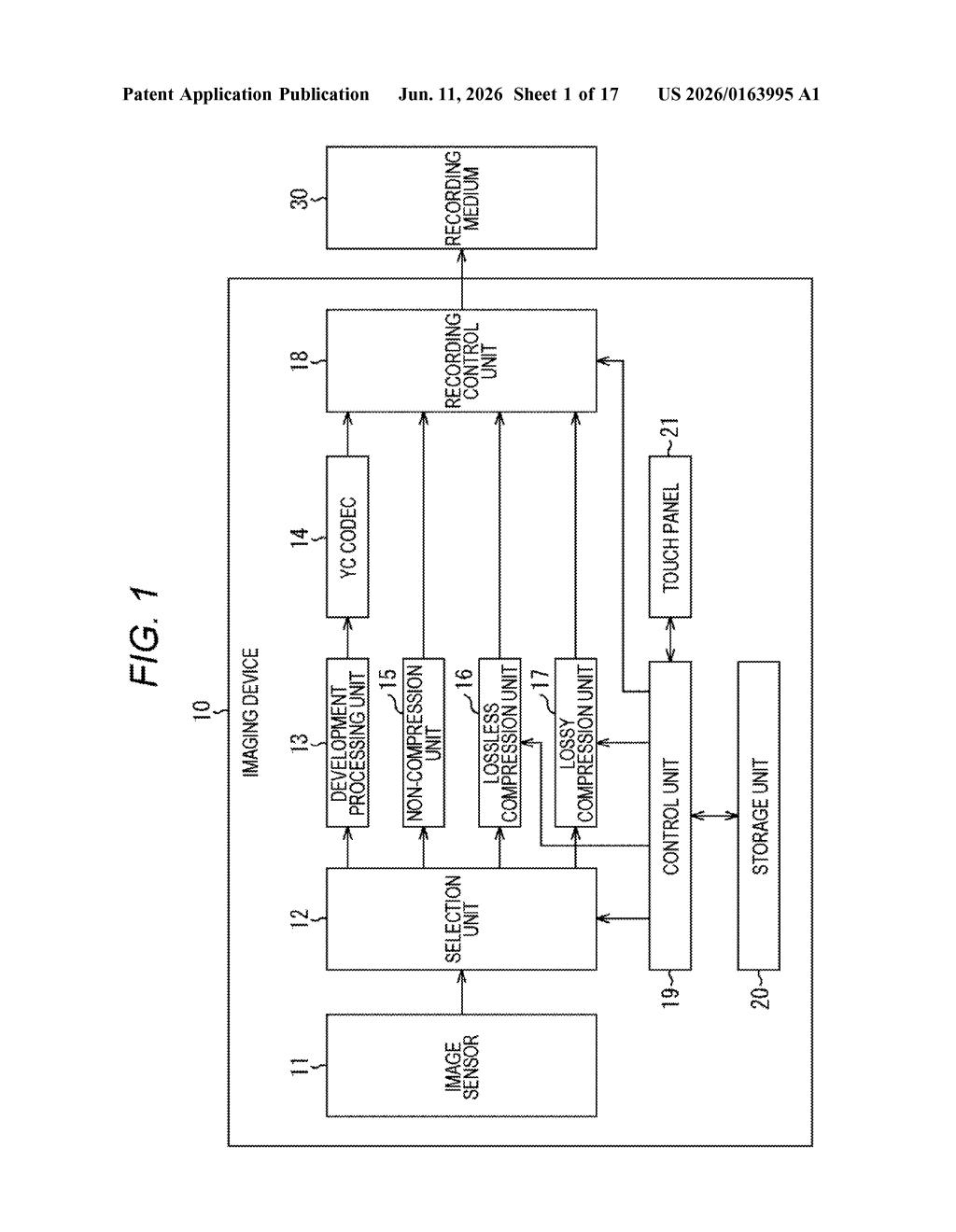
The patent describes an imaging device (a camera) with two main components working together.
First, an acquisition unit — likely tied to camera settings or a touchscreen interface — collects information about the intended development size: basically, how large the photographer intends the final processed image to be. This could be a screen resolution, a print dimension, or a preset.
Second, a lossy compression unit uses that target size to set a compression ratio before writing the RAW file to storage. The compression method works by decomposing the image into spatial frequency components — think of this like separating a painting into broad color blocks (low frequency) and fine edge detail (high frequency). When the output size is small, fine high-frequency detail becomes invisible anyway, so the camera discards more of it without any perceptible quality loss.
The key rule: the smaller the intended output size, the higher the compression ratio applied. A photo destined for a thumbnail gets compressed far more aggressively than one destined for a large print.
This approach is distinct from simple JPEG-style compression — it's applied at the RAW stage, before any color processing or tone mapping, which preserves editing flexibility while still reducing file size.
What this means for photographers shooting in RAW
For working photographers, storage is a constant headache. A single day of shooting can fill multiple high-capacity cards, and archiving years of RAW files demands terabytes of space. A camera that intelligently sizes its files to the actual job — without forcing you to choose between quality and capacity — is a genuinely practical improvement.
This also has implications for burst shooting and video workflows, where data rates are a hard technical constraint. If Sony can apply this logic to high-speed capture, it could mean longer bursts, faster buffer clearing, or the ability to shoot higher-resolution RAW at the same card speed. For most consumers this is invisible plumbing — but for professionals and serious enthusiasts, it's the kind of thing that changes how you work day to day.
This is a practical, unsexy patent that solves a real problem photographers actually complain about. It's not a flashy AI feature — it's smart engineering applied to file management, and that's exactly the kind of thing that makes professionals choose one camera system over another. Sony filing this suggests it may be baking output-aware compression into a future camera body or firmware update.
There are more where this came from
We read every patent application Big Tech publishes and send you the ones worth knowing. Plain English, free, every week.
Want this weekly breakdown for a company we don't cover? Patentlyze Pro →