
Qualcomm
Qualcomm · Chip · Filed Nov 13, 2024 · USPTO published May 14, 2026 · May 14 release
Qualcomm Patents a Video Decoder That Stops Waiting for Data to Arrive in Order
Qualcomm's latest patent targets a surprisingly mundane but costly problem in video decoding: processor cores sitting idle while waiting for the 'right' data to arrive in the 'right' order. The fix is letting the decoder skip ahead and work on whatever data shows up first.
- Publication number
- US 2026/0136017 A1(US20260136017A1)
- Applicant
- QUALCOMM Incorporated
- Filed · Published
- Nov 13, 2024 · May 14, 2026
- Inventors
- Garimella Rama Aditya, Krishna Murthy, Sandeep Nellikatte Srivatsa, Ashish Mishra
- Status when we published
- Approved; patent expected soon
- Document
- 20 claims
- US classification
- 375/240.26
- Examiner
- TARKO, ASMAMAW G (Art Unit 2482)
What Qualcomm's out-of-order video decoder actually does
Imagine you're assembling a two-part report, but you're told to always finish Part A before touching Part B — even if Part B is sitting right in front of you and Part A is still stuck in the mail. That's essentially how traditional video decoders work with color information.
When your phone or TV decodes a video, it breaks each frame into two types of data: luma (brightness) and chroma (color). Classic pipelines insist on processing them in a fixed sequence, so if the brightness data is delayed, the hardware stalls even if the color data is ready and waiting.
Qualcomm's patent describes a smarter approach: a pixel processor that checks which data — luma or chroma — has arrived from the decoder, and gets to work on whichever one is available first. It's a small scheduling change, but on a chip handling 4K or 8K video, idle cycles add up fast.
How the pixel processor picks chroma over luma on the fly
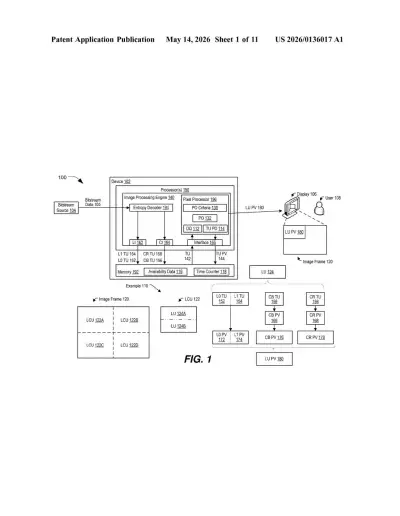
The patent centers on a pixel processor that sits downstream of an entropy decoder (the stage that decompresses the raw bitstream into structured image data). Normally, a coding unit in a video frame is processed luma-first, chroma-second — in that strict order.
Qualcomm's system introduces availability checks. Before doing any work, the pixel processor asks two questions:
- Is the luma transform unit (TU) — the brightness block — ready from the entropy decoder?
- Is the chroma TU — the color block — ready?
If the chroma TU has arrived but the luma TU hasn't, the processor doesn't wait. It immediately processes chroma to produce chroma pixel values, then circles back to handle luma once it shows up. The logical unit (a grouping of luma and chroma TUs that together represent a region of the frame) is only considered complete once both are done, but the order of internal processing becomes flexible.
This is essentially a lightweight form of out-of-order execution — a technique CPUs have used for decades — applied specifically to video decode pipelines. The memory stores the in-progress image data so the processor can resume luma work without losing context.
What this means for mobile video decode efficiency
Video decode is one of the hardest-worked pipelines on any mobile SoC. Qualcomm's Snapdragon chips power a huge share of Android flagship phones, and any reduction in decode stall cycles translates directly to lower power draw or higher sustainable frame rates — both things users and OEMs care deeply about.
This is also relevant beyond phones. Qualcomm increasingly targets automotive infotainment, XR headsets, and always-on PC platforms like Snapdragon X, all of which do heavy video decoding. A more flexible pipeline that keeps the pixel processor busy rather than idle is exactly the kind of incremental efficiency gain that separates competitive silicon from also-rans.
Source: US 2026/0136017 A1 at the USPTO (PDF). Full patent text and figures are in the official publication.
Get our take in your Top Stories
Liked this breakdown? Add Patentlyze as a preferred source on Google, and our plain-English take shows up more often in your Top Stories the next time Qualcomm patent news breaks.
Add Patentlyze on Google
One click.
There are more where this came from
We read the new patents from Big Tech, carmakers and more and send you the ones worth knowing. Plain English, free, every week.
More from Qualcomm
All 637 Qualcomm patents →
More in Chip
All 651 Chip patents →
Samsung
Samsung Patents AI That Fixes Chip-Printing Template Errors Before Manufacturing
AMD
AMD Patents a Two-Step Data Conversion That Keeps AI Calculations More Precise
Intel
Intel Patents a Chip That Prepares AI Data for Calculations Without Slowing the Processor
AMD