
Sony Patents a Depth Sensor That Scans a Scene in Both Directions to Map It in 3D
Sony has filed a patent for a depth sensor that deliberately sweeps a light beam in opposite directions and then averages the two passes together, a small procedural trick that could remove a systematic error that plagues most structured-light depth cameras.
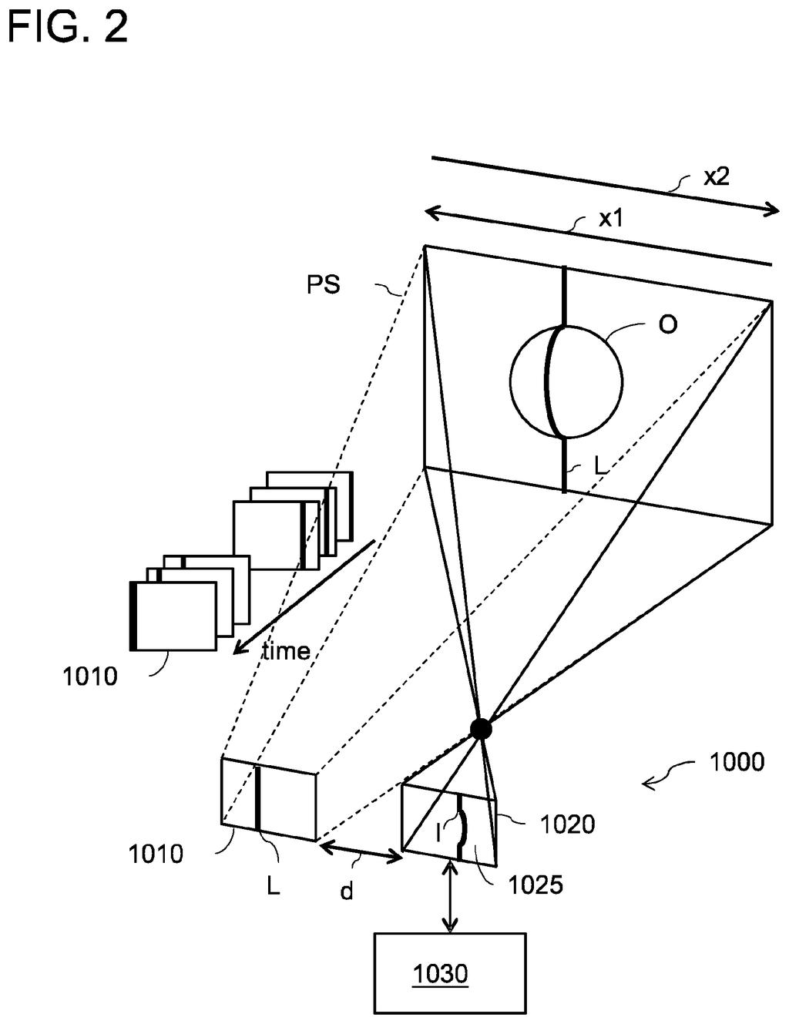
How Sony's back-and-forth light sweep builds a depth map
Imagine you're trying to measure how far away every object in a room is by flashing a moving dot of light across the scene and watching where the reflections come back. The faster the dot moves, the harder it is to pin down exactly when and where each reflection happened, which makes your distance measurements fuzzy.
Sony's approach runs two passes: one where the light dot sweeps left-to-right, and a second where it sweeps right-to-left. Any timing errors introduced during the first pass tend to push the distance estimate in one direction; the reverse sweep pushes it the other way. Averaging the two cancels out much of that error, leaving a cleaner picture of the scene.
The sensor also uses a special kind of image pixel called an event detection pixel, which only fires when the light hitting it changes, rather than reporting a brightness level every frame. That makes the system faster and less data-hungry than a conventional camera-based depth sensor.
… project a plurality of temporal series of light patches on the scene, with consecutive light patches of one series being either shifted along a first direction or a second direction that is opposite to the first direction …
Translation: The sensor flashes patterns of light across a room, moving them back and forth in opposite directions.
How alternating sweeps and event pixels cancel timing errors
The patent describes a structured-light depth sensor (a device that projects patterned light onto a scene and calculates distances from where the pattern lands) built around three main components.
- Projector unit: Casts a series of light patches onto the scene, moving each patch slightly to one side with every step. Crucially, it alternates between a "first sweep" (patches shifting left) and a "second sweep" (patches shifting right).
- Receiver unit: Uses an array of event detection pixels. Unlike normal camera pixels that report brightness continuously, these only signal when the light level changes beyond a set threshold. The time it takes each pixel to fire also depends on how bright the ambient light was before the change, a property the system accounts for. Each pixel watches only a fixed, narrow slice of the scene (called a solid angle), and together all pixels cover the full field of view.
- Control unit: Matches every pixel event to the exact light patch the projector was casting at that moment. It records both the angle of the projector at that instant and which pixel fired. Then, for each matching pair of left-sweep and right-sweep events, it averages the two projection angles. The averaged angle, combined with the known physical distance between projector and receiver, gives a precise depth value for that point in the scene.
The averaging step is the core novelty: systematic timing biases introduced by the sensor's response-time dependency on ambient brightness are largely opposite in direction between the two sweeps, so averaging them suppresses the error.
… receiver unit includes event detection pixels that indicate an event when measured light intensity changes by more than a threshold within a time period …
Translation: Special pixels notice when light levels change suddenly to track where the projected patterns fall.
What this means for 3D sensing in cameras and robotics
Depth sensors are everywhere: they help phones take portrait-mode photos, let robots navigate warehouses, and power facial-recognition locks. Most current designs struggle with accuracy when ambient light varies across the scene, because the timing of each detection pixel shifts depending on how bright the background is. Sony's alternating-sweep design addresses that without requiring faster or more expensive hardware.
For you as a user, a cleaner depth map means better-segmented photos, more reliable face unlock in mixed lighting, and robots that make fewer mistakes when moving around people. Sony's run of depth-sensing filings suggests the company is building toward higher-accuracy 3D sensing across its semiconductor product lines.
Sony's 24th filing we've tracked since July in the self-driving sensing race adds to a run that includes one fixing LiDAR timing errors and one on mixed array alignment.
Claim 1 is written broadly enough to cover any depth sensor that combines alternating sweep directions, event-detection pixels, and the averaging step. That combination is specific enough to be defensible but wide enough to apply to a range of hardware form factors, from smartphone cameras to automotive lidar-adjacent sensors.
The practical blocking power, if the patent is granted, is meaningful. Any competitor using event cameras for structured-light depth sensing and averaging bidirectional sweeps to cancel timing bias would land squarely inside this claim. The event-pixel requirement keeps it from being a blanket claim on all alternating-sweep depth sensors, but that is still a real moat around a growing product category.
The underlying idea is elegant in its simplicity: two passes, opposite directions, average the result. Patents that solve a real engineering problem with a clean procedural fix tend to hold up better than ones built on exotic materials or complex architectures. This one looks like the former.
There are more where this came from
We read every patent application Big Tech publishes and send you the ones worth knowing. Plain English, free, every week.
The drawings
18 drawing sheets from US 2026/0276372 A1 · click any drawing to enlarge


Want this weekly breakdown for a company we don't cover? Patentlyze Pro →