
Sony Patents a Camera System That Reads Colors and Measures Distance Simultaneously
Sony has filed a patent for a camera system that uses two specialized color sensors with overlapping light bands to calculate depth and produce richer color data at the same time, without sacrificing one for the other.
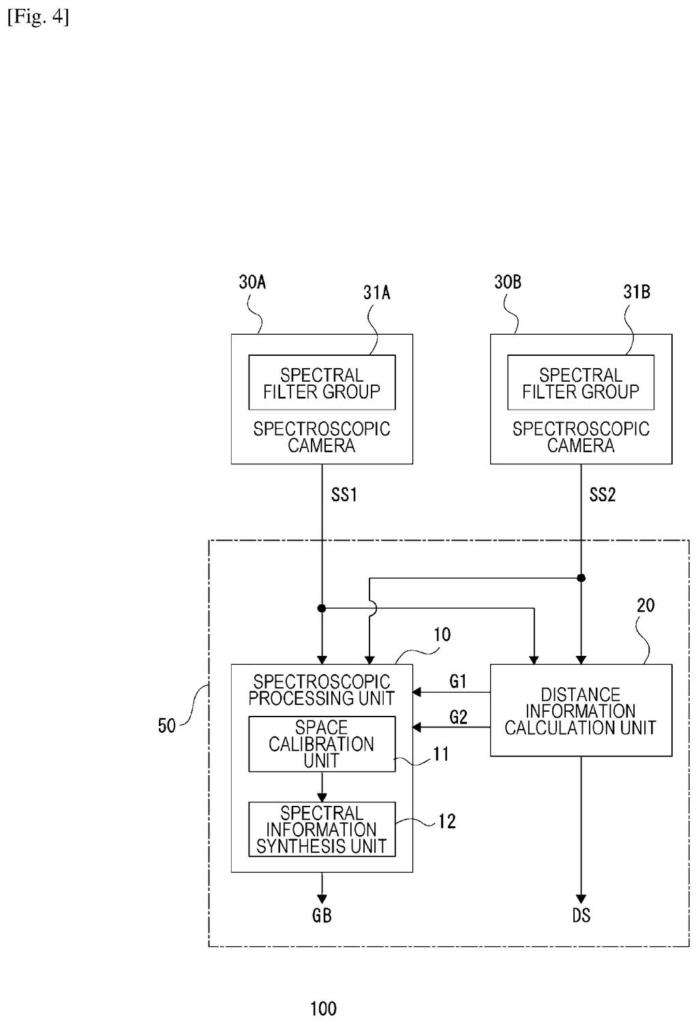
What Sony's two-camera color-plus-depth trick actually does
Imagine a camera on a medical scanner or a self-driving car that needs to both identify what it's looking at by color and figure out how far away it is. Today, doing both well at the same time is hard, because the sensors designed for one job tend to compromise the other.
Sony's patent describes a system with two spectral cameras pointed at the same scene. Each camera reads a different set of light wavelengths, like slices of the color spectrum, but they share a few wavelengths in common. That overlap is the key: the shared readings let the system calculate distance, while the full combined set of readings produces a much richer color picture than either camera could manage alone.
The result is a single device that gives you both depth information and high-quality spectral color data, without forcing a trade-off between the two.
a distance information calculation unit configured to calculate distance information on a basis of first spectral information that is an imaging signal for each of a plurality of wavelength bands of a first spectroscopic camera …
Translation: The device uses two cameras that capture different light wavelengths to calculate how far away an object is.
How the two spectral cameras share wavelength bands for depth
The patent centers on a spectral information generation device that takes input from two cameras, each capturing light across multiple wavelength bands (narrow slices of the color spectrum, from visible light into near-infrared).
The first camera and second camera use different sets of wavelength bands, but they share a subset in common. That partial overlap is load-bearing: the distance information calculation unit uses the shared bands to compute depth, essentially the same principle as stereo vision, where two slightly different views of a scene let you triangulate how far away objects are, except here the "difference" is spectral rather than purely spatial.
The spectroscopic processing unit then combines the full output from both cameras to generate richer color data than a single sensor could produce. Because each camera covers bands the other doesn't, the combined picture has more spectral detail:
- Camera one covers its unique wavelength bands
- Camera two covers its own distinct bands
- Overlapping bands anchor the depth calculation
- All bands together form the high-resolution output
The design tries to solve a known tension in spectral imaging: adding more wavelength bands improves color fidelity but can degrade distance accuracy, and this dual-camera approach is Sony's proposed way out of that bind.
Both improvement of resolution and appropriate distance information calculation are achieved. A spectral information generation device includes a distance information calculation unit configured to calculate distance information on the basis of first spectral information …
Translation: This system aims to produce sharper images while simultaneously measuring the distance to objects in the frame.
What this means for cameras that need to see and measure
Spectral cameras show up in places like food inspection lines, surgical robotics, agricultural drones, and autonomous vehicles, anywhere a system needs to understand what something is (by its light signature) and where it sits in space. Combining those two functions in a compact, accurate system is genuinely useful for industrial and medical imaging markets Sony already sells into.
Claim 1 of this patent is written broadly enough that it could cover any two-spectral-camera arrangement where the cameras share some wavelength bands and the device uses those bands for depth. That breadth is notable: if granted, it could apply to a wide range of implementations, not just one specific sensor configuration. Sony's spectral imaging work sits alongside the latest Big Tech patents in the broader race to make cameras that measure the world as precisely as they photograph it.
Claim 1 is written at a high level of abstraction. It covers any device using two spectral cameras with partially overlapping wavelength bands to produce both distance information and combined spectral output. That scope is wide. If granted as written, it would potentially reach far beyond Sony's own products to block any dual-spectral-camera depth system that happens to share wavelength bands, which is almost the obvious engineering approach to the problem. Whether the patent office finds sufficient prior art to narrow it will matter a lot, because the claim as filed stakes out a large portion of a growing field.
There are more where this came from
We read every patent application Big Tech publishes and send you the ones worth knowing. Plain English, free, every week.
The drawings
14 drawing sheets from US 2026/0235444 A1 · click any drawing to enlarge


Want this weekly breakdown for a company we don't cover? Patentlyze Pro →
Be the first to weigh in