
Sony Files Patent for a System That Predicts Sleepwalking Before You Fall Asleep
Sony has filed a patent for a system that reads your body's signals before you go to sleep and assigns a score predicting how likely you are to sleepwalk that night. If the risk is high, a second system watches for the moment it actually starts.
What Sony's sleepwalking-risk score actually does
Every night, millions of people who sleepwalk go to bed with no idea whether tonight will be one of those nights. A parent of a sleepwalker sets up baby monitors, or just hopes for the best. Sony's patent describes a system designed to change that by doing the math before you ever close your eyes.
The idea is a two-step process. First, a device reads your physiological data, things like heart rate, stress markers, or other body signals gathered before your sleep period, and produces a risk score for that particular night. Then, once you're asleep, a separate detection layer watches your movement and position. Crucially, that second layer uses the risk score to decide how sensitive it should be, so it isn't crying wolf on a low-risk night.
Sony doesn't specify a single device here, but the architecture fits naturally into a wearable or smart home sensor setup. The goal is an early warning: catch the onset of a sleepwalking episode, not just notice it after someone has already wandered into the hallway.
An apparatus for determining a somnambulism event risk level score of a user, the apparatus comprising: interface circuitry configured to receive, before a sleep period of the user, physiological data of the user generated before the sleep period …
Translation: This device calculates your chances of sleepwalking before you even go to bed.
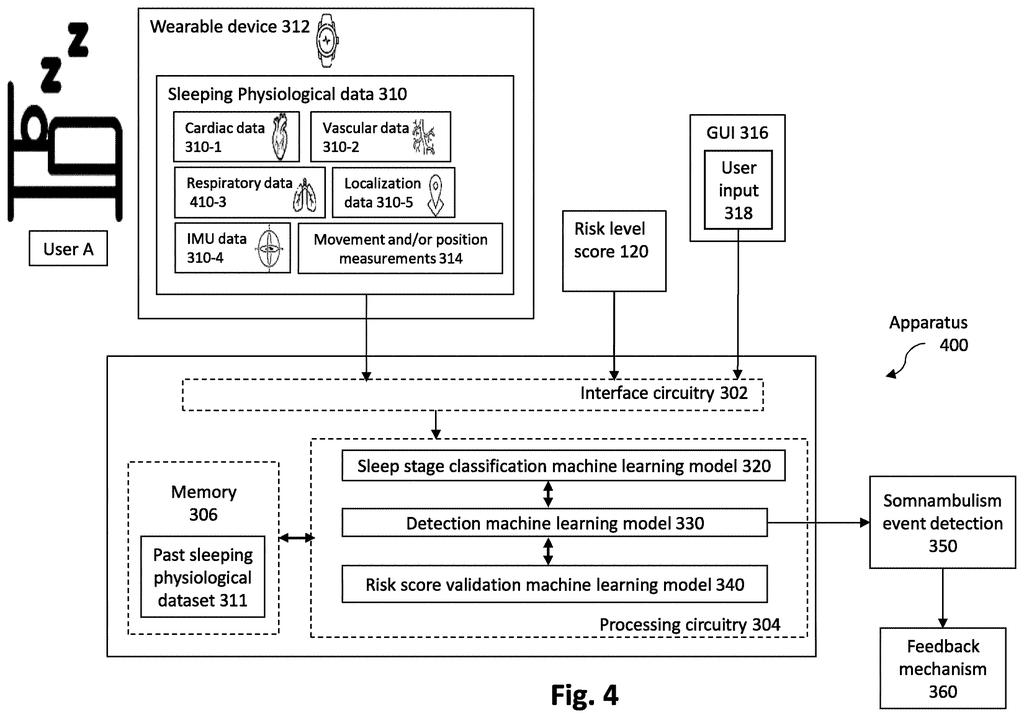
How the two-stage detection pipeline works
The patent describes two linked apparatus designs that work in sequence.
Stage one: the risk scorer. Before you sleep, interface circuitry collects physiological data from the user. The patent doesn't lock this down to one sensor type, which gives Sony flexibility, but the intent is pre-sleep body measurements (think heart rate variability, temperature, or similar biometric signals). Processing circuitry then computes a risk level score representing how probable a somnambulism (sleepwalking) event is during the upcoming sleep period.
Stage two: the onset detector. A second apparatus receives two inputs during the sleep period: movement and position measurements (from accelerometers or similar sensors) and the risk score produced in stage one. By feeding the risk score into the detection logic, the system can adjust its sensitivity dynamically. On a high-risk night, it pays closer attention; on a low-risk night, it filters out the normal tossing and turning that would otherwise generate false alarms.
- Pre-sleep physiological data collection
- Risk score generation before the sleep period starts
- Real-time movement and position monitoring during sleep
- Risk-score-weighted onset detection to reduce false positives
The architecture is deliberately modular: the two apparatus can run on the same device or on separate hardware talking to each other.
Another apparatus is provided for detecting the onset of a somnambulism event during a sleep period. This apparatus includes interface circuitry configured to receive movement and/or position measurements generated during the sleep period and the risk level score …
Translation: A second system watches your movements while you sleep to catch sleepwalking as it starts.
What this means for sleep-tech wearables
Sleepwalking affects roughly 1-7% of adults and a much higher share of children, and current home options are essentially reactive: cameras, door alarms, or a family member staying alert. A system that predicts a high-risk night ahead of time gives caregivers a window to act preventively, whether that's adding a door sensor, giving a child a safer sleeping environment, or consulting a doctor about an unusually frequent pattern.
Sony's growing push into health-sensing wearables makes this filing fit a larger picture. The modular design, where the risk scorer and the event detector are separate but linked, also means this could layer onto existing sensor hardware rather than requiring entirely new devices. That lowers the bar for getting something like this into a product.
This is the sixth Sony filing since July we've tracked on our wearable body sensors watchlist, following applications on a three-electrode signal reader and a sensor-securing strap.
The ship path here is longer than the abstract makes it sound. Stage one, the pre-sleep risk scorer, requires reliable physiological signals that actually predict sleepwalking with enough accuracy to be useful. That's a clinical validation problem, not just an engineering one, and the patent doesn't establish what those signals are or how well they work.
Stage two is closer to ready. Movement and position detection during sleep is already in consumer wearables, and the idea of making detection more sensitive when a risk score is high is a sensible, buildable filter. That part could ship relatively quickly if stage one were solved.
The honest read is that this patent plants a flag on the architecture before the hard research is done. It's a reasonable bet on where sleep-health wearables are heading, but the gap between a filed patent and a clinically validated consumer feature is where most of the real work lives.
Get our take in your Top Stories
Liked this breakdown? Add Patentlyze as a preferred source on Google, and our plain-English take shows up more often in your Top Stories the next time Sony patent news breaks.
There are more where this came from
We read every patent application Big Tech publishes and send you the ones worth knowing. Plain English, free, every week.
The drawings
9 drawing sheets from US 2026/0260758 A1 · click any drawing to enlarge


Show the other 1 sheets

Want this weekly breakdown for a company we don't cover? Patentlyze Pro →
Be the first to weigh in