
Sony's New Patent Cuts the Size of 3D Distance-Measuring Sensors by Sharing Data
When two neighboring pixels in a depth camera catch light at the same instant, Sony's patent application says they should share one tally instead of keeping two. The goal the filing describes is a smaller chip that still counts accurately.
What Sony's shared pixel counter actually does
Ever had two friends blurt out the same answer at the exact same moment? You wouldn't write the answer down twice. You'd make one mark and remember that two people said it.
Depth cameras face a version of that. They fire a flash of light, then time how long it takes to bounce back, and the tiny light detectors on the chip (called pixels) each keep their own running count of the light particles they catch. Every one of those counters takes up room on the chip, and that room is valuable.
Sony's patent application describes a circuit that notices when neighboring pixels get hit at nearly the same moment. When they do, the circuit sends the hits to one shared counter. When they don't, each pixel goes back to counting on its own. The filing says this saves chip space and keeps the signal clean.
determine, based on a degree of overlap in time of at least two pixel signals of at least two pixels of a photon counting time-of-flight sensor, whether a signal coincidence of the at least two pixel signals is present …
Translation: The sensor checks if signals from two different pixels arrive at the exact same time.
How the chip decides when pixels count together
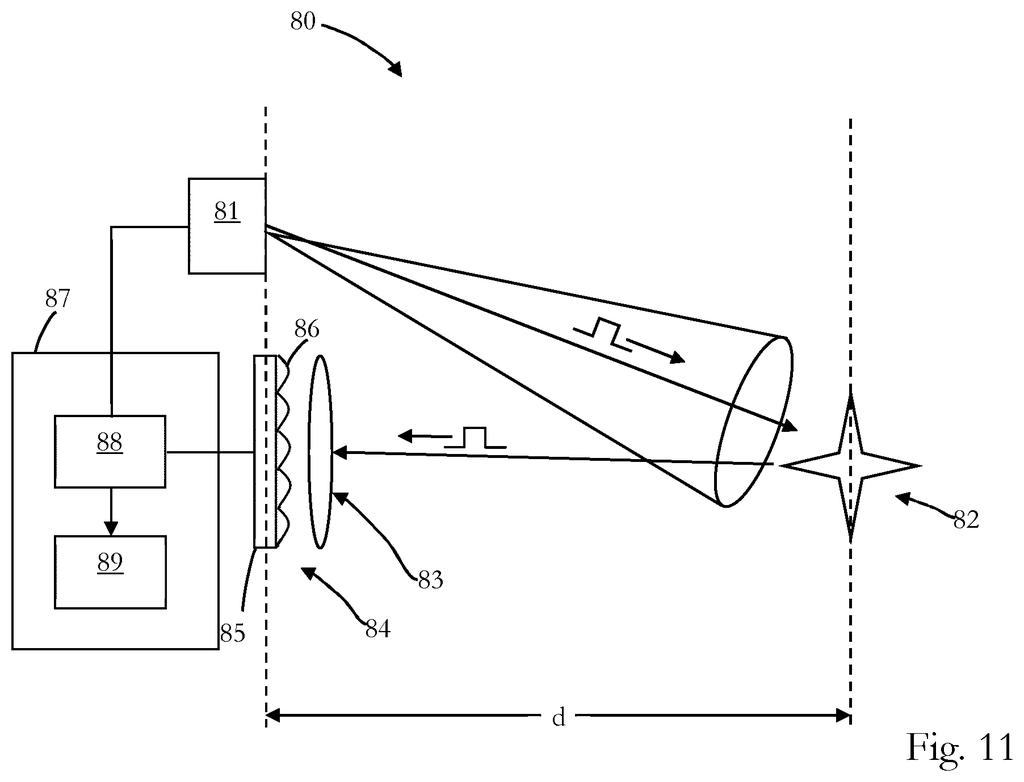
The filing covers circuitry for a photon counting time-of-flight sensor, a depth-sensing chip that measures distance by timing light. Each pixel is typically a SPAD (single photon avalanche diode, a detector sensitive enough to react to a single particle of light), and it gives off a pulse each time light arrives.
A coincidence detection block watches the pulses from two pixels. If they overlap in time by at least a set threshold, it declares a coincidence and lets one clock signal through to a shared counter. Per the description, that signal is the later of the two pixel signals, because the circuit needs a moment to confirm the overlap first. If the overlap falls below the threshold, each pixel's pulses go to its own counter.
In one four-counter version, a mode-select control switches the layout:
- With sharing off, the counters are paired up so each pixel has its own.
- With sharing on, two of the counters pool into one common counter, and the other two keep counting separately when no coincidence shows up.
Pixel groups of 1x2, 2x1 or 2x2 are named as examples. The filing also says the shared count can be doubled afterward to estimate the real number of events.
Why sharing counters could shrink depth sensors
If you own a phone or car with a depth camera, the practical stake is chip real estate. Counters take up space, and space limits how small each pixel can be. Sony's filing says sharing counters can shrink the area used while keeping more of the light counted, which could improve the signal-to-noise ratio (how clearly the real signal stands out from random speckle).
The sensor can still count pixel by pixel when neighbors aren't firing together, which protects fine detail. The examiner's first review rejected the claims as filed, which is routine and usually followed by amendments, so the final scope could change. Nothing here names a product; it is a building block for light-timing sensors in general.
Sony's 94th filing in the Display patents we've tracked since May adds to a run that includes a fix for headphone orientation and moving LED panels without recalibration.
Claim 1 covers any circuitry that checks whether two pixels in a depth-sensing camera fire at the same moment and then shifts into a mode that counts those simultaneous hits together. The claim sets no minimum overlap time, specifies no particular counter arrangement, and places no limits on where the circuitry sits on the chip, meaning the protection wraps around the core idea rather than one specific way of building it.
If granted as written, any depth sensor design that merges simultaneous pixel hits through any coordinated counting mode would fall inside this claim, regardless of the engineering choices made underneath.
For anyone buying a phone or camera with depth-sensing features, the practical result is quieter, more accurate distance measurements from a smaller chip, and this filing controls the legal ground on which that improvement stands.
Get our take in your Top Stories
Liked this breakdown? Add Patentlyze as a preferred source on Google, and our plain-English take shows up more often in your Top Stories the next time Sony patent news breaks.
There are more where this came from
We read every patent application Big Tech publishes and send you the ones worth knowing. Plain English, free, every week.
The drawings
8 drawing sheets from US 2026/0332909 A1 · click any drawing to enlarge


Want this weekly breakdown for a company we don't cover? Patentlyze Pro →
Be the first to weigh in