
Samsung Patents a Display That Automatically Reads Your Health Stats When Ready
Samsung is patenting a display that tracks whether you're in the right state to have your health data read, then takes the measurement automatically. No button to press, no app to open.
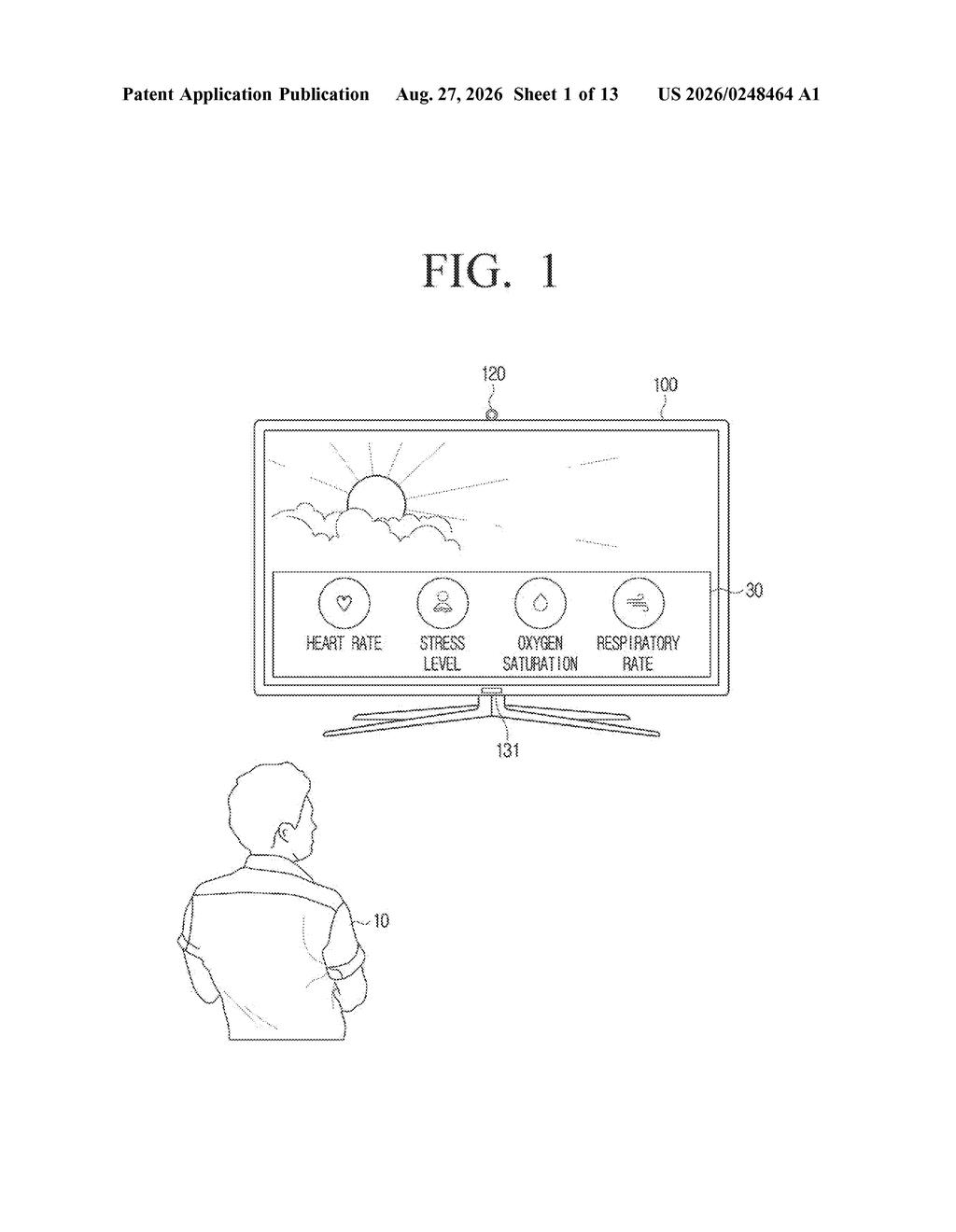
What Samsung's watch-and-wait health scanning actually does
Imagine you're watching TV late at night, slumped sideways on the couch with a bag of chips. Your heart rate reading from that moment would be useless. Samsung's patent is designed to solve exactly that problem.
The idea is that a Samsung display would use its built-in camera and sensors to continuously watch how you're positioned and how attentive you seem. An AI model, trained on patterns of how people actually watch content, judges whether you're in a stable enough state for a reliable health reading. Only then does the screen capture a fresh image of your face to extract biometric data like heart rate.
You don't tap anything. The display figures out the good moment for you, takes the measurement, and moves on. The whole thing is designed to happen in the background while you're just watching your show.
… a memory to store an artificial intelligence model trained based on learning data related to content viewing characteristics …
Translation: It uses AI trained on how people watch TV to figure out the right moment for a health check.
How the AI decides when your face is readable enough
The patent describes a display (think a smart TV or monitor) equipped with a camera, at least one additional sensor, and an on-device AI model. The system runs in a continuous loop:
- Usage-state monitoring: The processor constantly collects image data from the camera alongside sensor readings, building a picture of how the user is positioned and behaving in front of the screen.
- AI gating: The stored AI model, trained on data about how people watch content, evaluates that usage-state data in real time. It classifies the current moment as either suitable or not suitable for biometric capture.
- Triggered capture: Only when the model gives a green light does the system trigger a fresh, dedicated image capture of the user's face. That new image is then processed to extract biometric information, such as heart rate estimated from subtle skin-color changes (a technique called remote photoplethysmography, or rPPG).
The key engineering insight is the separation between passive monitoring and active measurement. Most camera-based health features either run constantly (draining resources and capturing noisy data) or require the user to sit still on command. This patent proposes using an AI filter as a gatekeeper so that measurements only happen when conditions actually favor accuracy.
… based on the usage state being identified as suitable to measure biometric information based on data associated with the usage state of the user and an artificial intelligence model, newly obtain image data of the user through a camera, and obtain the biometric information based on the newly obtained image data of the user …
Translation: Once the AI decides you are sitting still enough, the camera snaps a fresh picture to check your vital signs.
What this means for health features on your next Samsung TV
For Samsung, this fits neatly into an ongoing push to make its televisions useful for more than entertainment. A TV that can measure your resting heart rate while you watch the news is a genuinely different product category than one that just streams video. The challenge has always been data quality: a camera reading taken when you're pacing around the room or leaning in to read a subtitle is worse than useless, it's misleading. This patent directly attacks that data-quality problem by making the measurement conditional on a favorable moment.
For you as a potential user, the practical upside is health data you might actually trust. The downside worth watching is privacy: a display that continuously observes your behavior to judge your physical state is a significant amount of ambient monitoring, and Samsung's filing doesn't detail how or whether that raw observation data is stored or shared. Health and display patents from companies like Samsung are part of the latest Big Tech patents Patentlyze tracks as the boundary between consumer electronics and personal health devices keeps narrowing.
That makes this Samsung's 16th filing we've tracked since June in our body-sensing wearables watchlist, which already includes applications like one adjusting video to physical reactions and one moving cursors with body motion.
Passive health monitoring on consumer screens has struggled for years because readings taken from a fidgeting or poorly positioned viewer are essentially noise dressed up as data. Feeding that noise into a health dashboard can actively mislead people about their own wellbeing, which makes the problem costly in a direct, personal way. Samsung's answer is to make the timing smarter rather than the sensor more powerful. An AI model watches for moments when conditions are actually favorable, then takes the measurement.
That's a well-matched response to a problem rooted in context, not raw capability. Whether continuous behavioral observation of someone in their living room feels acceptable to buyers is still an open question.
The engineering may be sound, but the privacy framing will determine whether this becomes a feature people trust or one they disable.
Get our take in your Top Stories
Liked this breakdown? Add Patentlyze as a preferred source on Google, and our plain-English take shows up more often in your Top Stories the next time Samsung patent news breaks.
There are more where this came from
We read every patent application Big Tech publishes and send you the ones worth knowing. Plain English, free, every week.
The drawings
13 drawing sheets from US 2026/0248464 A1 · click any drawing to enlarge


Want this weekly breakdown for a company we don't cover? Patentlyze Pro →
Be the first to weigh in