
Sony Patents a Projector That Automatically Blocks Unwanted Duplicate Images From Appearing
When you bend light to create a holographic image, physics tends to produce unwanted duplicate images as a side effect. Sony's new patent describes a display system that creates those ghost images deliberately in a known location, then blocks them before they reach the screen.
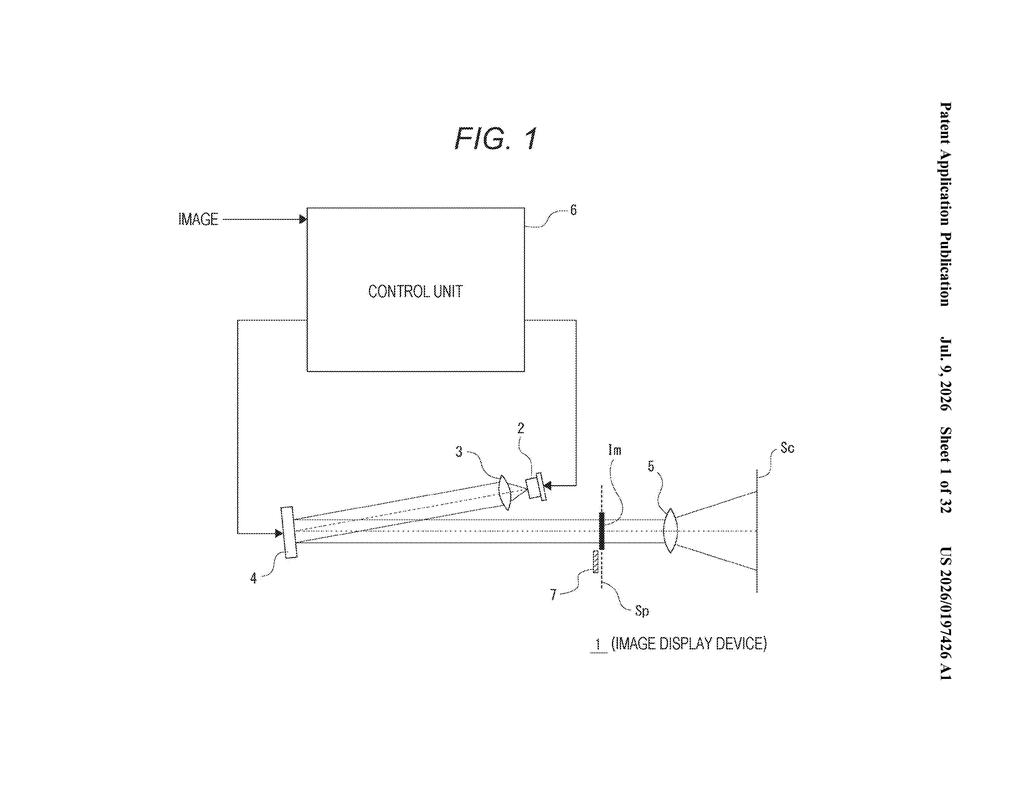
What Sony's ghost-image-blocking projector actually does
Imagine a projector that uses light itself, bent and shaped at a microscopic level, to paint images in mid-air. That's the promise of holographic displays. The catch is that the technique for bending the light, called phase modulation, almost always produces extra, unwanted copies of the image as a byproduct. These ghost images can corrupt or wash out the picture you actually want to see.
Sony's patent describes a way to deal with this problem by turning it into something predictable. Instead of trying to eliminate the ghost image entirely, the system deliberately pushes it to a specific, known spot in the display. Then a physical light-blocking element, positioned at that exact spot, stops the ghost image from ever reaching the lens.
The result is a cleaner projected image with fewer visual artifacts. The system uses a spatial light modulator, basically a chip that controls how each tiny section of a beam of light is shaped, to manage both the real image and the decoy ghost at the same time.
How the phase modulator and light shield work together
The device has five main components working together:
- A light emitting unit that generates the raw light source.
- A phase modulator (a spatial light modulator, or SLM) that reshapes the light by changing its phase, essentially the timing of the light waves, across thousands of tiny zones. This is the core holographic trick.
- A control unit that programs the modulator to produce two reproduced images simultaneously: the first reproduced image (the one you want) and a second reproduced image (the unavoidable ghost) placed at a deliberately different position in the image plane.
- A projection lens that captures and projects the first image onto the target surface.
- A light shielding unit, essentially a physical blocker, placed at the location of the second image so it never reaches the lens.
The key insight is control through prediction. Phase modulation systems (used in laser projectors and holographic displays) inherently generate conjugate or diffraction-order artifacts, which are mirror or offset copies of the intended image. Rather than trying to suppress these mathematically, Sony's approach is to place them somewhere specific and then physically intercept them.
The control unit calculates the phase pattern needed to send that unwanted image to a predetermined spot, making the blocking step reliable and consistent.
What this means for holographic display quality
Holographic and laser phase-modulation displays have been stuck in a quality rut partly because of these ghost-image artifacts. Every approach to removing them through software or optical design adds complexity and often reduces brightness. A physical blocker at a known interception point is a simpler, more direct solution that does not eat into the brightness of the main image.
For Sony, which already makes high-end projectors and has invested in spatial reality displays (screens that create 3D depth for a single viewer), cleaner holographic output would directly improve product quality. This kind of artifact control is a necessary engineering step before holographic displays can move from research demos into consumer or professional products.
This is solid, unglamorous optical engineering. It does not reinvent holographic displays, but it addresses a real and persistent problem that has held the technology back. The elegance here is in the simplicity: instead of a complex algorithmic fix, Sony uses geometry and a physical blocker. That kind of practical thinking tends to actually make it into shipping products.
Get our take in your Top Stories
Liked this breakdown? Add Patentlyze as a preferred source on Google, and our plain-English take shows up more often in your Top Stories the next time Sony patent news breaks.
There are more where this came from
We read every patent application Big Tech publishes and send you the ones worth knowing. Plain English, free, every week.
Want this weekly breakdown for a company we don't cover? Patentlyze Pro →