
Sony Files Patent for Keeping Surround Sound in Place When Audio Changes Formats
Convert a surround-sound mix from one format to another with plain math, and a sound meant for 30 degrees can end up at 45. Sony's patent filing adds a step to stop that drift.
What Sony's surround-sound converter actually does
Imagine a sound engineer mixes a movie so a gunshot comes from your front-left speaker, which sits 30 degrees off center. Someone converts the file to a different surround format, and now the gunshot plays from 45 degrees, noticeably wider. Nothing is broken. The two formats simply disagree about what 'left' means.
Here is why. One format (AC-4) stores a sound as a spot in a room and lets the speakers sort it out. Another (MPEG-H 3D Audio) stores it as an angle measured from the listener. Convert the numbers with basic geometry and the sound shifts, because the first format was pulled toward wherever the speakers sat.
Sony's patent adds a step. It first works out where you would actually hear the sound with the original speaker setup, then writes that direction into the new format. The sound stays put.
… converts first position data of a sound source in the first data format or second position data of the sound source in a second data format in which a rendering scheme at the time of reproduction is different from the first data format into the second position data or the first position data on a basis of the speaker layout information.
Translation: It translates sound locations between different audio formats so the speaker setup stays consistent.
How Sony finds where a sound really lands
Modern surround sound is often object-based. Each sound (a voice, a guitar) is stored as a recording plus a small label of data, called metadata, saying where it should seem to come from. The player then works out how to feed the speakers in your room.
The trouble is that formats describe position differently. The filing calls them the Allocentric and Egocentric schemes. AC-4 is Allocentric: it uses absolute coordinates (a spot in a box-shaped room) and splits sound among speakers by distance. MPEG-H 3D Audio is Egocentric: it uses polar coordinates (an angle and distance from the listener) and a blending method called VBAP (vector base amplitude panning, which spreads a sound across nearby speakers).
To convert, Sony's method does this:
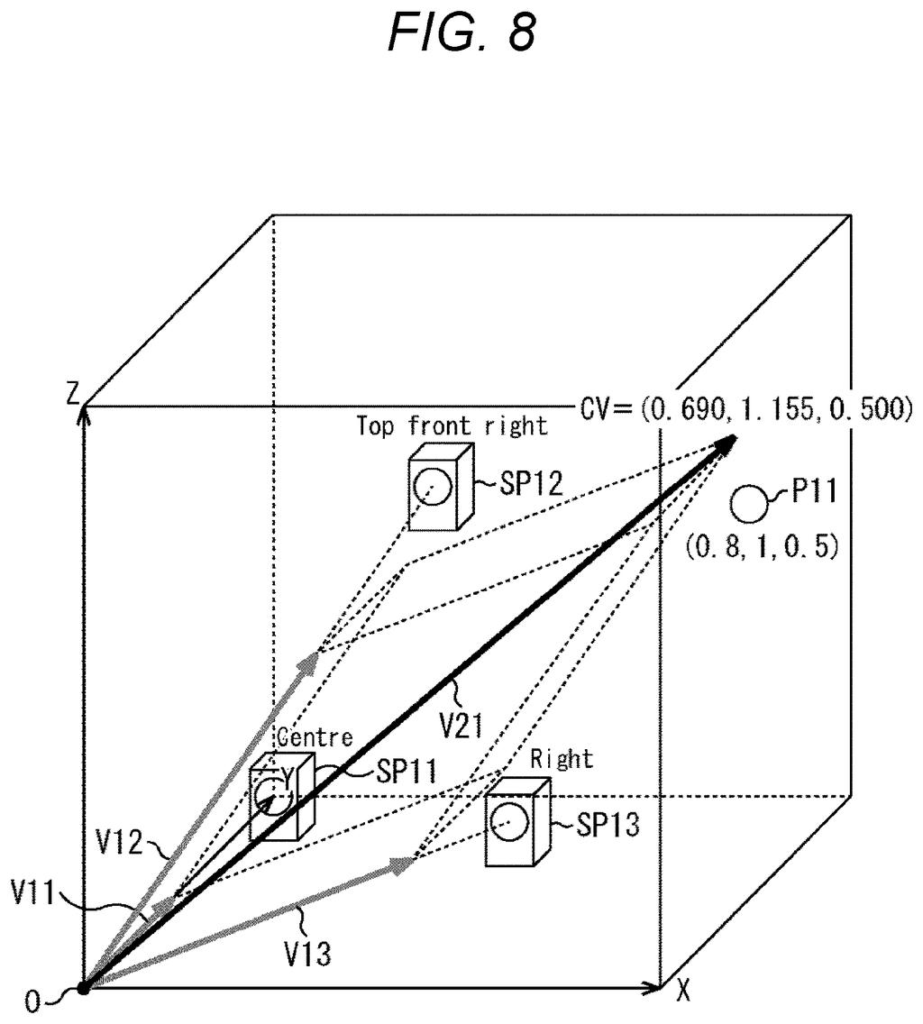
- Uses the speaker layout to work out how much volume the original format sends to each speaker.
- Draws an arrow toward each speaker, as long as that speaker's volume.
- Adds the arrows together; the result points to where the sound is heard.
- Turns that point into an angle and distance for the new format.
In the filing's example, the estimate puts a sound about 31 degrees off center, versus about 39 with plain conversion. The system can skip the estimate for unimportant sounds like reverb, adjust volume by distance, and also run in reverse.
What this means for movie and music mixes
For you, the payoff is a soundtrack that keeps its shape. Movies, music and games get mixed in one format and played on gear built for another, and a conversion that nudges a voice or a helicopter overhead can undo what the creator intended. The filing describes this running inside a standalone conversion app, a plug-in for audio-editing software, or a player that converts on the fly.
It also reaches beyond speakers. The filing says the converted sound can be prepared for headphones, earphones, hearing aids and head-mounted displays, and it points to free-viewpoint audio, where you walk around inside a scene. It names no product, so treat it as groundwork for moving audio between rival standards.
Sony's 670th filing we've tracked since May in our Sony coverage adds to a run that includes needle-free glucose sensing and brain-wave headphones.
The price of this design is a guess. Sony's method needs to know which speaker layout the original mixer used, and the filing admits that is sometimes unknown, in which case it falls back to a standard layout. A wrong layout gives a wrong answer, though a smaller miss than plain conversion produces.
There is a second cost. The conversion locks in one setup's quirks: a sound that came from a speaker at 30 degrees is now written down as 30 degrees, even if another system would have placed it differently. Running the estimate for every sound in every frame also takes extra computing, which is why the filing lets low-priority sounds like echoes skip it.
Those costs are small next to what a sound engineer gets, which is a mix that survives a format change intact. It is routine plumbing for the audio industry, and useful plumbing.
Get our take in your Top Stories
Liked this breakdown? Add Patentlyze as a preferred source on Google, and our plain-English take shows up more often in your Top Stories the next time Sony patent news breaks.
There are more where this came from
We read every patent application Big Tech publishes and send you the ones worth knowing. Plain English, free, every week.
The drawings
14 drawing sheets from US 2026/0353030 A1 · click any drawing to enlarge


Show the other 6 sheets


Want this weekly breakdown for a company we don't cover? Patentlyze Pro →
Be the first to weigh in