
Samsung Files Patent to Keep a Fire Alarm Out of Your Party Video
Samsung describes a video tool that treats a blaring fire alarm as noise at your party, then treats it as the whole point when you send the clip to the fire department.
What Samsung's sound-sorting video patent does
Ever filmed a friend's birthday toast and later found the video is mostly a blaring fire alarm? That is the scenario Samsung's filing starts from: a house party with a guitar, a howling dog, laughing guests, and an alarm that goes off by mistake.
Ordinary noise removal treats unwanted sound the same way no matter what you're filming. Samsung describes a phone that first works out what you're filming, then sorts every sound into main, secondary or background, and turns each one up or down to match. Aim the camera at the guitarist and the guitar gets most of the volume. Swing toward the dog and the howl takes over.
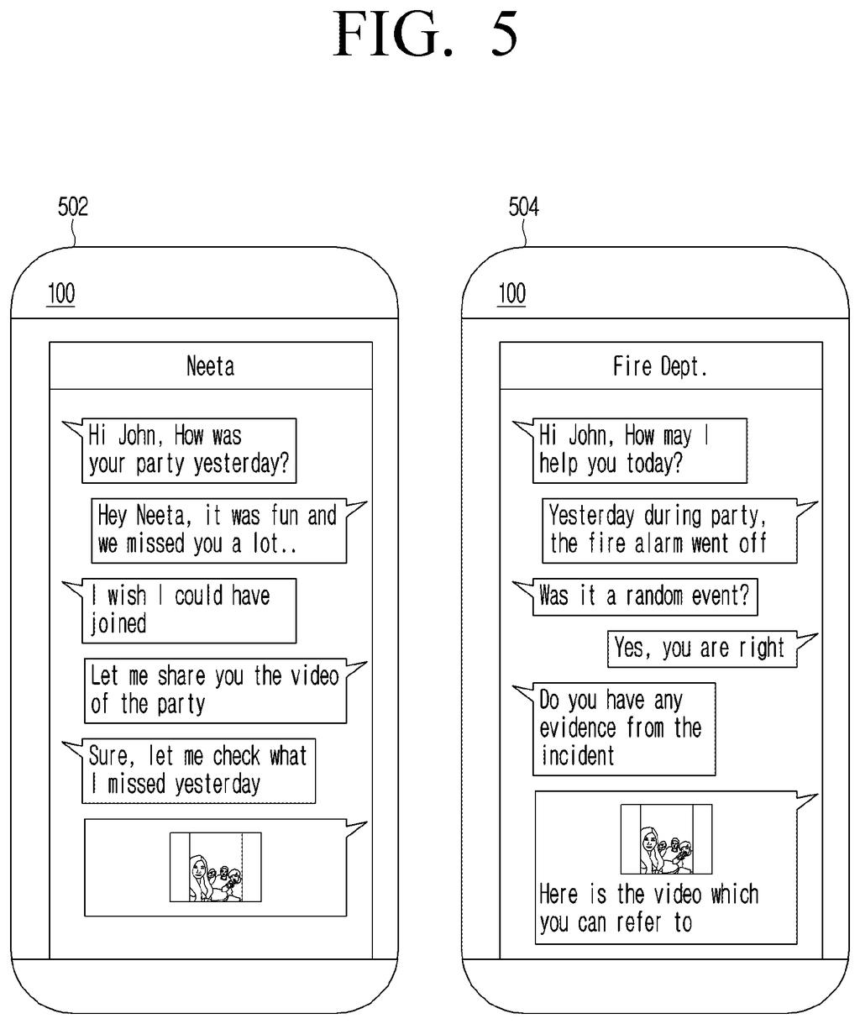
The twist is that the same alarm can be the star. If you send the clip to the fire department as evidence, the party fades and the alarm stays at full volume.
determining and classifying, by an electronic device, a relevant sound source in the media as a primary sound source, a secondary sound source, and a non-subject sound source based on a context in the media …
Translation: The device figures out what noises are important and which ones are background clutter.
How the phone ranks each sound in a scene
The phone first splits the audio into separate sound sources (speech, a guitar, a barking dog, a fire alarm) and spots the visible subjects in the frame. A matching step, which the filing calls an audio-visual subject pair generator, links each sound to something you can see, so it knows which voice belongs to which person.
Next, a context step builds a knowledge graph (a map of how the people, objects and scene fit together) from the environment, the type of scene (a birthday party) and the device context (the app you're using and what you're doing, such as sharing a video). The listener's hearing profile can also feed in.
A classifier then labels each sound:
- Primary: the sound you're focused on
- Secondary: sounds closely tied to it
- Non-subject: background that can stay quiet
- Irrelevant: sound to remove entirely
A mixer assigns each source a percentage using an AI model (software trained on examples). With the camera on the guitarist, the guitar gets 90 percent, the dog 0, and speech and clapping 5 each. The filing also covers speakers who turn their heads away from the mic, adjusting the mix to keep their voice level steady.
… generating an output sound by suppressing at least one of the secondary sound source and the non-subject sound source in the media and optimizing the primary sound source in the media using a data driven model based on the determination and classification …
Translation: It turns down the annoying background noises while making the main sounds clearer.
What this means for videos on Samsung phones
If this ever reached a phone, your videos would need less cleanup. You wouldn't have to choose between a noisy original and a manual edit, because the sound would follow what your camera is pointed at and what you plan to do with the clip.
The filing lists phones, tablets, smart TVs and headsets as example devices, and says the same approach could apply to call recordings and plain sound recordings. It also mentions tuning audio for the playback device and the listener's hearing profile. Those are descriptions in a patent application, not announced products.
Samsung's 1511th filing we've tracked since May in our Samsung coverage continues its audio work, following patents on voice memory and TV dialogue clarity.
On the ship-path question, this one sits close to software only. The filing names no new sensor. It relies on a microphone, a camera, and models that sort sounds and recognize scenes, all of which phones already run in some form.
The shortest route to a product would be a mode in the camera app that follows your focus: aim at the guitarist and the guitar gets louder. The hard part is the other half, a phone knowing from your messaging app that the fire department wants the alarm and your friends do not.
The filing gives no accuracy figures or processing costs, so it is unclear whether this could run live while you record. A cleanup pass after filming looks like the safer first step, since a wrong guess could erase the very sound you wanted to keep.
Get our take in your Top Stories
Liked this breakdown? Add Patentlyze as a preferred source on Google, and our plain-English take shows up more often in your Top Stories the next time Samsung patent news breaks.
There are more where this came from
We read every patent application Big Tech publishes and send you the ones worth knowing. Plain English, free, every week.
The drawings
25 drawing sheets from US 2026/0331120 A1 · click any drawing to enlarge


Show the other 17 sheets


Want this weekly breakdown for a company we don't cover? Patentlyze Pro →
Be the first to weigh in