
Sony Patents a Display That Expands When You Rotate Your Wrist
Sony has filed a patent for a system that reads both your finger position and the rotation of your wrist to decide how much screen content to show you. Tilt your wrist one way while holding a specific grip, and the display area grows.
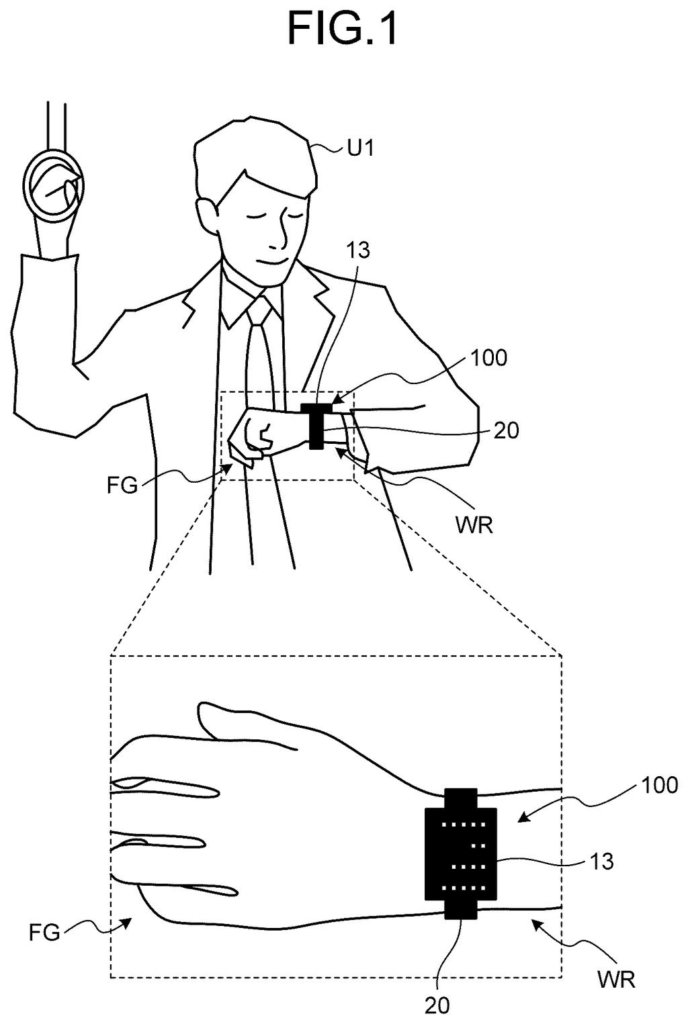
What Sony's wrist-rotation display control actually does
A person glances at their wrist to check a notification, but the screen only shows a sliver of text. They rotate their wrist slightly and the full message expands into view. That scenario is exactly what Sony's new patent is designed to make possible.
The system watches two things at once: what your fingers are doing and how your wrist is rotated. Only when both conditions line up, say, your fingers are in a particular grip and your wrist turns in a specific direction, does the display grow to show more content. It's a way of making a small screen feel bigger without adding any extra buttons.
This kind of gesture-aware display could be useful on smartwatches or wrist-worn devices where screen space is always tight. Instead of tapping a tiny button to expand a view, you'd just shift your wrist naturally.
… determine, based on the first information and the second information, a display area of content on a display, wherein the display area expands upon a rotation of the wrist in a first rotational direction when the first information indicates that the state of the fingers of the user satisfies a predetermined condition; …
Translation: The screen grows larger when you twist your wrist and hold your fingers just right.
How finger state and wrist angle determine the display area
The patent describes a device with two sensing inputs feeding into a central decision system.
First information tracks the state of the user's fingers. This likely means whether the hand is open, closed, or in some partial grip. The patent calls this checking whether the finger state "satisfies a predetermined condition," meaning the system is looking for a specific recognized hand shape before it acts.
Second information tracks wrist rotation, meaning how far the wrist has turned and in which direction. The claim specifically distinguishes between a "first rotational direction" that triggers expansion and presumably an opposite direction that does not.
When those two inputs align, the system calculates a display area on a connected screen and sends a command to that screen to resize the content zone accordingly. The display area expands as the wrist rotates further in the trigger direction. Think of it like a dimmer switch, except instead of light brightness you're controlling how much of the screen is in use.
- Finger sensor reads hand shape or grip
- Motion sensor reads wrist angle and rotation direction
- Processing unit combines both to set a display area size
- Command is sent to the display to render content in that area
What this means for wearable screens and gesture control
Small screens on wrist-worn devices are a genuine usability problem. Reading a long message or viewing a map on a smartwatch often means scrolling through tiny text. A system that lets the display area grow in response to a natural wrist motion, without pressing anything, could make those interactions feel much less frustrating for you as a user.
The dual-input requirement (fingers plus wrist rotation) is also worth noting. Requiring both conditions to be true at once reduces the chance of the display changing accidentally every time you turn your wrist to check the time. That kind of intentional design choice separates a genuinely usable gesture system from one that fires constantly at the wrong moment.
Sony's seventh filing we've tracked since July in our wearables that read your body watchlist builds on the sleepwalking prediction application and the three-electrode body signal work.
The hardware this system needs mostly exists already. Smartwatches can detect wrist rotation today, and basic hand-gesture sensing is already appearing in consumer devices. The missing piece is reliable finger-state reading from the wrist, which is harder than it sounds and is the one thing that has to work before any of this is useful.
Once that sensor problem is solved, the rest is relatively straightforward software. Checking two inputs and adjusting how content displays is not a heavy engineering lift.
That makes this closer to a near-term product feature than a research sketch, but the timeline runs through a specific unsolved sensing challenge rather than through any grand invention. Whoever cracks wrist-based finger detection with enough consistency can turn this into a shipping feature quickly.
There are more where this came from
We read every patent application Big Tech publishes and send you the ones worth knowing. Plain English, free, every week.
The drawings
17 drawing sheets from US 2026/0277311 A1 · click any drawing to enlarge


Want this weekly breakdown for a company we don't cover? Patentlyze Pro →