
Boeing
Boeing · Flight & Space · Filed May 19, 2025 · USPTO published Nov 19, 2026 · This week's release
Boeing Patents a Silicone Seal to Keep Bathroom Water Out of Airplane Floors
Boeing has filed for a molded silicone pad that sits between an airplane's cabin floor and its bathrooms, built to stop spilled water from creeping toward the electrical bay below. It's a small part aimed at a gap that sealant doesn't handle well.
- Publication number
- US 2026/0365306 A1(US20260365306A1)
- Applicant
- THE BOEING COMPANY
- Filed · Published
- May 19, 2025 · Nov 19, 2026
- Inventors
- Jeff S. Siegmeth, Christopher Matthew Krako, Jeffrey Scott Schaub, Sean Nelson Lee Davis
- Status when we published
- Waiting for an examiner
- Document
- 20 claims
- US classification
- 244/120
- Examiner
- CURRY, CINDI M (Art Unit 3642)
What Boeing's lavatory floor seal actually does
You're washing your hands in an airplane bathroom, and a little water slops onto the aisle floor. Over time, water like that can creep sideways through the narrow gap between the cabin floor and the base of the bathroom, looking for a way down.
Boeing's filing targets one of those ways down: the openings where the bathroom's plumbing lines run through the floor toward the electrical bay underneath. Boeing says that area is already protected and that this isn't considered a safety hazard. Still, the usual fix is a bead of sealant around the bathroom, which may not stick well to carpet and may not be redone as well if the bathroom is pulled out for repairs.
Boeing's answer is a silicone seal: a flat pad with a hole in the middle and a flexible ridge around the hole. It sits in the floor opening and acts like a small dam.
… a liquid blocker extending from the first surface around the passage, wherein the liquid blocker is configured to extend into a second opening formed in a base floor of the lavatory …
Translation: A barrier prevents bathroom spills from leaking into the lower structure of the plane.
How the flexible bead blocks water at the floor
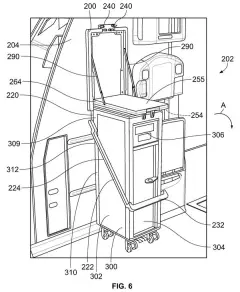
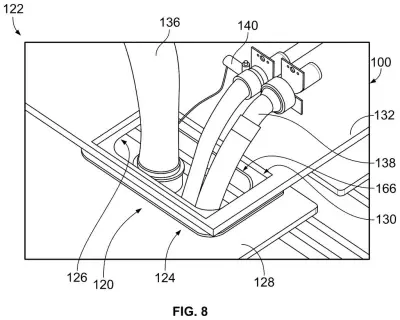
The filing describes a barrier: a one-piece molded part, made of flexible material such as silicone, that sits where the bathroom meets the cabin floor. A flat base has a hole through it, and the bathroom's plumbing lines (toilet vacuum, pressurized water and sink drain) pass down through that hole.
Two features do the work:
- A lip on the underside turns down into the opening in the cabin floor and covers its edges, which can expose sharp honeycomb material that might scratch the lines.
- A liquid blocker on the top face rises around the hole and extends into a matching opening in the bathroom floor. The lead claim describes it as a curved, inward-leaning ridge called a bead, which works as a small dam.
Part of the base is sandwiched between the two floors. When the bathroom slides into place, its floor pushes the bead down, and the bead springs back up once the openings line up. A second version uses a rim cut with slits, so each section flexes like a hinge.
The method claim is short: attach the lip to the edges of the floor opening, then place the bathroom so the blocker extends into its opening.
A system is configured to provide an interface between a main floor of an internal cabin of and a lavatory secured to the main floor.
Translation: This setup creates a secure connection between the passenger cabin floor and the airplane bathroom.
Why a small silicone part matters in a cabin
For passengers, the best outcome is that nothing happens: spilled water stays on the aisle and out of the equipment below. Boeing says the electrical bay is already protected by an impermeable floor and drip trays, and that the gap in question isn't considered a safety hazard. The seal adds another layer at a spot where sealant is hard to apply well, especially on carpet.
The bigger gains look likely to go to the people building and repairing planes. A molded part is the same every time, and it doesn't depend on how carefully someone reapplies sealant after a bathroom has been removed for rework. The filing also says the same barrier could work with galleys or closets, and in other vehicles or buildings.
Boeing's third filing we've tracked since November in our Boeing coverage follows a bathroom leak seal and a landing-spot drone.
Source: US 2026/0365306 A1 at the USPTO (PDF). Full patent text and figures are in the official publication.
Get our take in your Top Stories
Liked this breakdown? Add Patentlyze as a preferred source on Google, and our plain-English take shows up more often in your Top Stories the next time Boeing patent news breaks.
Add Patentlyze on Google
One click.
There are more where this came from
We read the new patents from Big Tech, carmakers and more and send you the ones worth knowing. Plain English, free, every week.
The drawings · 7 sheets
7 drawing sheets from US 2026/0365306 A1 · click any drawing to enlarge


More from Boeing
All 3 Boeing patents →
More in Flight & Space
All 10 Flight & Space patents →
SpaceX
SpaceX Files Patent for Internet Dishes That Hop Satellites Before a Tree Blocks Them
Airbus
Airbus Patents a Timetable That Tells Each Plane Where to Taxi and When
Airbus
Airbus Patents a Fuel System That Changes Its Own Blend During Flight
Airbus
No comments yet