
Nvidia Patents a Way to Stop Lighting From Lagging in Real-Time 3D Scenes
Real-time 3D graphics has a persistent headache: recycle too much lighting data from the last frame and the scene looks laggy when lights change; throw it all away every frame and the image gets noisy. Nvidia's new patent proposes a way to tell, pixel by pixel, exactly how much to trust yesterday's light.
Why lighting in games flickers — and what Nvidia's doing about it
Imagine you're playing a game and a flashbang grenade goes off. The scene should instantly flood with white light — but sometimes the brightness "catches up" a beat later, like a slow camera adjusting to sunshine. That stutter happens because the graphics engine was reusing lighting data from the previous frame to save time, and didn't realize the world had just changed dramatically.
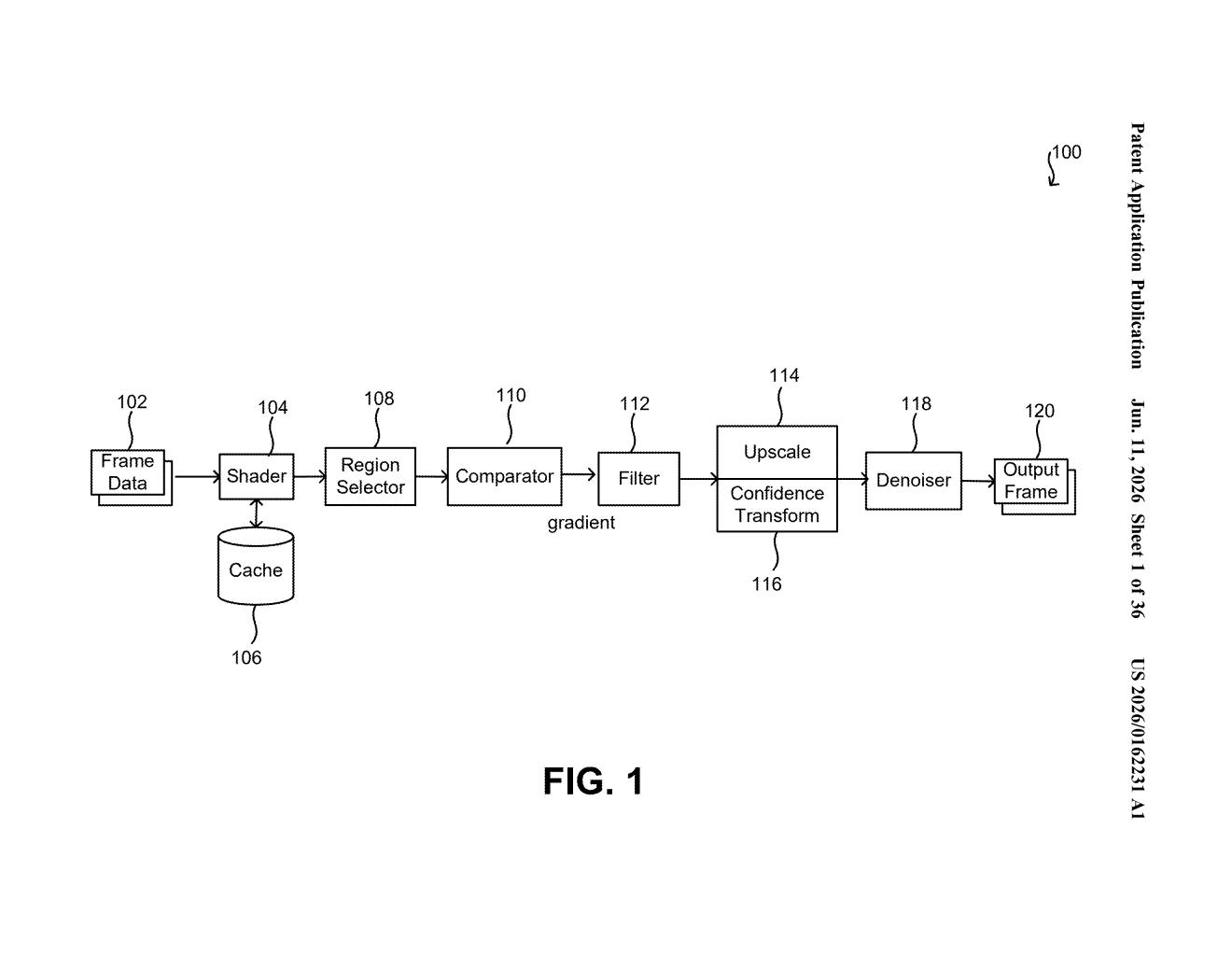
Nvidia's patent describes a system that checks how much the lighting actually changed between two consecutive frames, tile by tile across the screen. If a region barely changed, it's safe to lean on the previous frame's lighting data. If the difference is large, the system flags that region with a low confidence score and uses fresher, current-frame lighting instead.
The result is that stable, unlit parts of a scene stay smooth and noise-free, while areas hit by a sudden light change update quickly and accurately. You get the best of both worlds — responsiveness where it counts and visual calm everywhere else.
How Nvidia measures frame-to-frame light shifts to steer resampling
The patent describes a pipeline that runs during each rendered frame in a light transport simulation — the technical process of tracing how light bounces around a 3D scene, used in ray tracing.
Here's how the steps fit together:
- Sample a single light ray per tile: The screen is divided into small groups of pixels (tiles). The system fires one light ray per tile — a cheap operation — for both the current and the previous frame using the same tile positions.
- Compute gradients: A gradient here just means the numerical difference in lighting brightness between the two frames at each tile. A big number means the lighting shifted; a near-zero number means it stayed the same.
- Filter and upscale: The gradient grid is at lower resolution (one value per tile, not per pixel). A filtering pass smooths out noise in those values, and then they're scaled back up to full screen resolution.
- Generate confidence values: Large gradients translate to low confidence; small gradients translate to high confidence. These scores tell the renderer how much historical lighting data is trustworthy.
- Weighted blending: Each pixel's final shading blends current-frame and previous-frame lighting in proportion to its confidence score — heavy on the past where nothing changed, heavy on the present where something did.
The approach is designed to be computationally light because only one ray per tile — not per pixel — drives the gradient calculation.
What this means for ray-traced games and real-time rendering
Ray tracing and path-traced global illumination — the gold-standard lighting techniques used in modern games and real-time rendering — are inherently noisy when run at playable speeds. Engines cope by reusing lighting samples across frames, a technique called temporal resampling. The tradeoff has always been ghosting and lag when lights change fast.
This patent addresses that tradeoff directly with a gradient-based confidence gate, which is a more principled approach than simple heuristics (like checking whether an object moved). For GPU-accelerated games and design tools that rely on Nvidia hardware, a smoother, more responsive temporal resampler could mean visibly cleaner lighting during dynamic events — explosions, blinking lights, changing time-of-day — without extra per-pixel ray cost.
This is solid, focused engineering on one of the genuinely hard problems in real-time path tracing. Temporal resampling artifacts are a known, visible flaw in current ray-traced games, and Nvidia's gradient-confidence approach is a clean, computationally frugal way to attack it. It's not a headline-grabbing AI announcement, but it's the kind of incremental pipeline work that quietly makes the next generation of games look noticeably better.
There are more where this came from
We read every patent application Big Tech publishes and send you the ones worth knowing. Plain English, free, every week.
Want this weekly breakdown for a company we don't cover? Patentlyze Pro →