
Google Patents a Way to Drag Virtual Objects Across Real-World Surfaces in AR
Imagine pinning a virtual sticky note to your wall, then sliding it over to your desk without it floating awkwardly in mid-air. That's the specific problem Google is trying to solve with this AR patent.
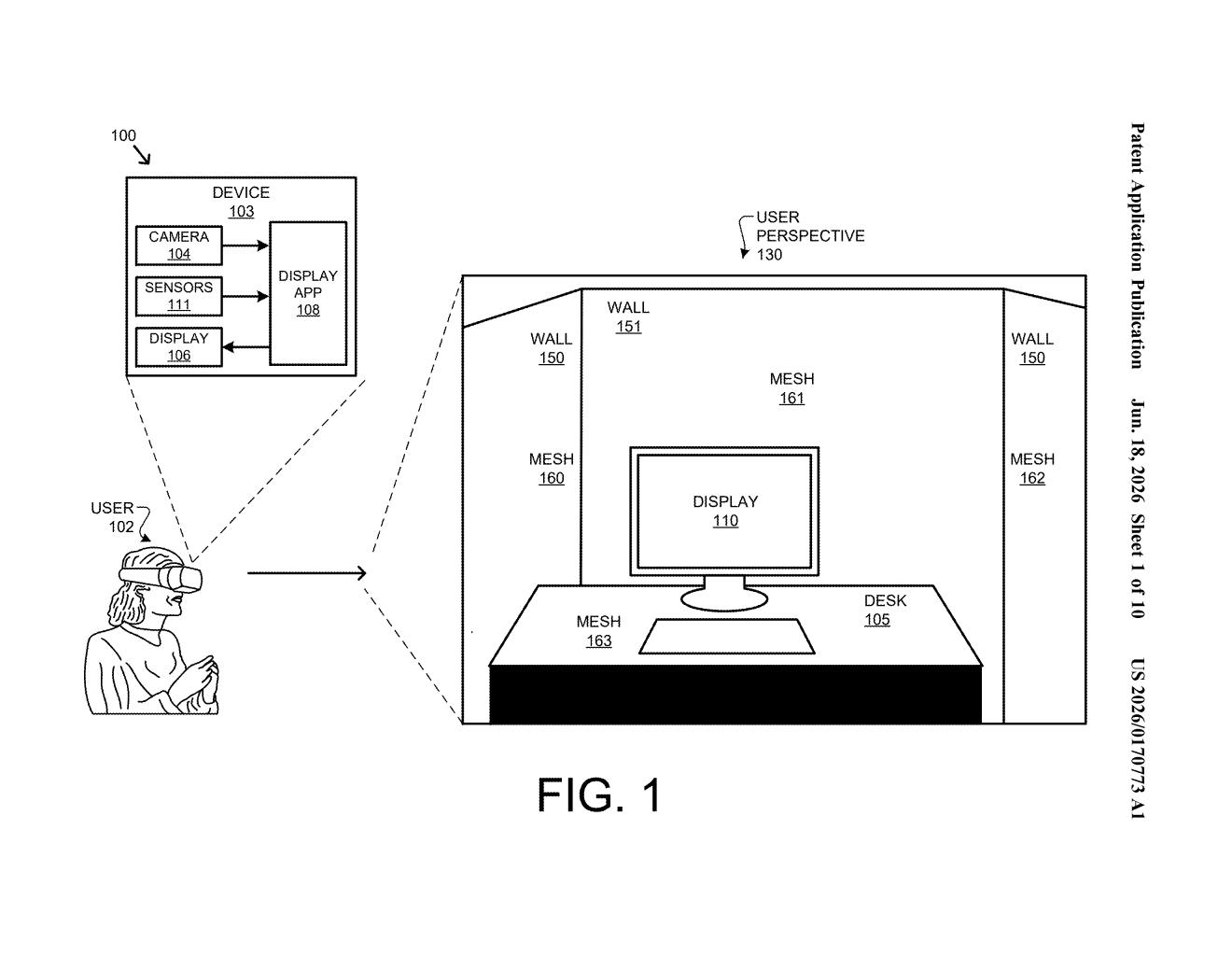
What Google's surface-hopping AR objects actually do
Picture wearing AR glasses that overlay digital objects — a calendar, a to-do list, a photo — onto the physical surfaces around you. Today, moving one of those objects from your wall to your desk is harder than it sounds: the glasses have to understand that you're crossing from one real surface to another, and reattach the virtual item correctly.
This patent describes a system where the glasses map your environment as a series of meshes — essentially digital skins stretched over real physical surfaces like walls, tables, and floors. When you reach out and move a virtual object, the glasses detect that gesture and figure out which surface you're dropping it onto, then anchor it there.
The result is that a virtual note you "place" on your desk stays flat against the desk, not floating in space. It's a small quality-of-life detail, but it's exactly the kind of thing that makes AR feel natural rather than gimmicky.
How the dual-mesh system tracks and repositions virtual objects
The patent describes a method running on an extended reality (XR) device — think AR glasses or a mixed-reality headset — that tracks virtual objects as users move them between physical surfaces.
Here's the core sequence:
- The device scans the room and generates a mesh for each surface it detects (a mesh is a 3D geometric map — imagine wrapping plastic wrap tightly over a table or a wall).
- A virtual object — say, a floating app window — is initially anchored to one mesh, so it sits flush against that surface.
- When the user makes a selection gesture (a grab, a tap, a hand movement), the system tracks the motion and determines a new target location on a different mesh.
- The virtual object is then re-anchored to that second mesh and displayed at the new position.
The key technical insight is that the system treats each surface as a separate spatial reference frame. Moving an object isn't just changing XYZ coordinates — it's transferring ownership from one mesh to another, which keeps the object correctly oriented and stuck to the new surface. The patent doesn't specify a particular input method, leaving room for hand tracking, controllers, or gaze-and-gesture combos.
What this means for Google's AR glasses ambitions
For AR to feel like a natural extension of your workspace rather than a novelty, virtual objects need to behave like physical ones — which means they have to respect real surfaces. A sticky note on a wall should look like it's on the wall; a widget on a desk should look like it's on the desk. This patent tackles the plumbing that makes that possible when you move things around.
Google has been building toward consumer AR glasses for years, and this filing sits squarely in that effort. Surface-aware object placement is a foundational capability for any device that wants to replace physical screens with virtual ones. If your AR glasses can't keep a floating calendar from drifting into the ceiling, you'll take them off inside a week.
This is solid foundational work rather than a flashy feature — the kind of unglamorous spatial-computing infrastructure that separates AR devices people actually use from ones that end up in a drawer. Google clearly needs this if its AR hardware is going to compete with Meta's and Apple's spatial platforms. Worth watching as an indicator of where Google's AR OS is heading.
There are more where this came from
We read every patent application Big Tech publishes and send you the ones worth knowing. Plain English, free, every week.
Want this weekly breakdown for a company we don't cover? Patentlyze Pro →