
Google's New Patent Turns a Flat Photo Into a 3D Scene You Can Hear
Google is patenting a system that looks at an ordinary photo, rebuilds it as a 3D scene, and then figures out what sounds you'd hear — and from which direction — based on exactly where you're standing inside that scene.
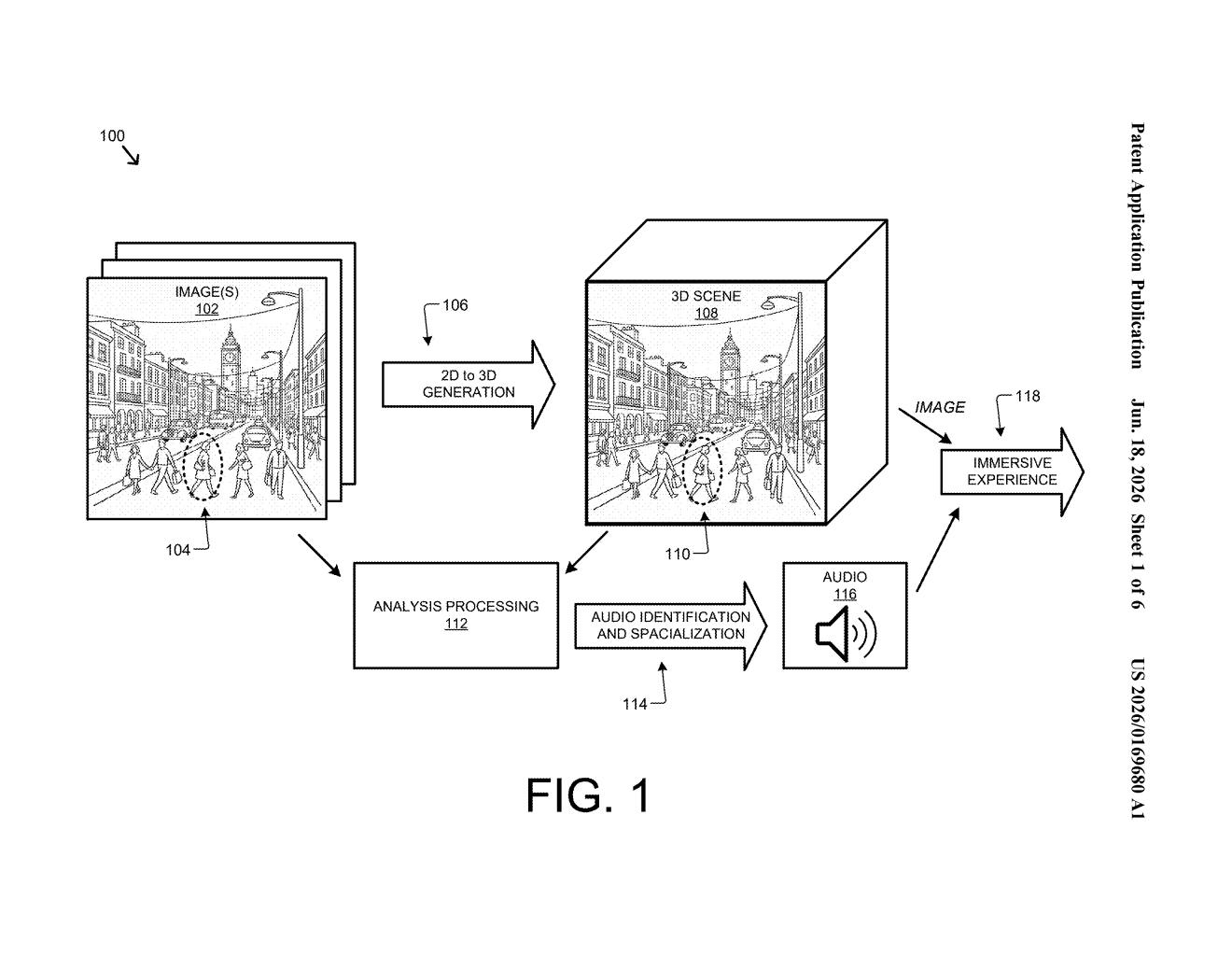
What Google's photo-to-3D audio system actually does
Imagine handing someone a postcard of a busy street corner and they immediately know what it would sound like to stand there — the traffic to your left, a café behind you, birds above. That's roughly the idea behind this Google patent.
The system takes a regular flat photo, reconstructs it as a 3D environment, then works out what audio belongs in that scene and how it should be positioned relative to a viewer's angle. So if you tilt or navigate around the scene, the sounds shift accordingly — a passing car moves from right to left as you turn.
Spatial audio — sound that feels like it's coming from specific directions — is already common in headphones and VR headsets. What's new here is automatically generating that directional audio from a still image, rather than requiring a dedicated audio recording or a fully produced virtual reality scene.
How Google maps sound to a reconstructed 3D scene
The patent describes a four-step pipeline:
- Scene reconstruction: A flat 2D image (a photo or frame) is converted into a 3D scene — a depth map or similar spatial model that gives objects a sense of distance and position.
- Image generation: The system generates a view of that 3D scene from a chosen camera angle or perspective, similar to how photo apps already offer "cinematic" or parallax effects.
- Audio identification: Using visual analysis of the original image, the system identifies what audio content belongs in the scene. If the photo shows a waterfall, street traffic, or a concert crowd, it infers appropriate sounds.
- Spatialization: The identified audio is then positioned in 3D space (a process called spatialization — placing sounds at specific angles and distances relative to the listener) based on where objects appear in the reconstructed scene and the viewer's current vantage point.
Critically, the audio perspective updates with the viewer's position. If you're looking at the scene from the left side versus straight on, the sound sources shift accordingly. The patent doesn't specify whether audio identification uses a trained AI model or a content database, though AI-driven audio inference is the obvious candidate given Google's broader toolset.
What this means for Google Photos and immersive media
This kind of technology has obvious applications for Google Photos, Google Street View, or any platform where static images are the primary content format. Rather than needing a film crew to capture spatial audio alongside video, the system could generate plausible directional sound automatically — a meaningful step toward making ordinary photos feel genuinely immersive without requiring specialized hardware to capture them.
For AR and VR specifically, automatically generating audio from images could lower the production barrier dramatically. Right now, building an immersive scene typically means recording audio separately and mixing it by hand. If Google can reliably infer and spatialize sound from a photo alone, that changes what a solo creator — or a consumer app — can produce. Whether the output audio is convincing enough to matter in practice is the real open question.
This is a genuinely interesting patent because it closes a gap that immersive media has always had: photos are everywhere, good spatial audio is rare and expensive to produce. Automatically inferring directional sound from a still image is a problem worth solving, and Google is in a strong position to do it given its investments in both computational photography and audio AI. The idea is clear; the hard part is whether the inferred audio is good enough to hold up under scrutiny.
There are more where this came from
We read every patent application Big Tech publishes and send you the ones worth knowing. Plain English, free, every week.
Want this weekly breakdown for a company we don't cover? Patentlyze Pro →