
New Patent Turns Plain-Text Descriptions Into Working Chatbots
Writing a chatbot today usually means mapping out every possible conversation by hand. Microsoft has filed a patent for a system that skips all of that by letting an AI do the blueprint work itself.
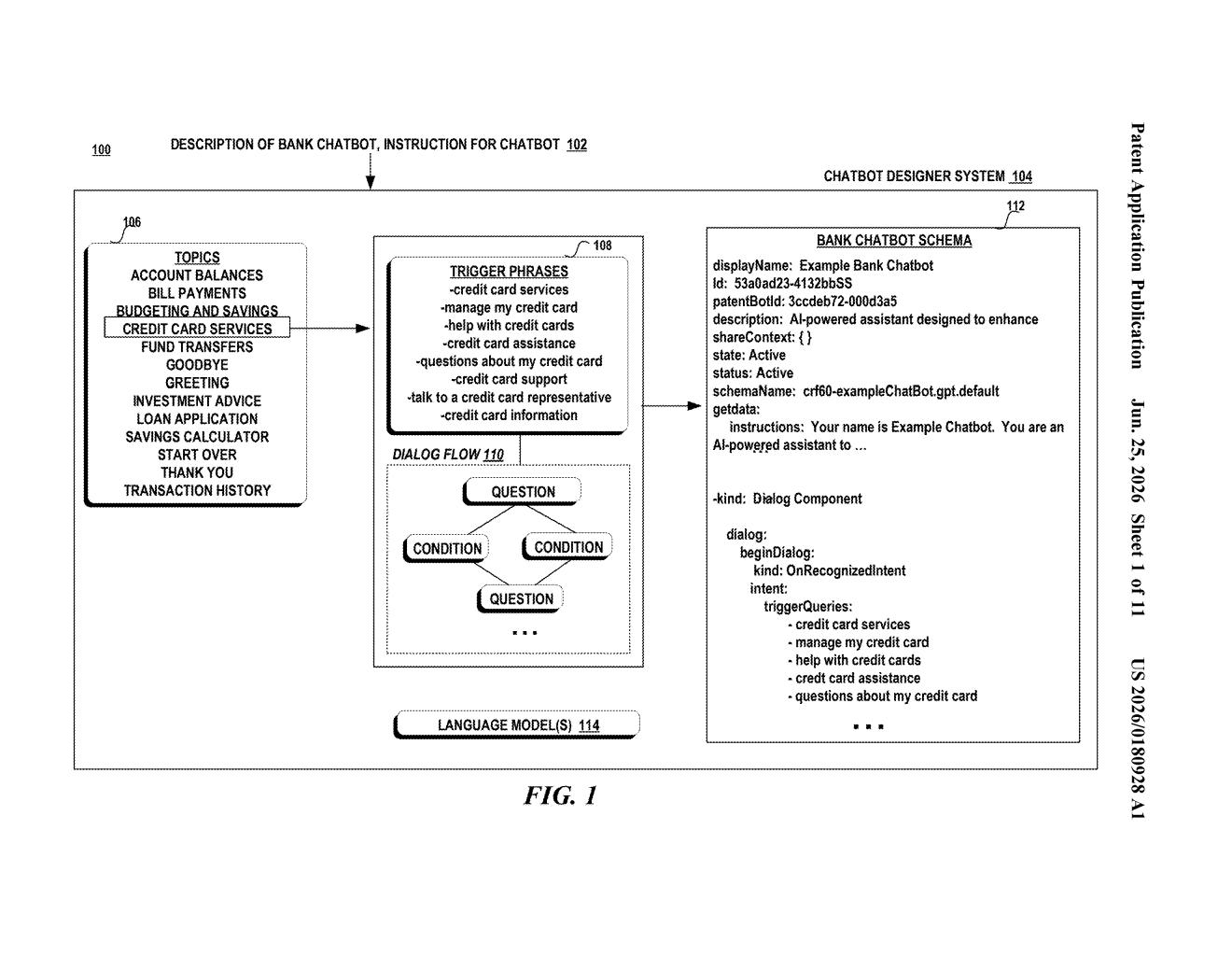
What Microsoft's auto-chatbot-builder actually does
Imagine you want to build a customer-support chatbot for your business. Right now, you'd have to manually write out every topic it can handle, every trigger phrase that starts a conversation, and every possible reply path. That work takes time and technical skill.
Microsoft's patent describes a system that handles all of that automatically. You type a short description of what you want the chatbot to do, and the AI generates the entire underlying structure for you, including the topics it should cover, the phrases that will kick off each conversation, and the step-by-step flow of how each conversation should go.
The system also checks its own work, flagging potential errors before the chatbot goes live. The goal is to let someone with no coding experience spin up a working chatbot in a fraction of the usual time.
How the system turns fake conversations into a real bot
The system takes a plain-language description of a desired chatbot and feeds it to a large language model (an AI trained on text, similar to what powers ChatGPT). The model first figures out the chatbot's core objective, then generates a large batch of simulated conversations, essentially fake back-and-forth exchanges between a pretend user and the pretend bot.
Those simulated conversations are then analyzed using clustering, a technique that groups similar conversations together based on how closely their meanings match (measured via embeddings, a way of representing text as numbers so a computer can compare them). Each cluster of similar conversations gets turned into a topic, which is the chatbot's internal label for a subject it knows how to handle.
From each topic, the system automatically generates:
- Trigger phrases: the kinds of things a user might say to start that conversation
- Dialog flows: the step-by-step logic for how the bot should respond
The finished product is a chatbot schema, a structured blueprint that a chatbot platform can read and run. The system then validates the schema, checking for gaps or conflicts before deployment.
What this means for businesses building chatbots
Building a chatbot from scratch is tedious work even for experienced developers. For a small business owner or a non-technical team, it can be a genuine barrier. A system that generates the entire conversation architecture from a short description could make self-service chatbots accessible to a much wider group of people.
For Microsoft, this fits squarely into its push to embed AI into its enterprise tools, including Microsoft Copilot Studio, which already lets businesses build custom bots. If this approach makes it into that product, you could potentially describe a support bot in a few sentences and have a working draft ready in minutes rather than days.
This is a useful, practical idea that solves a real pain point. Chatbot configuration is one of those tasks that sounds simple but turns into a time sink fast. Automating the schema-generation step with simulated conversations is a genuinely clever approach, not just AI glued onto an existing workflow. That said, the patent covers infrastructure that already exists inside products like Copilot Studio, so this reads more like a formalization of ongoing work than a hint at something new.
There are more where this came from
We read every patent application Big Tech publishes and send you the ones worth knowing. Plain English, free, every week.
Want this weekly breakdown for a company we don't cover? Patentlyze Pro →