
Meta Patents a Camera That Refocuses Itself Without Moving Parts
Most cameras change focus by physically moving glass around. Meta is filing patents for a camera that does it electrically, with no moving parts at all.
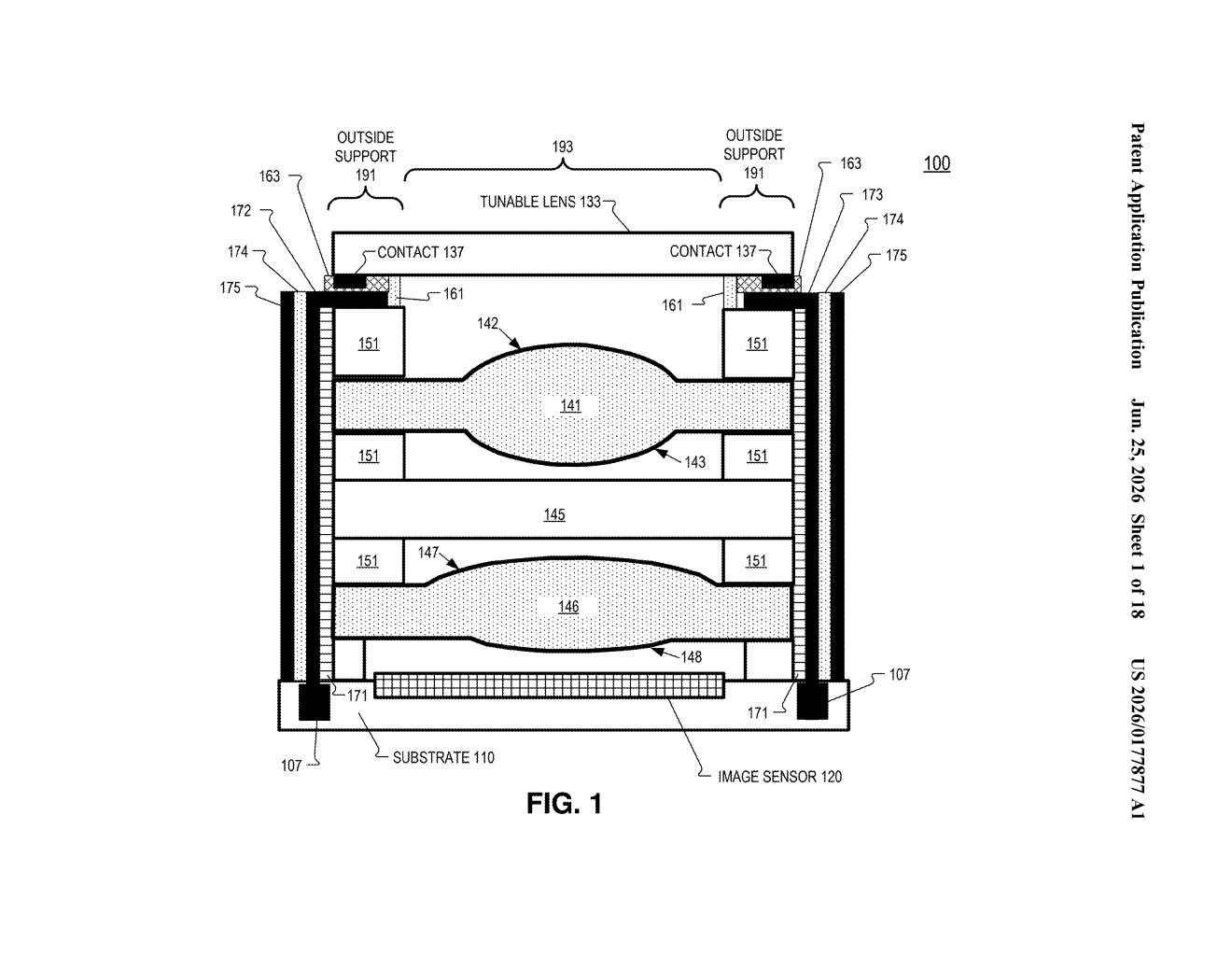
What Meta's self-adjusting camera lens actually does
Think about how your phone struggles to focus when you quickly shift from looking at something close to something far away. Traditional cameras handle this by physically sliding lenses back and forth inside the module, which takes space and time.
Meta's patent describes a different approach: a tunable lens that can change how strongly it bends light just by receiving an electrical signal. No motors, no moving glass. The camera also includes a set of fixed lenses etched directly onto a chip wafer, which keeps the whole assembly tiny.
The result is a camera module that can shift focus almost instantly and is compact enough to fit inside something like a pair of smart glasses. For a company that is actively building AR headsets, that size-and-speed combination matters a lot.
How the tunable lens and wafer optics work together
The patent describes a camera module built from three main components working together.
- Image sensor: the chip that actually captures the picture, mounted on a substrate (a flat base board).
- Wafer level optics (WLO): two or more tiny fixed lenses manufactured directly onto a silicon wafer, sitting between the tunable lens and the sensor. WLO is a production technique that stamps optical elements onto chips at scale, making them very thin and cheap to make.
- Tunable lens: a lens whose optical power (how sharply it bends light) can be changed on the fly by sending it an electrical signal. This is typically achieved with liquid crystal or electrowetting technology, meaning the lens material itself changes shape or refractive index without any mechanical movement.
The fixed wafer optics handle the heavy lifting of directing light onto the sensor, while the tunable lens adds a variable correction on top. The claim specifically places the fixed optics between the tunable lens and the sensor, suggesting the tunable element sits at the front of the stack to intercept incoming light first.
What this means for Meta's AR glasses ambitions
AR glasses live or die on how thin and light they can be. A traditional autofocus camera requires a small motor and room to move glass, which adds bulk and drains battery. A tunable lens that refocuses with just an electrical signal sidesteps both problems, making it a natural fit for the constrained space inside a glasses frame.
Meta's Ray-Ban smart glasses already include cameras, and the company is working on more capable AR headsets. A faster, thinner, lower-power autofocus system would improve photo and video quality in wearables where you physically cannot make the device any thicker. This patent suggests Meta is working on that exact piece of the puzzle.
This is a focused, practical patent rather than a moonshot. Tunable lenses are a real and active area of optics research, and Meta filing on a specific integrated module design shows they are solving concrete engineering problems for next-generation wearables. It is worth tracking as a signal of where the hardware stack for Meta's AR glasses is heading.
There are more where this came from
We read every patent application Big Tech publishes and send you the ones worth knowing. Plain English, free, every week.
Want this weekly breakdown for a company we don't cover? Patentlyze Pro →