
IBM Patents an AI System That Keeps 3D Printers on Track Mid-Print
A 3D print job can fail because the room got too warm, the filament shifted, or a vibration knocked something slightly off. IBM's new patent describes an AI engine that watches for all of that and corrects the printer before the damage shows up in the finished part.
What IBM's AI-driven 3D print correction actually does
Imagine you're printing a complex part on a 3D printer and, halfway through, someone opens a window and the temperature drops, or a nearby machine starts vibrating the table. The printer doesn't know any of this is happening, so it keeps going with the wrong settings and you end up with a warped or failed print.
IBM's patent describes a system that wraps a network of sensors around the printer to track both external factors (like room temperature, humidity, and vibrations) and internal factors (like nozzle heat and material feed rate). An AI engine learns from past print runs and sensor data to figure out how those conditions affect the final object.
When a new print job starts, the AI generates the best possible printer commands for those conditions and keeps adjusting them throughout the job. Think of it as a co-pilot that watches everything the printer can't see itself and compensates on the fly.
How the AIDE sensor loop adjusts printer commands live
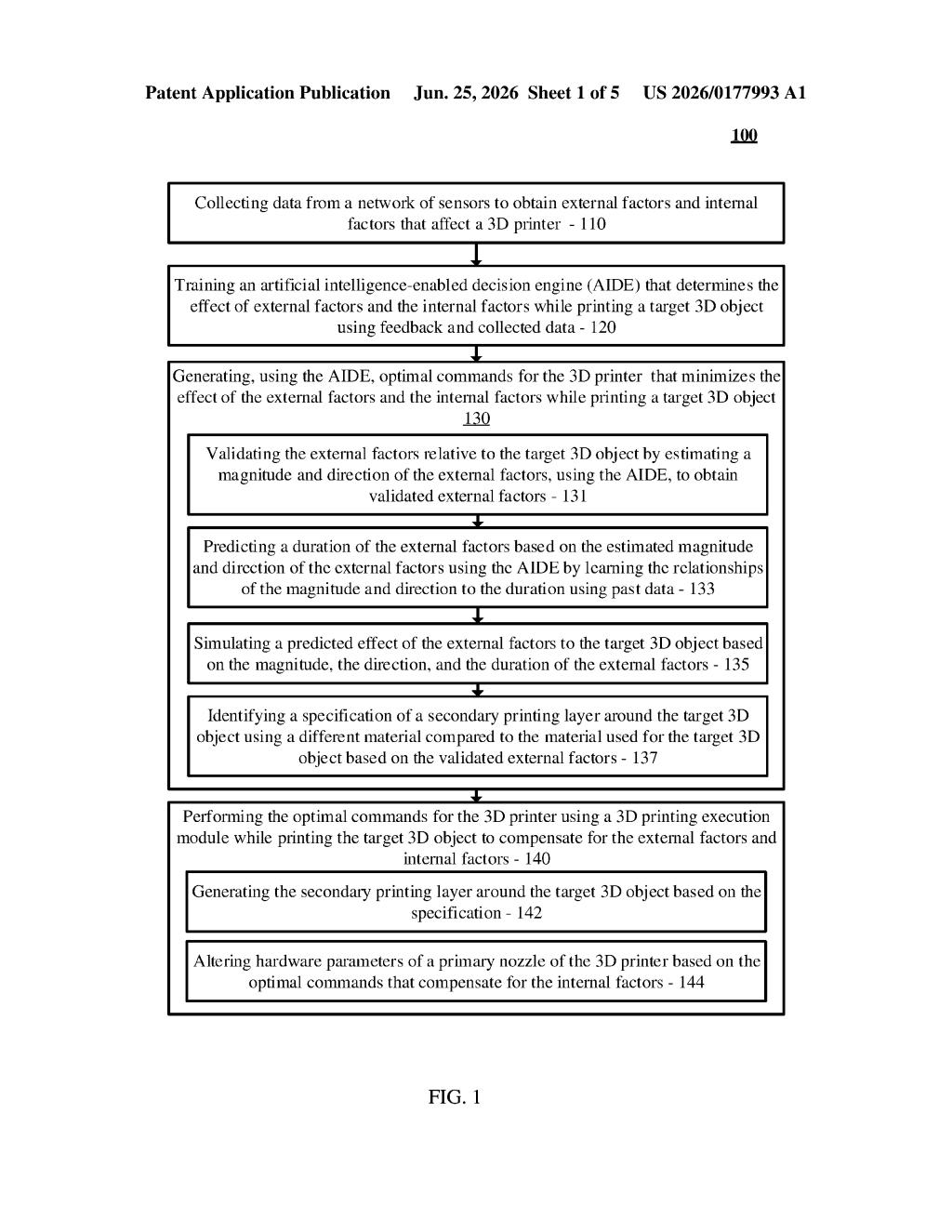
The patent describes a three-part pipeline built around what IBM calls an Artificial Intelligence-Enabled Decision Engine (AIDE).
- Sensor collection: A network of sensors feeds the system both external data (ambient temperature, humidity, nearby vibrations) and internal data (nozzle temperature, material viscosity, feed consistency). Together these are the inputs the AI uses to understand the printing environment.
- Training and feedback loop: The AIDE is trained using collected sensor data and feedback from previous print outcomes (meaning: did the object come out correctly or not?). Over time it learns which combinations of conditions lead to print defects and which printer adjustments fix them.
- Command generation and execution: For each new print job, the AIDE generates optimal commands tailored to current conditions. A separate 3D printing execution module applies those commands in real time while printing, continuously compensating as conditions change.
The core idea is a closed feedback loop: sensors feed the AI, the AI updates the print commands, the execution module applies them, and outcomes feed back into training. The patent doesn't lock this to a specific printer type or material, suggesting IBM intends it as a general-purpose management layer.
What this means for industrial 3D printing reliability
3D printing at an industrial scale is sensitive to environmental and mechanical variation in ways that current printers largely ignore. A system that actively corrects for those variables during a print job could meaningfully reduce material waste and failed runs, which are significant cost drivers in manufacturing contexts.
For everyday or desktop printing, the benefit is more modest, but IBM's framing here points toward enterprise and manufacturing environments where print quality and consistency are non-negotiable. If this kind of AI oversight becomes standard, it could shift 3D printing from a process that requires constant human supervision to one that manages itself across a factory floor.
This is a sensible, practical application of AI to a real manufacturing problem. It's not flashy, but failed 3D prints in industrial settings cost real money, and a sensor-driven correction loop is a genuinely useful idea. The patent is broad enough that IBM could apply it across many printer types, which is either a strength or a sign that the specific implementation details are still thin.
There are more where this came from
We read every patent application Big Tech publishes and send you the ones worth knowing. Plain English, free, every week.
Want this weekly breakdown for a company we don't cover? Patentlyze Pro →