
Microsoft Patent Uses Relationship Maps to Train AI for Label Predictions
Most real-world data doesn't live in neat tables; it lives in webs of relationships. Microsoft is patenting a way to teach AI to navigate those webs, figure out which connections matter most, and make confident predictions from the structure itself.
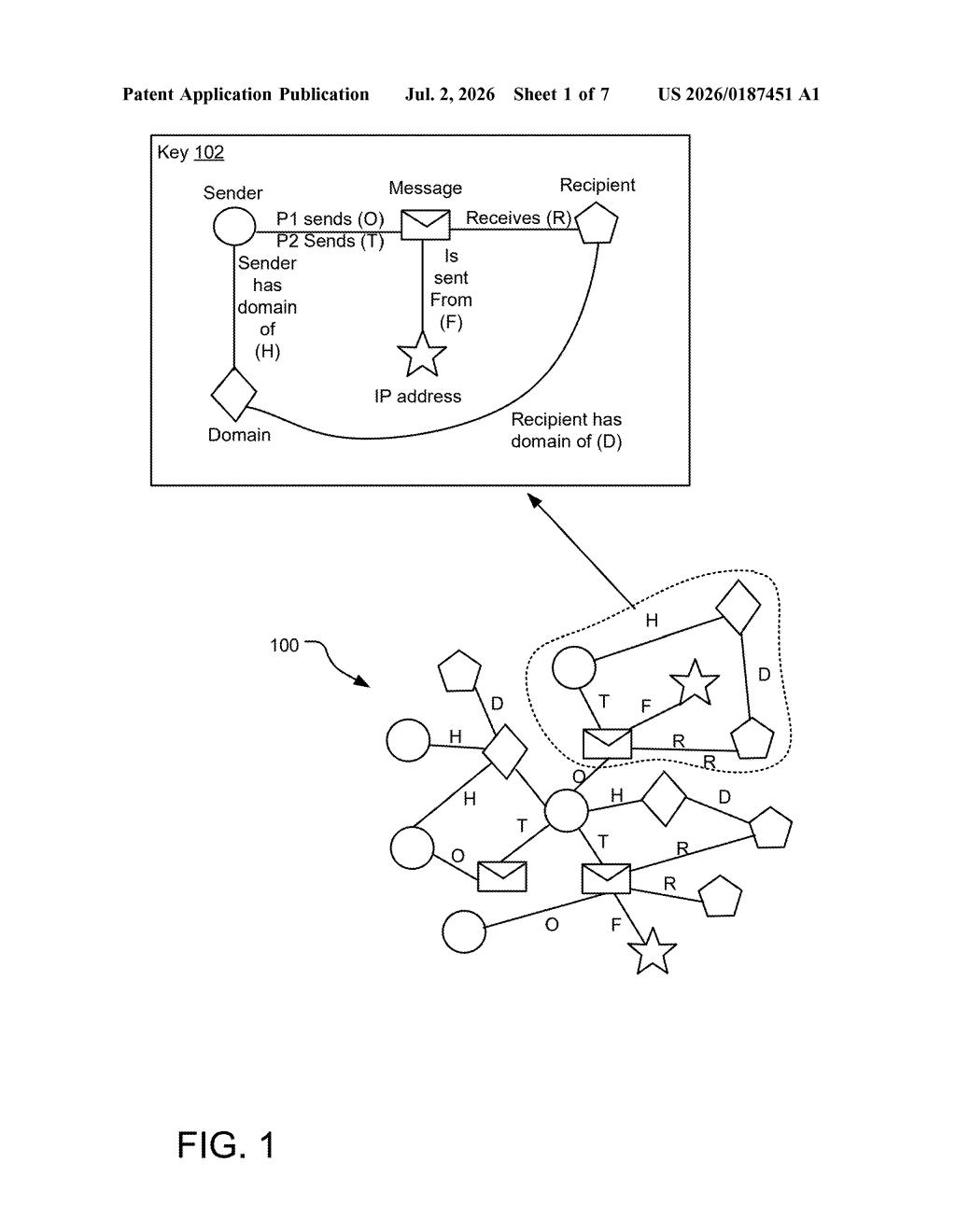
What Microsoft's relationship-graph AI actually does
Imagine trying to figure out whether a software file is malicious. The file doesn't exist in isolation; it was downloaded by a user, on a specific device, from a certain website, flagged by a particular security tool. Understanding the threat means understanding all those connections and how they relate to each other.
Microsoft's patent describes an AI system that maps out those kinds of webs, where the nodes are things like files, users, and devices, and the lines between them represent relationships. Instead of treating every connection as equally important, the system builds a ranked tree of connection paths and uses an attention mechanism (a technique that lets AI focus on the most relevant inputs) to decide which relationships are most useful for making a prediction.
The result is a label: essentially a verdict. Is this file dangerous? Is this account compromised? By structuring the problem as a hierarchy rather than a flat list of features, the system can handle messier, more realistic data without getting lost in the noise.
How the attention mechanism weighs each data path
The patent describes a heterogeneous tree graph neural network, which sounds dense but breaks into two key ideas.
First, heterogeneous graph: the data being analyzed isn't uniform. Nodes in the graph can represent totally different things, like a user account, a domain name, a process, and a file, connected by different types of edges ("downloaded," "executed," "flagged"). Traditional graph neural networks struggle when nodes and edges have different types; this system is built for exactly that messiness.
Second, tree structure: instead of reasoning over the whole graph at once, the system extracts a semantic tree rooted at the "target" node (the thing you want to classify). Each branch of the tree represents a metapath, meaning a specific sequence of relationship types leading to the target. For example: User → Device → File → Target.
- The system groups paths by their type and length into a hierarchy.
- An attention mechanism (a scoring technique that weights inputs by relevance) assigns importance scores to each path based on how similar it is to the target node's current representation.
- A weighted sum of all path embeddings (numeric representations of nodes) is fed into a neural network to generate an updated target-node embedding.
- That final embedding drives the prediction label, such as "malicious" or "benign."
What this means for AI-powered threat detection
Microsoft's security products, including Defender and Sentinel, already ingest massive graphs of entity relationships across enterprise networks. A more accurate way to classify nodes in those graphs translates directly into fewer false positives and better threat detection, without requiring analysts to manually trace every connection.
Beyond security, the same architecture applies anywhere data is relational and heterogeneous: fraud detection in financial networks, recommendation systems, or knowledge graphs. The patent's core contribution, using a tree-based hierarchy with attention-weighted paths rather than a flat graph traversal, is a structural bet that how you organize the graph matters as much as how you train on it.
This is a real technical contribution, not a trivial filing. The specific combination of heterogeneous graph handling, metapath-based tree extraction, and hierarchical attention is a meaningful architectural choice that addresses a known weakness in graph neural networks. Whether it ships as a discrete product feature or powers an existing security pipeline, this is the kind of ML infrastructure patent that ages well.
Get our take in your Top Stories
Liked this breakdown? Add Patentlyze as a preferred source on Google, and our plain-English take shows up more often in your Top Stories the next time Microsoft patent news breaks.
There are more where this came from
We read every patent application Big Tech publishes and send you the ones worth knowing. Plain English, free, every week.
Want this weekly breakdown for a company we don't cover? Patentlyze Pro →