
Google Patents a Chain of AI Steps That Turns Text Into Video
Google has patented a system that generates videos from plain text by passing the output through a chain of AI models, each one making the footage sharper or smoother than the last.
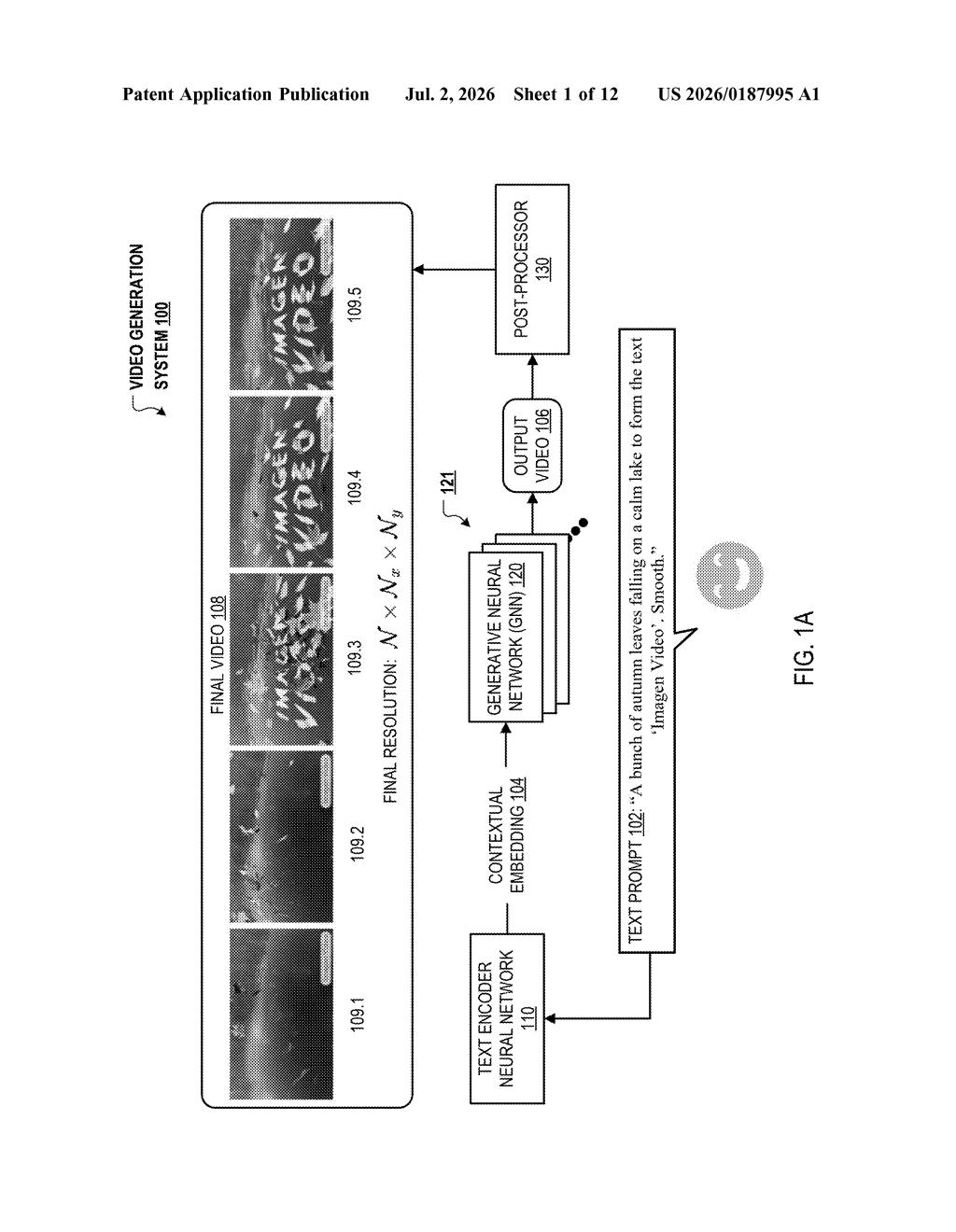
How Google's text-to-video chain actually works
Imagine typing 'a red fox running through a snowy forest at dusk' and getting back a short, fluid video clip. That's the basic idea behind this Google patent.
The system works in stages. First, a model reads your text and builds a compact mathematical summary of what you described. Then a first AI uses that summary to create a rough, low-quality video. Subsequent AIs in the chain each receive that rough video and improve it, adding more visual detail or making the motion smoother, one step at a time.
The result is a final high-resolution video that reflects your original description, built up incrementally rather than attempted all at once. Think of it like a photo lab that first prints a thumbnail, then a medium print, then a full-size version, each pass adding more clarity.
How each network hands off a sharper video to the next
The patent describes a cascaded generative pipeline for text-to-video synthesis. Here's how the sequence breaks down:
- Text encoder: A neural network converts your typed prompt into a contextual embedding (a dense numerical representation that captures the meaning and relationships in your words).
- Initial generative model: Takes that embedding and produces a first rough video at low spatial resolution (few pixels) and low temporal resolution (few frames per second or fewer total frames).
- Upsampling models: One or more subsequent networks each receive the previous model's output video plus the original text embedding, then output a higher-resolution or higher-frame-rate version.
Each step in the chain has a narrower job to do, which is a core reason this architecture exists. Generating a polished, high-resolution video in one shot is extremely difficult because the model has to get every detail right simultaneously. Breaking the problem into stages, where early models handle coarse structure and later models handle fine detail, makes the overall task more tractable.
The text embedding is fed into every stage of the chain, not just the first. That means each upsampling model can 'check' what the prompt said and make sure the refined video still matches the original description.
What this means for AI video tools and Google's competition with OpenAI
Text-to-video generation is one of the most contested areas in AI right now. OpenAI's Sora, Meta's Movie Gen, and other systems are all chasing the same goal: turning a sentence into a believable video clip. This patent shows Google working on a cascaded architecture, a technique that has already proven effective in image generation (Google's own Imagen used a similar approach for photos). Extending it to video is a natural but technically demanding step.
For you, the practical stakes are about what ends up inside Google's products. If this approach ships, it could power video creation inside Google Workspace, YouTube Shorts tools, or Google's Vertex AI platform for developers. The patent itself doesn't confirm any of that, but the research team named on the filing has published foundational work in exactly this area.
This is a core research patent from a team (Ho, Saharia, Chan) that built some of the most influential text-to-image and video diffusion models of the last few years. The cascaded pipeline concept isn't brand new, but Google staking a formal patent claim on this specific video architecture signals that this is a real engineering bet, not a speculative filing. It's worth watching.
Get our take in your Top Stories
Liked this breakdown? Add Patentlyze as a preferred source on Google, and our plain-English take shows up more often in your Top Stories the next time Google patent news breaks.
There are more where this came from
We read every patent application Big Tech publishes and send you the ones worth knowing. Plain English, free, every week.
Want this weekly breakdown for a company we don't cover? Patentlyze Pro →