
Nvidia's New Patent Teaches Self-Driving Cars to Tell a Cyclist from a Trash Can
Teaching a self-driving car to tell a cyclist from a trash can, in real time, across dozens of laser-scanned frames, is one of the hardest problems in robotics. Nvidia is patenting a way to do it without paying humans to label millions of training examples by hand.
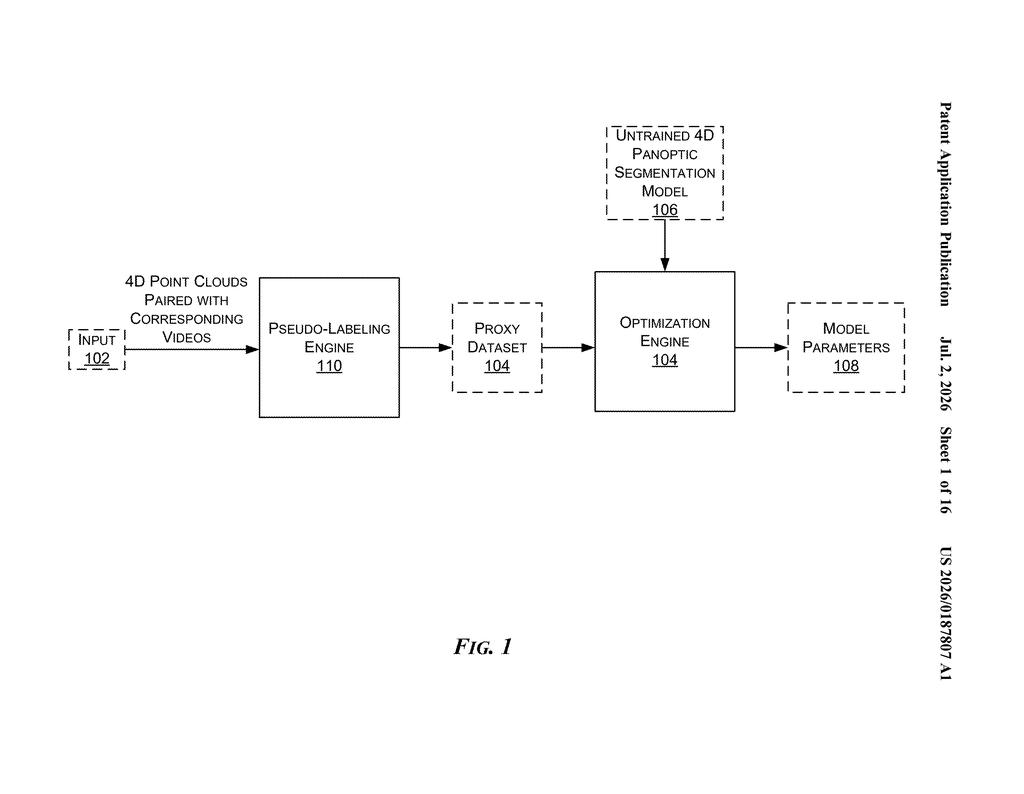
How Nvidia's system sees and labels a moving world in 3D
Imagine a self-driving car's sensors sweeping a busy intersection several times per second, building a 3D map of everything around it. The car doesn't just need a snapshot; it needs to know what each object is and where it's going across time. That combination of labeling things AND tracking them through time is what engineers call "panoptic 4D segmentation," and it's notoriously expensive to train because someone usually has to sit down and manually tag thousands of examples.
Nvidia's patent describes a way to sidestep most of that manual work. Their system uses existing AI models (trained on ordinary video) to automatically generate consistent labels across a sequence of 3D laser-scan frames. Those auto-generated labels then become the training data for a new, specialized network.
The end result is a model that can look at a fresh scene it has never encountered before and still correctly identify and track every pedestrian, vehicle, or obstacle in it. That capability is central to making autonomous vehicles and robots work reliably in the real, unpredictable world.
How the model builds its own training data from video and laser scans
The patent centers on training a neural network to perform panoptic segmentation (labeling every point in a scene by both category, like "car" or "person," and individual identity, like "car #3") on 4D point clouds (3D laser-scan data captured across multiple time steps, making time the fourth dimension).
The key engineering challenge is building a training dataset. Manually labeling 4D point clouds is expensive and slow, so Nvidia's approach uses vision foundation models (large, general-purpose AI models pre-trained on images and video) to automatically produce pseudo-labels, meaning labels generated by the AI rather than by a human annotator. Critically, the system ensures these labels stay temporally consistent, so the same car is tagged with the same identity across every frame, not just within a single snapshot.
Once the training data is built, a segmentation model is trained on it using a standard supervised loop:
- Feed a 4D point cloud in, get predicted labels out
- Compare predicted labels to the pseudo-labels to compute an error (the "loss")
- Adjust the network's internal parameters to reduce that error
The goal is zero-shot segmentation, meaning the trained model can correctly label scenes it was never explicitly trained on, which is essential for deployment in unpredictable real-world environments like city streets.
What this means for self-driving cars and robotics perception
For autonomous vehicles, perception is everything. A car that can't reliably distinguish a pedestrian stepping off a curb from a fire hydrant is a car that shouldn't be on public roads. The expensive bottleneck has always been labeled data: you need enormous amounts of it, and labeling 3D time-series data by hand is far more painstaking than tagging a photograph. Nvidia's approach of using existing AI to generate its own training labels is a direct attack on that cost.
For Nvidia, the strategic picture is clear. The company sells the chips and increasingly the software stack that runs inside autonomous vehicle systems. A patent on the core perception training pipeline puts Nvidia deeper into the value chain, well beyond just supplying the GPU.
This is genuinely substantive work, not a peripheral patent. The hard part of autonomous driving has always been perception at scale, and the specific problem of generating consistent 4D labels cheaply is a real blocker the industry is actively wrestling with. Whether this particular approach ships in a product or gets folded into Nvidia's DRIVE platform, it signals that Nvidia is investing seriously in the full perception stack, not just the hardware underneath it.
Get our take in your Top Stories
Liked this breakdown? Add Patentlyze as a preferred source on Google, and our plain-English take shows up more often in your Top Stories the next time Nvidia patent news breaks.
There are more where this came from
We read every patent application Big Tech publishes and send you the ones worth knowing. Plain English, free, every week.
Want this weekly breakdown for a company we don't cover? Patentlyze Pro →