
Qualcomm Patents a Chip That Continuously Retunes Itself Using On-Device AI
Most chips are tuned at the factory and stay that way. Qualcomm is patenting a system where the chip itself learns, in real time, how to adjust its own settings based on what's actually happening inside your device.
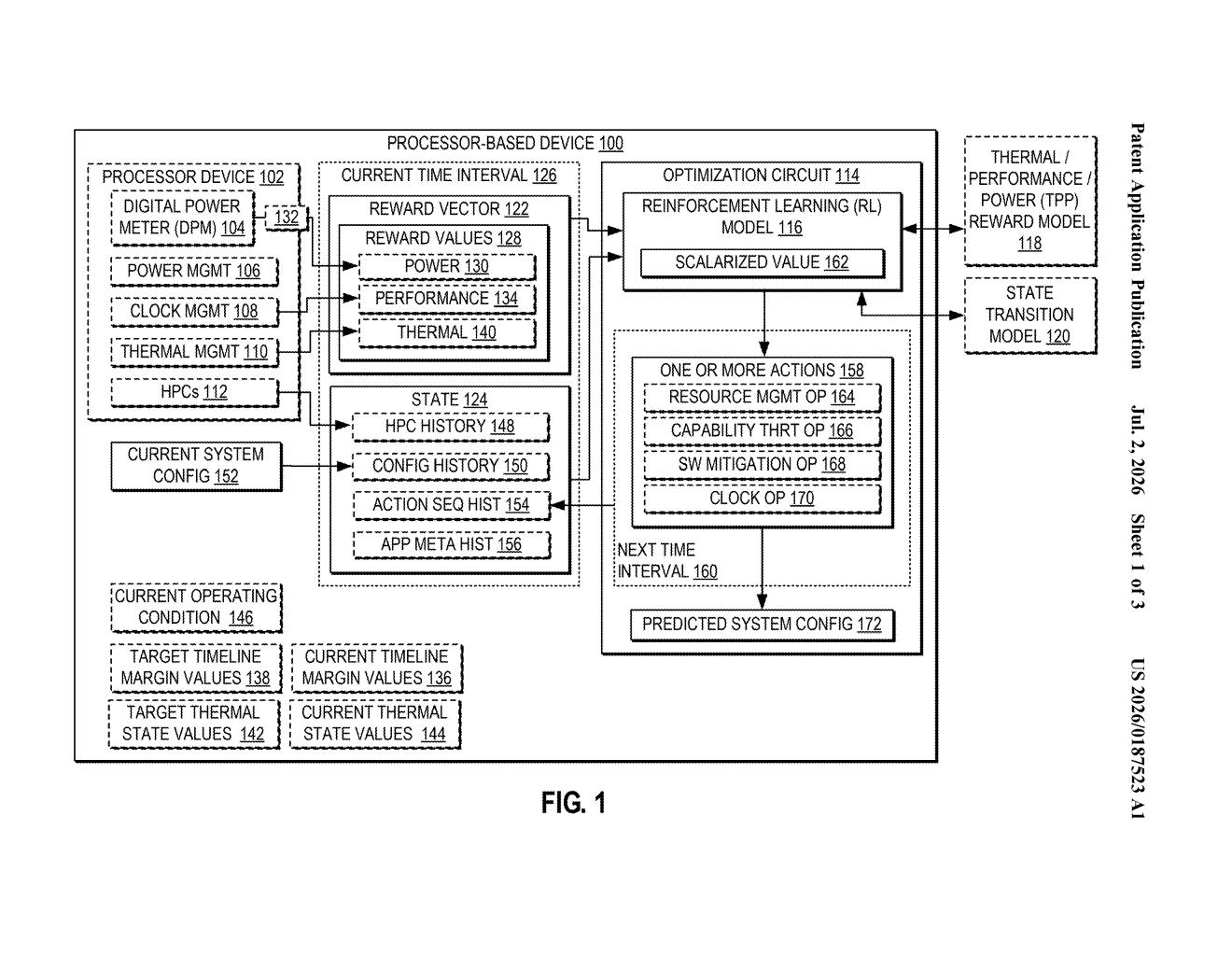
How Qualcomm's self-adjusting chip optimization works
Imagine your phone's processor is like a car engine that can only be tuned at the dealership. Once it leaves the factory, it runs the same way whether you're watching a video in bed or editing photos on a plane. Qualcomm wants to change that.
This patent describes a chip that watches how it's performing, receives a kind of scorecard measuring things like speed, temperature, and battery draw, and then uses an AI model to decide whether to change its own internal settings. If a better configuration is available, it switches. If not, it stays put.
The key idea is that this all happens on the device itself, not in the cloud. The AI isn't downloading new instructions from a server; it's making small adjustments every fraction of a second based on what your device is doing right now.
Inside Qualcomm's reward-vector tuning loop
The patent describes an optimization circuit built into a processor that runs a reinforcement learning (RL) model. RL is the same family of AI techniques used to train game-playing programs: the system tries actions, gets feedback on how well they worked, and gradually learns to make better decisions.
Here's how the loop works:
- The circuit receives a reward vector, a list of numerical scores measuring multiple performance dimensions at once (think: speed score, heat score, battery score).
- It also receives a state, a snapshot of what the system is currently doing.
- The RL model calculates which settings to use next, aiming to maximize a combined score across all those dimensions over time, not just in the next instant.
- It then checks whether the new recommended configuration is actually different from the current one. If it is, it applies the change. If not, it does nothing.
The phrase "scalarized value of expected discounted cumulative rewards" sounds dense, but the idea is simple: the model weighs all the individual scores into one number and tries to make that number as high as possible over future time steps, not just the immediate one. Discounting means the model values near-term results slightly more than distant ones, which keeps it from chasing impractical long-term gains.
What this means for battery life and device performance
Phones and laptops already use basic power management, but those systems follow fixed rules written by engineers. An RL-based system can adapt to patterns those engineers never anticipated, like your specific mix of apps, your typical usage hours, or how your battery ages over time. That flexibility could translate into longer battery life and cooler-running devices without sacrificing speed.
For Qualcomm specifically, this kind of on-device intelligence is a strategic priority. The company supplies chips to a huge portion of the Android ecosystem, and any efficiency gain baked into the silicon benefits every device using it. A system that tunes itself also reduces the pressure on phone makers to fine-tune software for every hardware variant.
This is real, useful engineering work, not a flashy AI concept. On-device RL for chip management has been a research topic for years, and Qualcomm filing a patent on a specific hardware-circuit implementation suggests this is moving toward production. The 'only act if something actually changes' detail is a small but telling sign of practical design thinking.
Get our take in your Top Stories
Liked this breakdown? Add Patentlyze as a preferred source on Google, and our plain-English take shows up more often in your Top Stories the next time Qualcomm patent news breaks.
There are more where this came from
We read every patent application Big Tech publishes and send you the ones worth knowing. Plain English, free, every week.
Want this weekly breakdown for a company we don't cover? Patentlyze Pro →