
Nvidia Patents Software That Fills In Missing Image Colors Across Frames
Nvidia is patenting a way to use neural networks to figure out what color a pixel should be, not just from the current frame, but from how colors are changing across space and time. That's a different approach to image reconstruction than what most GPUs do today.
What Nvidia's pixel color reconstruction actually does
Imagine your GPU is rendering a fast-moving scene in a game. Instead of calculating every single pixel from scratch each frame, it might only calculate some of them and guess the rest. Bad guessing leads to blurry edges or flickering colors, which is the kind of visual noise that makes fast games look rough.
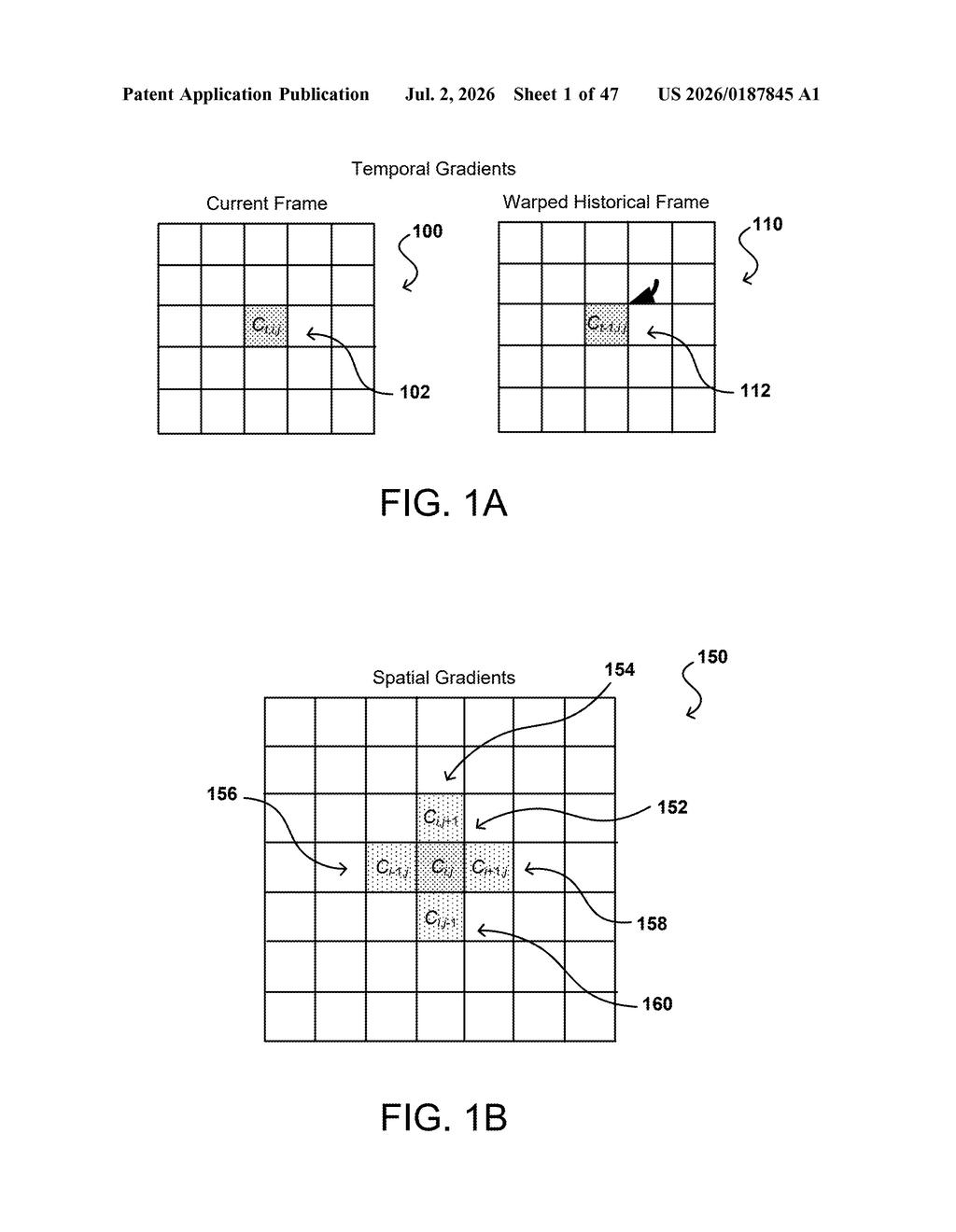
What Nvidia is patenting here is a smarter guessing system powered by a neural network. Instead of using simple math to fill in missing pixels, the system looks at how colors are changing across neighboring pixels (spatial variation) and across recent frames (temporal variation), then uses that pattern to reconstruct what the missing color should be.
This is the kind of technology that sits under the hood of features like DLSS, Nvidia's upscaling system. A patent like this suggests the company is continuing to push that neural-network-based image reconstruction further, making the fill-in logic more context-aware.
How the neural network reads spatial and temporal pixel shifts
The patent describes a processor containing circuits that run one or more neural networks. Those networks take a pixel's current color (called the "first color") and analyze how that color varies across nearby pixels in the same frame (spatial variation) and across previous frames (temporal variation). From that analysis, the system determines a corrected or reconstructed color (the "second color").
The core idea is that a pixel's true color isn't just its raw computed value. It's also shaped by context: what the pixels around it look like, and what the same pixel looked like a moment ago. Neural networks are well-suited to learning those relationships from training data, rather than relying on hand-coded rules.
- Spatial blending: the network checks how color shifts across neighboring pixels in the current frame to smooth or correct edges
- Temporal blending: the network checks how the same pixel's color has changed across recent frames to reduce flicker and instability
- Combined output: the reconstructed "second color" replaces or refines the original computed value
The patent's first claim focuses specifically on the spatial side, while the broader description covers both spatial and temporal processing together.
What this means for real-time rendering and gaming GPUs
For anyone who plays PC games or uses GPU-accelerated creative tools, this kind of technology directly affects how sharp and stable the image looks, especially in motion. Neural-network-based reconstruction lets a GPU render fewer pixels and then fill in the gaps intelligently, which is how Nvidia's DLSS already boosts frame rates without a proportional hit to visual quality. A patent like this points to continued refinement of that pipeline.
For Nvidia competitively, keeping a strong patent position around neural image reconstruction matters because AMD and Intel both have their own upscaling technologies. Owning more of the core technique space, particularly the approach of using spatial and temporal variation signals together, gives Nvidia leverage in defending DLSS and related products going forward.
This is incremental, not flashy, but it's exactly the kind of patent that matters in practice. Neural-network-based image reconstruction is one of the most user-visible features on a modern GPU, and Nvidia filing explicitly on the spatial-plus-temporal variation approach signals they're treating this as a defensible core asset, not just a product feature. Worth watching if you follow the GPU upscaling wars.
Get our take in your Top Stories
Liked this breakdown? Add Patentlyze as a preferred source on Google, and our plain-English take shows up more often in your Top Stories the next time Nvidia patent news breaks.
There are more where this came from
We read every patent application Big Tech publishes and send you the ones worth knowing. Plain English, free, every week.
Want this weekly breakdown for a company we don't cover? Patentlyze Pro →