
Nvidia Patents a Multi-Pass System for Cleaning Up Color Artifacts in Streamed Images
When video is compressed and streamed, some pixels end up the wrong color. Nvidia's new patent describes a layered process that finds those bad pixels and replaces them with values that look right, without accidentally smoothing over real edges in the image.
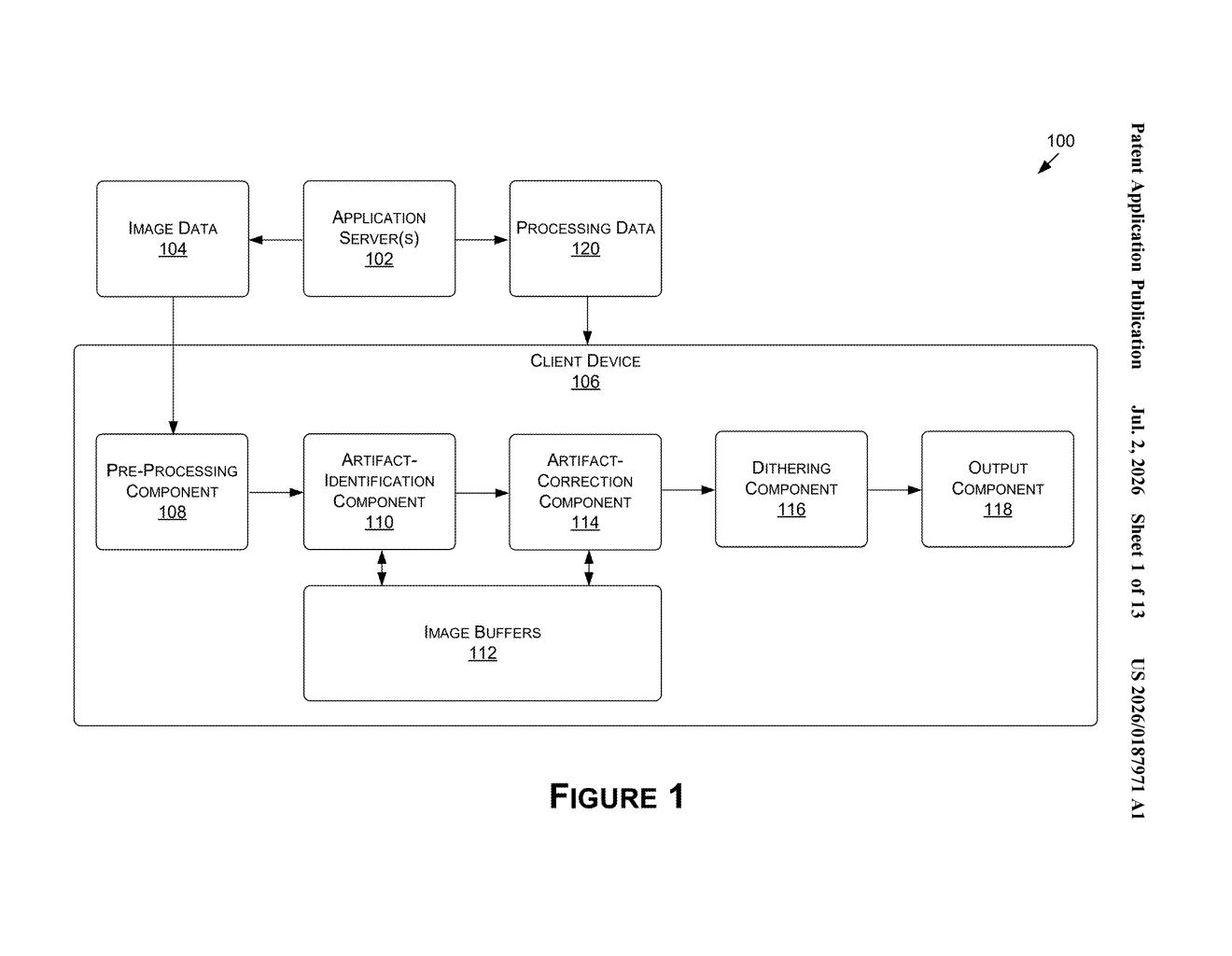
What Nvidia's artifact-removal pipeline actually does
Imagine watching a show on a slow internet connection and noticing a patch of the image looks slightly off, maybe a gradient that has visible banding, or a patch of skin tone that looks like a faint grid pattern. That kind of glitch is called an artifact, and it shows up a lot when images are compressed and sent over a network.
Nvidia's patent describes a system that automatically hunts for those bad patches in a streamed image. It runs the image through several analysis steps to figure out which areas have real color detail (like the sharp edge of a door frame) and which areas are just compression noise. It treats those two types of areas differently so it doesn't accidentally blur real detail while trying to fix the noise.
Once it knows where the problem pixels are, it works backward through its own analysis to calculate better color values for each one. It can then use a technique called dithering, which spreads tiny color errors across neighboring pixels so your eye blends them into a smooth result instead of seeing a visible pattern.
How the forward and backward passes fix bad pixels
The system runs the incoming image through a series of forward passes, each one generating a simplified version of the image at a different level of detail. By comparing these levels, it can distinguish between two things that look similar in a compressed image: a true color edge (where two genuinely different colors meet) and an artifact (where compression has introduced a false color pattern).
Once those areas are labeled, the system runs a series of backward passes, working from the most simplified level back to the original. At each step, it recalculates the color values for artifact-affected pixels using the color information from the level above. This layered correction means the fix is informed by both local pixel data and broader context from the image.
Finally, the corrected pixel values can go through dithering, a classic technique where tiny rounding errors in color are distributed across nearby pixels rather than concentrated in one spot. The result looks smoother to the human eye because vision naturally averages neighboring pixels together.
- Forward passes: build a multi-level map of the image to locate artifacts
- Backward passes: recalculate correct color values working from coarse to fine
- Dithering: spreads residual color error so it becomes invisible
What this means for game streaming and remote graphics
This kind of pipeline is most useful in cloud gaming and remote desktop streaming, where images are compressed hard before being sent to your device. Artifacts are a persistent complaint in those services, and fixing them on the receiving end without blurring real image detail is genuinely difficult.
For Nvidia, which runs the GeForce NOW cloud gaming service and sells GPUs used in data-center streaming setups, having a patented artifact-removal method baked into its processing stack would give it a quality argument over competitors. If this lands in a driver or streaming codec update, you might notice cleaner gradients and skin tones in streamed games without any change to your internet speed.
This is a solid, specific patent that addresses a real problem anyone who has used GeForce NOW or a remote desktop has noticed. The multi-pass forward-backward architecture is a reasonable engineering approach, not just a vague idea. Whether it ships in a meaningful form depends on whether the performance cost fits inside the tight latency budgets of live game streaming.
Get our take in your Top Stories
Liked this breakdown? Add Patentlyze as a preferred source on Google, and our plain-English take shows up more often in your Top Stories the next time Nvidia patent news breaks.
There are more where this came from
We read every patent application Big Tech publishes and send you the ones worth knowing. Plain English, free, every week.
Want this weekly breakdown for a company we don't cover? Patentlyze Pro →