
Nvidia Patents Software That Reads an Image's Shape and Meaning at Once
Most computer vision systems treat 'what something looks like' and 'what it is' as separate problems. Nvidia is filing a patent for a system that handles both at the same time, in a single pass.
What Nvidia's unified image-reading system actually does
Imagine you're trying to teach a robot to recognize a coffee mug on a cluttered desk. There are really two separate questions involved: where is the mug in space (its shape, edges, depth) and what kind of thing is it (a mug, not a jar). Most AI vision systems answer those questions separately, which takes more time and can cause errors when the two answers don't agree.
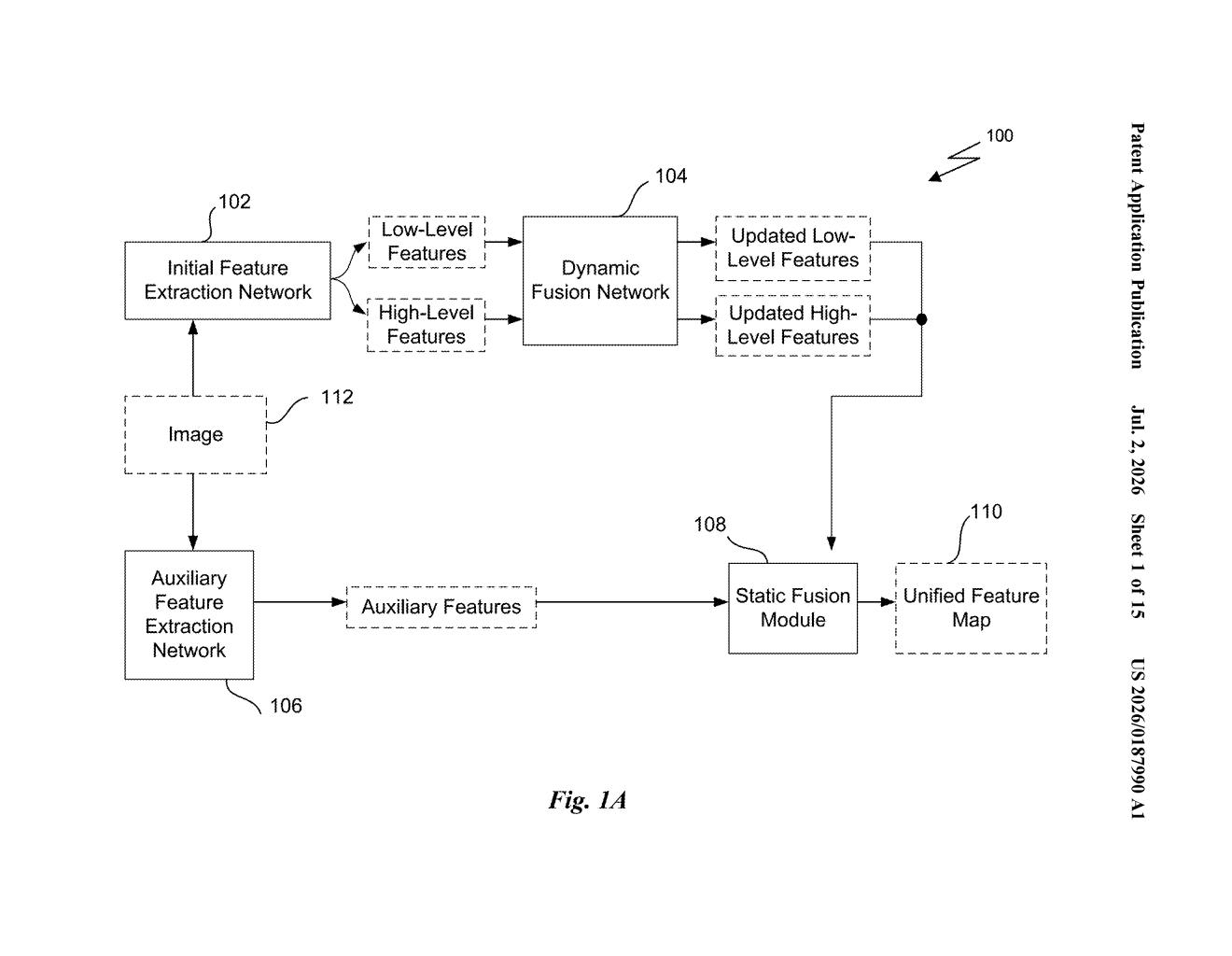
Nvidia's patent describes a neural network that extracts both types of information from the same image and then blends them together into a single, combined picture of what the camera sees. That combined output, called a unified feature map, captures both the geometry and the meaning of the scene at once.
The practical targets are things like 3D reconstruction (building a digital model of a room from photos), object tracking (following a person across video frames), and image retrieval (finding photos that contain similar objects). By combining feature types up front, the system aims to be more accurate and more general-purpose than today's specialized pipelines.
How the encoder and fusion network build the combined map
The patent describes a two-stage neural network architecture. In the first stage, at least one encoder processes an input image and produces two separate initial feature representations. Think of these as two rough sketches of the same image: one focused on geometry (edges, depth cues, spatial layout) and one focused on semantics (object categories, textures, meaning).
In the second stage, a fusion network takes those two rough sketches and refines them together, producing an updated version of each. The key word in the patent is dynamic fusion, meaning the blending weights are not fixed ahead of time but are calculated on the fly based on the content of the specific image being processed.
The output is a unified feature map that encodes geometric and semantic correspondences simultaneously. A "correspondence" in computer vision means: this patch in image A matches that patch in image B. Getting those correspondences right is the core challenge in tasks like:
- 3D scene reconstruction from multiple photos
- Tracking an object across video frames
- Retrieving visually similar images from a large database
The system stores its learned parameters in memory and runs inference on one or more processors, which is consistent with deployment on Nvidia's own GPU hardware.
What this means for robotics, AR, and 3D reconstruction
Computer vision pipelines today often chain together multiple specialized models, one for geometry, one for object recognition, one for matching. Each handoff is a potential point of failure, and running several networks sequentially is expensive. A single network that produces a joint representation could reduce both the engineering complexity and the compute cost of these systems.
For Nvidia, this fits squarely into its push to supply the AI infrastructure for robotics and autonomous systems, markets it is betting heavily on. A more general-purpose feature extractor could slot into Isaac (Nvidia's robotics platform) or any number of third-party vision applications that run on Nvidia hardware. Whether this specific approach ships in a product or stays as foundational research, it signals where the company's computer vision team is directing its energy.
This is solid, credible research-lab work, not a consumer-facing trick. The 'dynamic fusion' framing is genuinely interesting because fixed-weight feature blending is a known limitation of current architectures. Whether this patent represents a real step forward or a marginal improvement over existing multi-head encoders is something only a reproducible benchmark can answer, but the direction is sensible.
There are more where this came from
We read every patent application Big Tech publishes and send you the ones worth knowing. Plain English, free, every week.
Want this weekly breakdown for a company we don't cover? Patentlyze Pro →