
Samsung's New Patent Puts AI Inference Inside the Storage Drive Itself
What if your storage drive didn't just hold your data, but answered questions about it? Samsung's new patent describes a system where AI inference happens inside the drive itself, cutting out the expensive round-trip to a central processor.
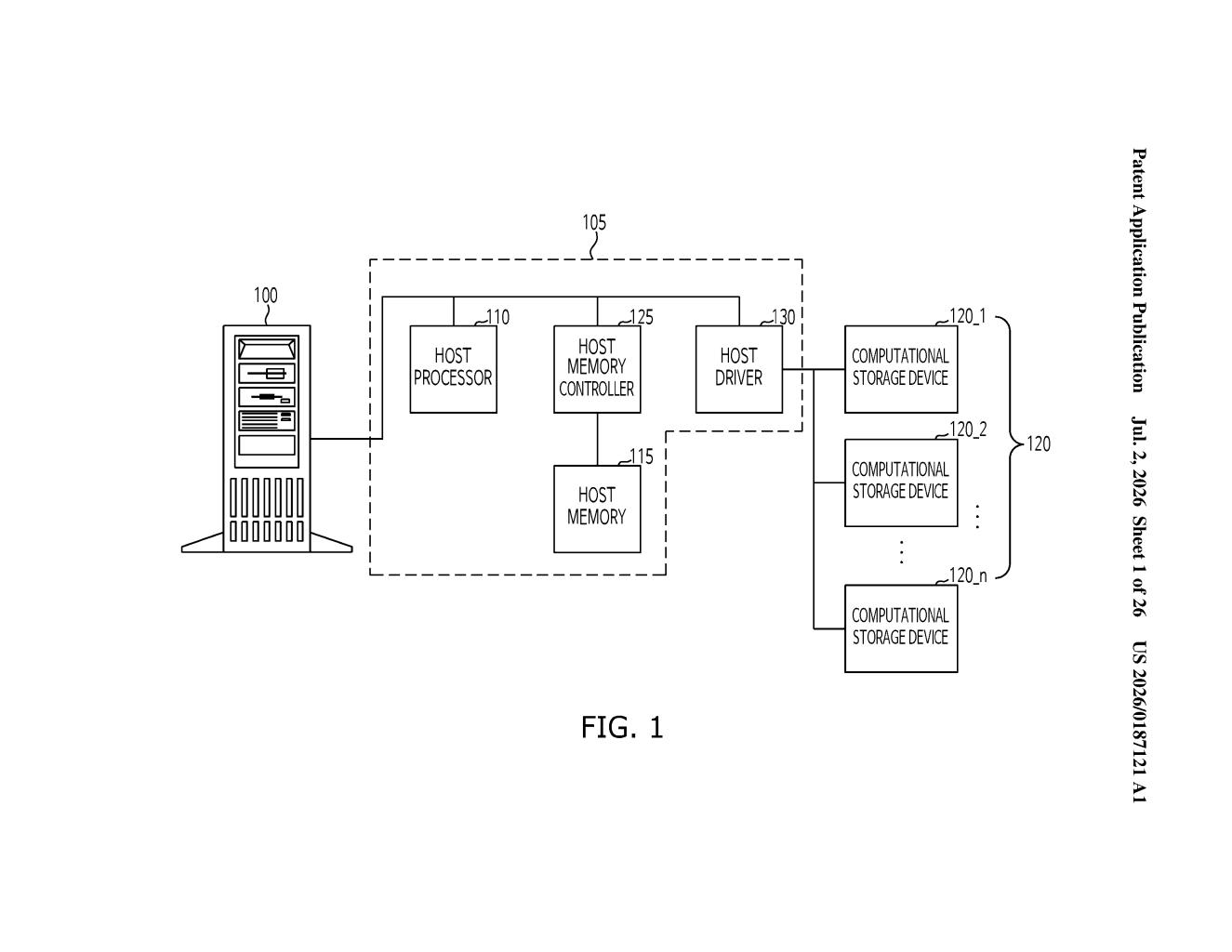
How Samsung wants AI answers to come from the drive, not the CPU
Imagine asking an AI assistant a question, and instead of shipping your entire filing cabinet to a librarian across town, the filing cabinet itself reads your question and hands you the answer. That's roughly the idea here.
Samsung's patent describes a setup where a large collection of documents or data gets split into chunks and stored across multiple special drives. Before any data is stored, a host computer figures out which chunks are topically similar to each other and groups them onto the same drive. That way, when a question comes in, the right drive already has everything it needs to answer.
The key twist is that each drive has its own processor, so it can run an AI inference step locally, without waiting for a central chip to pull all the data back first. You get faster answers and less traffic clogging the connection between storage and the main computer.
How the host sorts data across drives before inference runs
The patent describes a computational storage system, a category of hardware where processing power is embedded directly in storage devices rather than kept separate.
Here's the sequence the system follows:
- A host processor takes a large corpus (think: a company's document library, or a knowledge base) and breaks it into subsets.
- It then generates embedding vectors for each subset. An embedding vector is a list of numbers that captures the meaning of a chunk of text, so that topically similar chunks produce similar numbers.
- By measuring the distances between those vectors (closer distance means more related content), the host assigns each subset to a specific drive, grouping related material together.
- When a user query arrives, the relevant computational storage device runs an inference operation locally, using only the subset it was assigned, and returns a response.
This architecture is closely related to retrieval-augmented generation (RAG), the technique many AI systems use to answer questions by looking things up rather than relying purely on memorized training data. Here, the retrieval and the generation step both happen inside the drive.
What this means for AI servers and data-center storage costs
The biggest bottleneck in large AI deployments is often not the AI model itself but the constant movement of data between storage and compute. Every time a system needs to answer a question, it typically reads gigabytes of context from disk, shuttles it to a GPU or CPU, and then runs the model. Samsung's approach pushes the inference step to where the data already lives, which could mean faster responses and lower energy use at scale.
For enterprise AI servers and data centers, this kind of architecture could reduce the number of expensive GPUs needed for certain workloads. It also maps neatly onto Samsung's core business: the company makes both the storage drives and the memory chips that would power such a system, giving it a strong incentive to develop and sell the complete stack.
This is a real architectural bet, not a speculative curiosity. Computational storage has been a research topic for years, but pairing it explicitly with RAG-style AI inference is a concrete and timely application. Samsung is positioning itself to sell the entire hardware stack for on-device enterprise AI, and this patent sketches out exactly how that stack would work.
Get our take in your Top Stories
Liked this breakdown? Add Patentlyze as a preferred source on Google, and our plain-English take shows up more often in your Top Stories the next time Samsung patent news breaks.
There are more where this came from
We read every patent application Big Tech publishes and send you the ones worth knowing. Plain English, free, every week.
Want this weekly breakdown for a company we don't cover? Patentlyze Pro →