
Intel Patents Encryption That Blocks Unauthorized Programs From Reading Your Memory
Intel is patenting a technique that smuggles access-control information inside encrypted memory blocks, so a chip can verify who wrote a piece of data without needing a separate security ledger to check against.
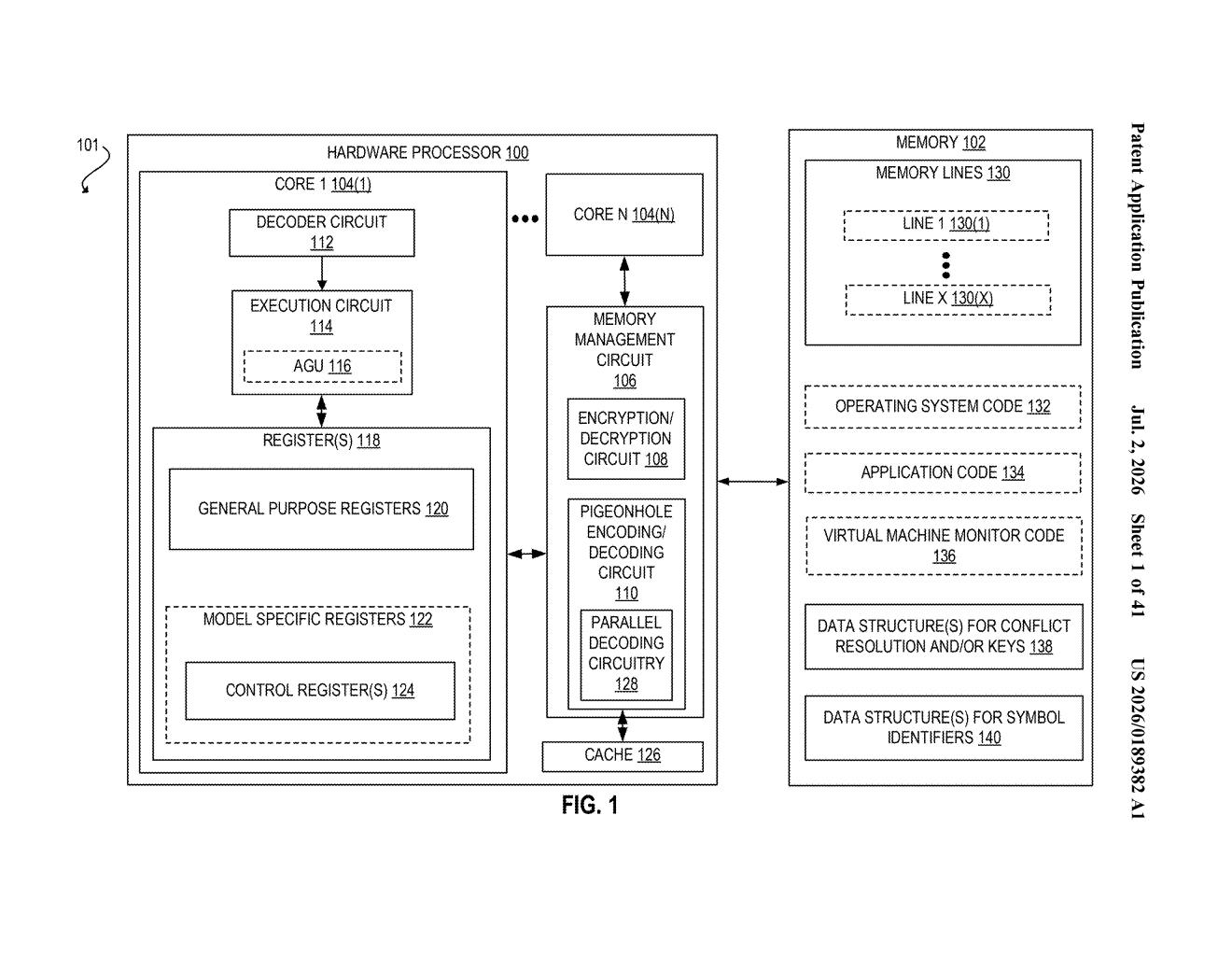
What Intel's pigeonhole memory security actually does
Imagine your computer's memory as a series of locked safe-deposit boxes. Normally, to check whether you're allowed to open a specific box, the bank needs to consult a separate logbook. Intel's idea is to hide that permission slip inside the box itself, encrypted along with the actual contents, so the check happens automatically when the lock is opened.
When your processor asks to read a chunk of memory, Intel's circuit decrypts the data and pulls out two hidden pieces: a tiny symbol (think of it as a secret stamp) and instructions for where that symbol belongs in the original data. The circuit reconstructs the full, correct data and uses the symbol to confirm who originally wrote it, all in one step.
The payoff is that the chip doesn't need to keep a running list of every memory transaction to catch tampering or unauthorized access. The proof is baked right into the encrypted data itself, which keeps things fast and avoids the overhead of maintaining a separate security table.
How the pigeonhole encoding and decoding circuit works
The patent describes a memory management circuit that performs what Intel calls pigeonhole encoding and decoding, a technique borrowed from a mathematical concept where more items than slots forces at least one slot to hold multiple items.
Here's the flow on a memory read (load):
- The processor requests a line of memory (a fixed-size chunk, typically 64 bytes on modern systems).
- The circuit decrypts the line to produce an intermediate plaintext.
- It reads two hidden fields from that plaintext: a symbol identification value (a tag indicating which redundant symbol was chosen) and a locator value (where that symbol belongs in the real data).
- It reconstructs the correct symbol and inserts it back into the data at the right position, producing the final, usable plaintext that gets handed to the processor.
The clever part is that when data is written to memory, the encoding step has a choice of which redundant symbol to embed. That choice is tied to the identity of the writer. On a subsequent read, if the recovered symbol doesn't match the expected identity, the circuit knows something is wrong, either the data was tampered with or it was written by an unauthorized party.
This approach is called stateless because the circuit doesn't need to maintain a separate running log (state) of past memory transactions to catch replay attacks (where an attacker re-feeds old, valid-looking data to fool a system).
What this means for hardware-level memory protection
Memory security is one of the harder problems in modern chip design. Approaches that rely on external tables or counters add latency and eat up chip area, and they can become bottlenecks in high-throughput workloads. A scheme that folds the integrity check directly into the encrypted data itself removes that bottleneck.
For confidential computing, where code runs in isolated, hardware-protected regions (Intel already ships this concept in its SGX and TDX technologies), this kind of stateless protection matters a lot. If this technique ships in future Intel silicon, it could make protected memory regions faster and harder to attack without requiring larger on-chip security structures.
This is deep plumbing work, not a consumer feature, but it addresses a real architectural pain point in confidential computing. Intel has been building out hardware memory protection for years, and a stateless, encoding-based approach would be a meaningful efficiency improvement over counter-based schemes. Worth tracking if you follow silicon security.
Get our take in your Top Stories
Liked this breakdown? Add Patentlyze as a preferred source on Google, and our plain-English take shows up more often in your Top Stories the next time Intel patent news breaks.
There are more where this came from
We read every patent application Big Tech publishes and send you the ones worth knowing. Plain English, free, every week.
Want this weekly breakdown for a company we don't cover? Patentlyze Pro →