
Intel Patents a CPU Trick That Skips Instructions It Already Knows the Answer To
Intel has filed a patent for a processor technique that spots when a chunk of a program loop produces the same result every time it runs, then simply stops running those instructions again and reuses the answer it already has.
How Intel's loop-skipping trick saves your CPU work
Imagine your oven timer counts down the same 20 minutes every time you bake the same recipe. A smart kitchen assistant wouldn't re-read the recipe every single time; it would remember that the answer is always 20 minutes and just reuse it. Intel's patent applies the same idea to your computer's processor.
Loops are one of the most common patterns in software: a program repeating the same set of steps over and over, perhaps processing every item in a list. Often, a few of those steps produce exactly the same result every single time through the loop because they depend on data that never changes. Right now, most processors run those steps anyway, wasting effort and energy.
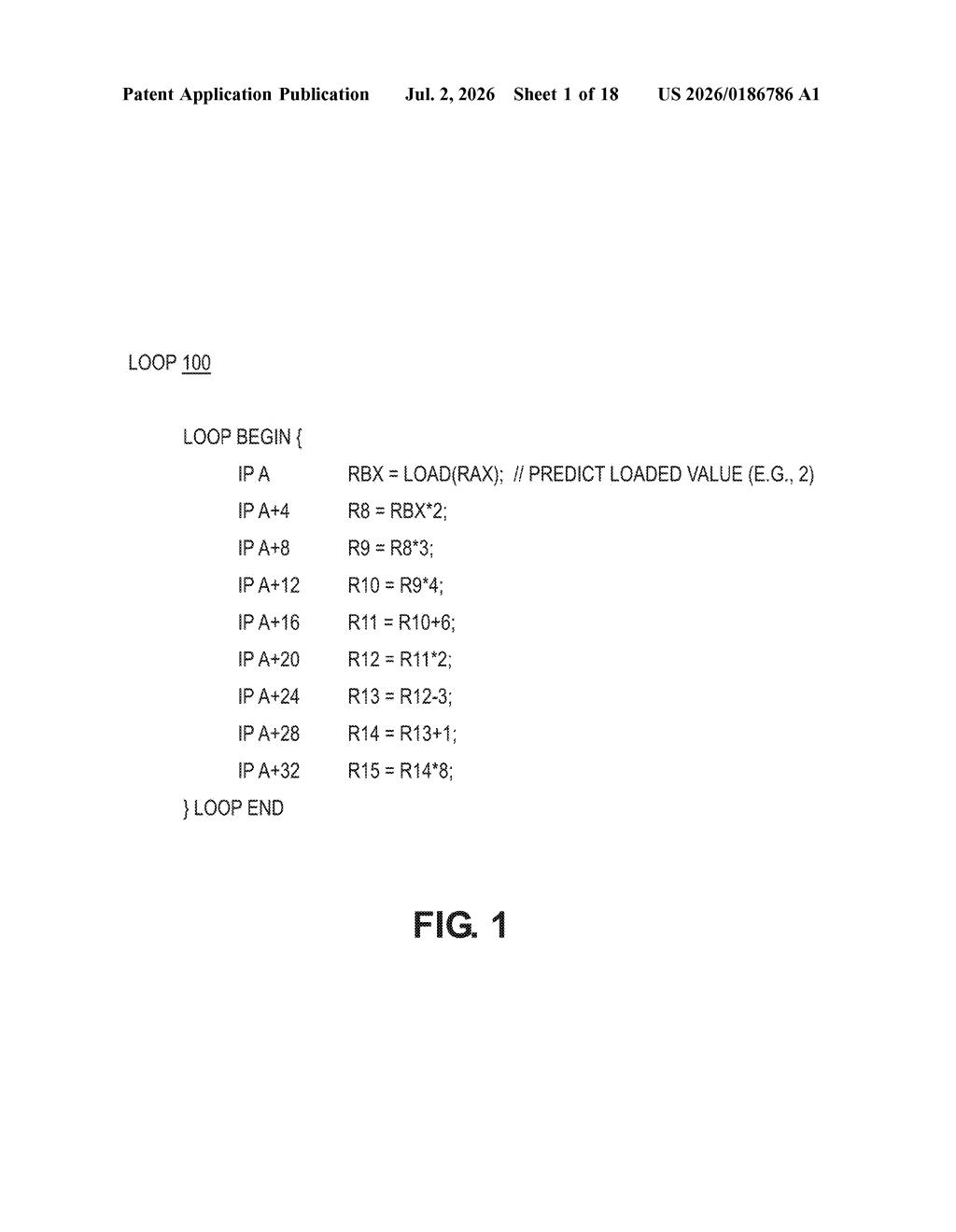
Intel's approach lets the chip predict what value a memory-reading step will produce, run the dependent instructions once to see what comes out, and then, for every later pass through the loop, skip re-running those instructions entirely and just deliver the already-known result. Less work, same output.
How the processor predicts, caches, and replays loop results
The patent describes a processor-level optimization that targets a specific pattern inside software loops. Here is how it breaks down:
- Value prediction on a load instruction: The chip predicts what value a "load" instruction (one that fetches data from memory) will return. Load-value prediction is an established research technique where the processor makes an educated guess about a memory result before the data has actually arrived.
- One-time execution of dependent instructions: On the first pass through the loop, the processor runs all the instructions that follow that load and whose outputs depend only on that predicted value, fixed constants, or combinations of the two. Critically, nothing variable from outside sneaks in.
- Result caching and replay: Because those downstream results are functionally constant (the inputs that drive them never change across loop iterations), the processor stores the results and, on every subsequent pass through the loop, produces those results without re-executing the instructions.
The key insight is that the processor is essentially identifying a sub-graph of instructions whose outputs are deterministic given a stable input, then hoisting that computation out of the loop at the hardware level, something compilers sometimes do in software but can miss when the relevant data is only known at runtime.
What this means for CPU performance in everyday software
For end users, faster loops mean faster everything: video encoding, gaming physics, database queries, scientific simulations, and machine-learning inference all spend enormous time inside tight loops. If Intel's hardware can automatically prune away constant-result instructions without requiring software changes, existing programs could get faster on future chips without a single recompile.
For Intel specifically, this fits a broader competitive push around instruction-level parallelism and efficiency. Doing less work per clock cycle while delivering the same output is one of the cleaner ways to improve performance-per-watt, which matters as much in laptop chips and data-center processors as it does in raw speed benchmarks. Whether this technique ships in a near-term product or stays a research concept is unknown, but it sits squarely in Intel's core architecture work.
This is genuinely interesting microarchitecture research, not a flashy consumer feature. The hard part isn't the idea (compiler engineers have done software versions of this for decades) but doing it reliably in hardware where the processor must verify its predictions and handle mismatches safely. If Intel can make the prediction accuracy high enough that the overhead of verifying it doesn't eat the savings, this could be a real, measurable win on workloads that matter.
Get our take in your Top Stories
Liked this breakdown? Add Patentlyze as a preferred source on Google, and our plain-English take shows up more often in your Top Stories the next time Intel patent news breaks.
There are more where this came from
We read every patent application Big Tech publishes and send you the ones worth knowing. Plain English, free, every week.
Want this weekly breakdown for a company we don't cover? Patentlyze Pro →