
Apple Patents a System That Sends Inflated Buffer Reports to Cell Towers for Faster Speeds
Apple is patenting a technique that tells cell towers your phone has more data to send than it actually does — a deliberate overstatement designed to unlock faster uplink speeds before your data even arrives.
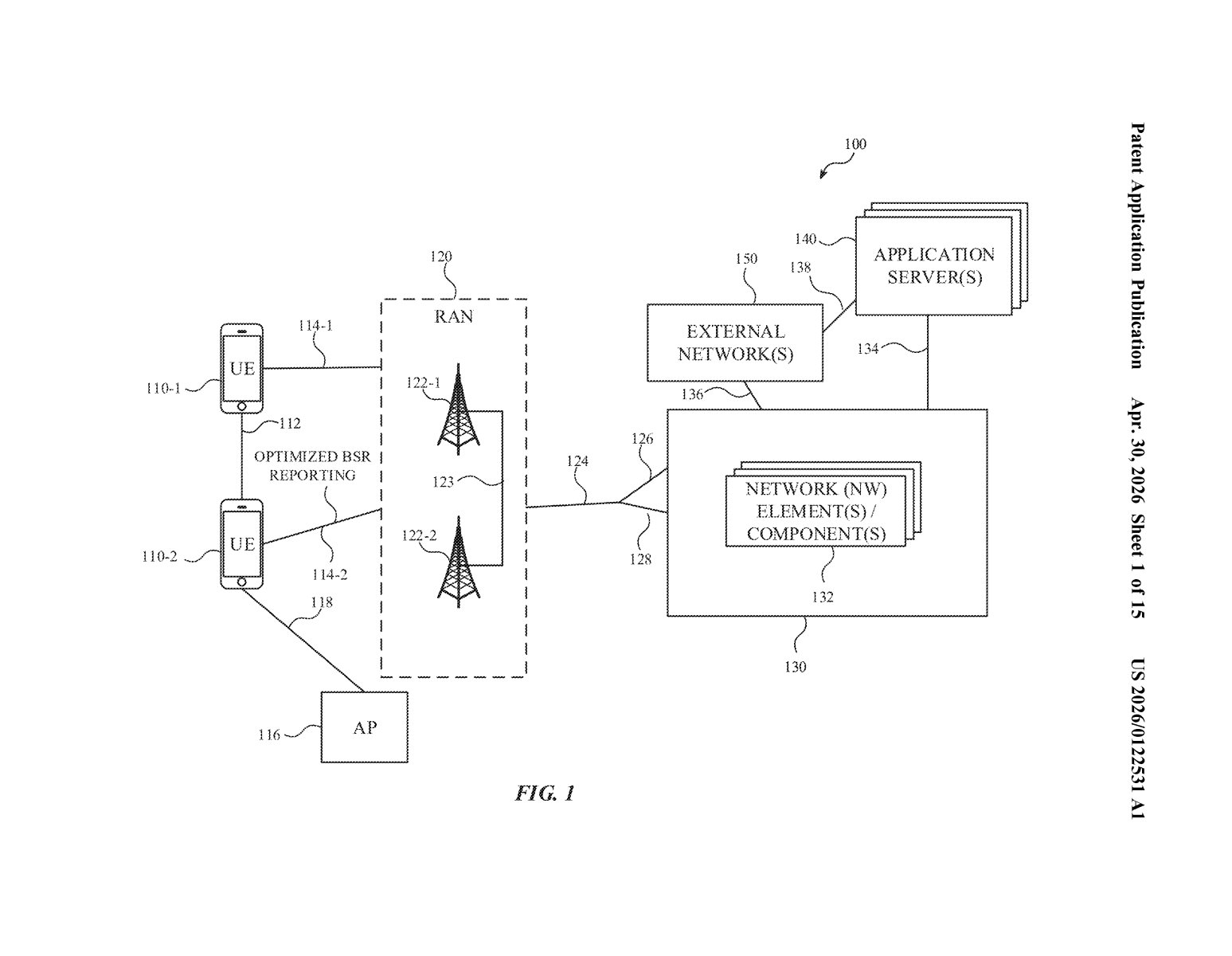
What Apple's 'inflated BSR' trick actually does for your iPhone
Imagine you're at an airport check-in and you tell the agent your bag is slightly heavier than it is, just to get bumped to a faster conveyor belt. Apple's new patent does something similar — but for your phone's connection to a cell tower.
When your iPhone wants to send data (uploading a video, making a FaceTime call, syncing files), it first tells the cell tower how much data it has queued up. The tower uses that number to decide how much airtime to give your device. Apple's patent describes a method where the phone reports a slightly higher number than it actually has — nudging the tower into granting more upload capacity, before the data even finishes arriving at the baseband chip.
The goal isn't to lie for the sake of it. The patent also describes smarter ways to estimate when data will arrive, report delays, and manage retransmission timers — all to smooth out the timing mismatch between when data lands in the baseband queue and when the tower needs to know about it.
How Apple's UE bumps the BSR index before transmission
The patent centers on a concept called the Buffer Status Report (BSR) — a small control message a phone sends to a cell tower to say "here's how much data I need to upload." The tower uses BSRs to schedule uplink time slots across all connected devices. If your BSR is too low, the tower underallocates bandwidth; if it's accurate, things work smoothly — in theory.
The problem is timing. Baseband queues (the chip-level buffers that hold data waiting to be transmitted over the radio) can be nearly empty at the exact moment a BSR snapshot is taken, even if more data is about to arrive milliseconds later. This creates "shallow queue" conditions where the tower under-schedules the device.
Apple's fix, as described in the first independent claim, works like this:
- The device measures how much data is actually in its baseband queue.
- It looks up the corresponding BSR index value — a standardized number that maps to a range of data sizes.
- It then deliberately reports the next higher BSR index, telling the tower it has more data than currently queued.
- The tower, seeing a larger buffer, grants more uplink resources — resources the device can use as the remaining data arrives.
The patent also covers related mechanisms: Delay Status Reports (DSR) to signal how long data has been waiting, estimating future packet arrival times, and modified retransmission timers to avoid the phone repeatedly asking for slots it doesn't immediately need.
What this means for 5G scheduling and iPhone data speeds
For everyday users, this is about faster, snappier uplink performance — particularly in real-time applications like FaceTime, live streaming, or cloud backups on 5G. The BSR mismatch problem is a known pain point in LTE and 5G uplink scheduling, and fixing it at the device level means Apple doesn't need to wait for carriers or standards bodies to act.
For Apple's competitive positioning, it's a reminder that a huge slice of modem performance comes from protocol-layer cleverness, not just raw silicon. As Apple deepens its in-house modem work (the C1 chip), patents like this one show the company is building institutional knowledge around exactly these kinds of scheduling optimizations — the details that separate a good modem from a great one.
This is genuinely clever — Apple is essentially teaching its devices to game the cell tower's scheduling algorithm in a way that's technically honest (the data really is coming) but strategically optimistic. It's not flashy, but this is exactly the kind of low-level modem intelligence that compounds into noticeable real-world speed improvements. Worth paying attention to as Apple's in-house modem ambitions mature.
There are more where this came from
We read every patent application Big Tech publishes and send you the ones worth knowing. Plain English, free, every week.
Want this weekly breakdown for a company we don't cover? Patentlyze Pro →