
Qualcomm Patents a Dual-Buffer Approach to Compressing 3D Point Cloud Data
Qualcomm is filing patents on a more efficient way to compress 3D point clouds, the dense data format used in LiDAR scanning, augmented reality, and autonomous vehicles, by keeping shape data and color data in separate, independently ordered memory buffers.
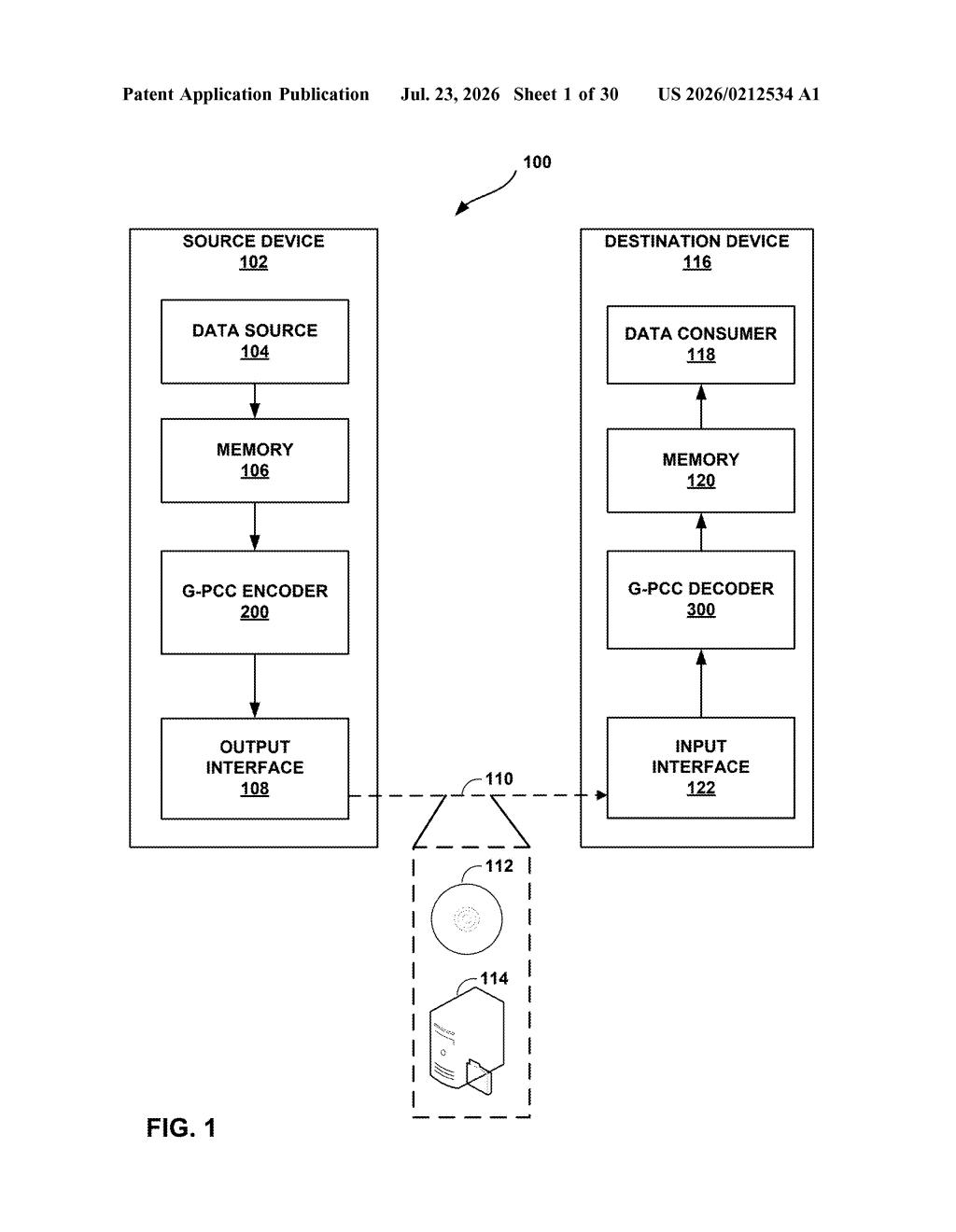
How Qualcomm's split-buffer idea handles 3D scene data
Imagine a 3D scanner capturing a busy street corner, producing millions of tiny data points that together describe where every surface is and what color it is. Sending all of that data in real time is expensive, so devices need to compress it, typically by comparing each new frame to the previous one and only sending what changed.
The problem is that shape information (where things are in 3D space) and color or texture information (what those things look like) have different patterns. Trying to predict both from the same reference list is a compromise that hurts accuracy for each.
Qualcomm's patent describes splitting that reference list into two separate buffers, one optimized for predicting shape and one optimized for predicting color. Your device would use whichever list makes the most sense for each piece of data, then combine the results into a clean final frame.
How the geometry and attribute buffers stay in sync
Point cloud compression works by inter prediction (borrowing from video compression), which means a decoder looks at a previously decoded frame and uses it to predict what the next frame probably looks like. The difference between the prediction and reality is all that needs to be transmitted, keeping file sizes small.
The standard approach keeps one unified list of reference points from the prior frame. Qualcomm's patent describes generating two separate buffers from the same decoded frame:
- Geometry reference buffer: Points are ordered in a way that best predicts 3D position (x, y, z coordinates) in the next frame.
- Attribute reference buffer: The same points are re-ordered differently, in a way that best predicts color, reflectance, or other surface properties.
The decoder then pulls from whichever buffer is appropriate when making each prediction, combines the predicted geometry value and the predicted attribute value, and reconstructs the final frame. The ordering difference is the key insight: what counts as the "nearest" reference point for shape is not necessarily the best neighbor for color.
What this means for streaming 3D environments
Point cloud data is the backbone of LiDAR systems in autonomous cars, spatial computing headsets, and industrial 3D scanning. As these use cases grow, so does the pressure to compress that data without losing fidelity. A compression scheme that handles shape and color with separate, purpose-built reference lists could recover quality that a one-size-fits-all buffer leaves on the table.
For Qualcomm specifically, this lands squarely in its XR (extended reality) and automotive chip strategy. More efficient point cloud compression means lower bandwidth demands and less processing overhead, both of which matter enormously when you're running spatial perception software on a mobile chip inside a headset or a car.
This is quiet, foundational compression work rather than a flashy product announcement. The concept is logical and the potential gain is real, but the patent covers a fairly narrow architectural choice inside a codec pipeline. Whether it translates to a measurable improvement in practice depends on implementation details not disclosed here.
Which company should we read for you?
We track 17 companies here. Pro is the same weekly breakdown for any company you choose, delivered privately. Type a name and we'll scope it and send you a quote.
Get one Big Tech patent every Sunday
Plain English, intelligent commentary, no hype. Free.
Editorial commentary on a publicly published patent application. Not legal advice.