
Google Patent Reveals Masked Token Prediction for Faster Text-to-Image AI
Google has patented an approach to AI image generation that produces pictures from text prompts without the slow, step-by-step process that makes tools like DALL-E 2 feel sluggish. The trick is teaching the model to fill in blanks rather than draw from scratch.
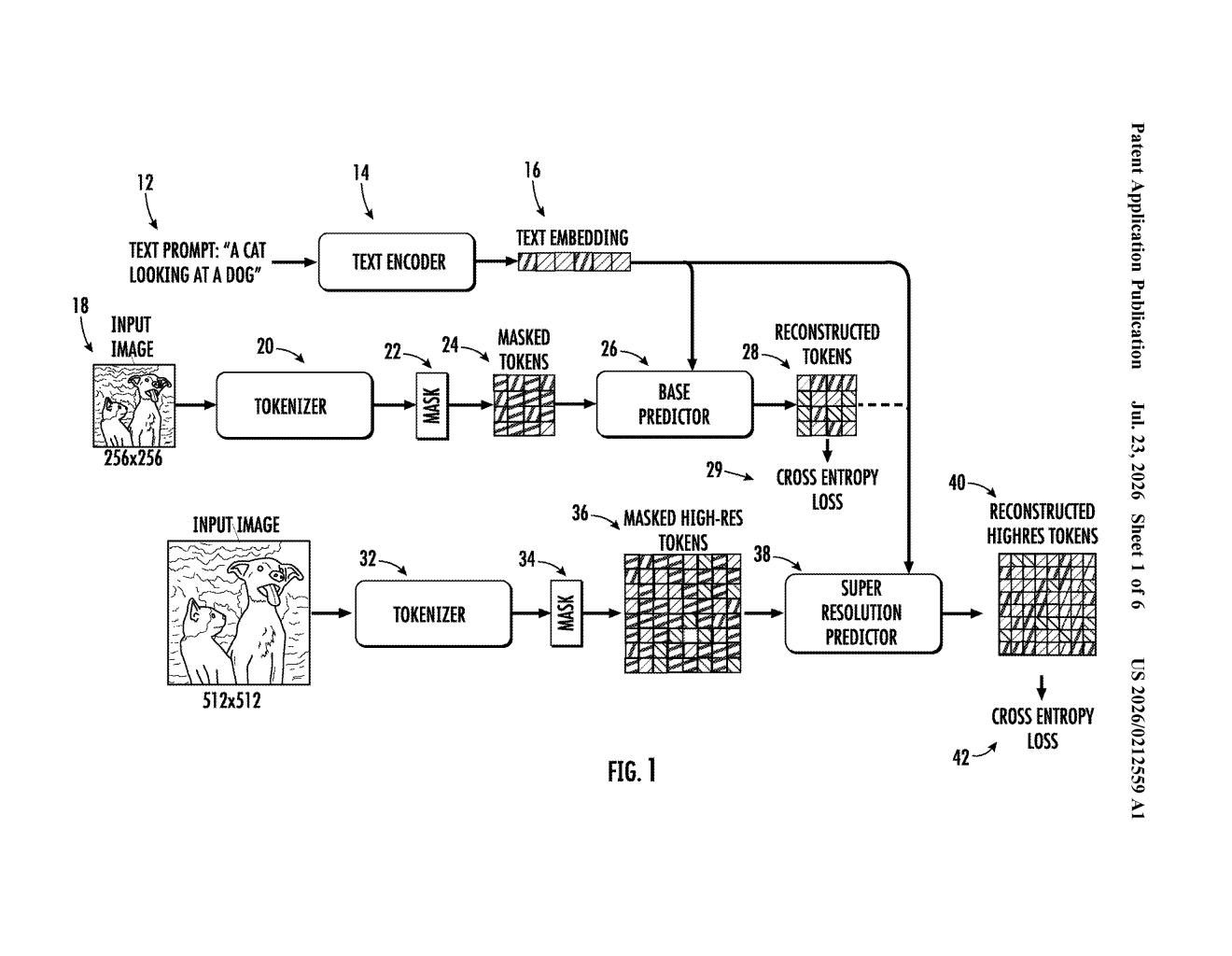
How Google's masked image model turns words into pictures
Imagine doing a crossword puzzle where you can fill in all the answers at the same time instead of one clue at a time. That's roughly what Google's system does when it turns a text description into an image.
Most popular AI image generators work like digital darkroom developers, gradually layering detail onto a picture through dozens or hundreds of passes. Google's patented approach instead converts images into compact coded "tokens" (think of them like puzzle pieces), hides some of them, and trains an AI to guess the missing ones all at once. Type "a red panda sitting in a snowy tree" and the model predicts the whole picture in far fewer steps.
The system also uses a large language model, the same kind of technology behind chatbots, to understand exactly what your words mean, including object positions, counts, and poses. That helps the final image actually match what you asked for, not just a vague approximation.
How token masking and parallel decoding speed up image generation
The patent describes a three-stage pipeline for generating images from text:
- Text embedding: A pre-trained large language model (LLM) converts your text prompt into a numerical representation that captures meaning, relationships between objects, quantities, and spatial cues.
- Base token prediction: A transformer model (the same family of AI architecture used in GPT-style chatbots) takes that text embedding and predicts a set of latent visual tokens at a low resolution. "Latent tokens" are compact, abstract codes for image regions, not actual pixels.
- Super-resolution token prediction: A second model takes those low-resolution tokens and generates a higher-resolution token set, adding fine detail.
- Token decoding: A third model converts the final token set into actual pixel output, the finished image.
The key efficiency gain comes from parallel decoding: instead of generating image tokens one at a time left-to-right (as autoregressive models like Parti do) or running many noise-removal passes (as diffusion models like Imagen or DALL-E 2 do), this model predicts multiple tokens simultaneously by learning to fill in randomly masked positions during training. The result is fewer compute steps for a comparable quality image.
What this means for AI image tools competing with DALL-E and Midjourney
For end users, faster generation means shorter wait times and lower server costs, which can translate into cheaper or more accessible AI image tools. Google's filing positions this architecture as more efficient than both diffusion models and autoregressive generators, the two dominant approaches powering most commercial tools today.
Strategically, this patent signals that Google is investing in its own architectural path for image generation, separate from the diffusion approach used in products like Imagen. If the efficiency claims hold up at scale, it could give Google an edge in running image AI on tighter compute budgets, which matters a lot when you're serving millions of queries through consumer products like Search or Workspace.
This is a real architectural bet, not a marginal tweak. Masked token prediction for images is a well-studied research idea (Google's own MaskGIT paper explored it), and this patent appears to productize that direction with a multi-stage pipeline. Whether it beats diffusion models in practice at the quality levels users expect is the open question, but the efficiency argument is credible and worth taking seriously.
Which company should we read for you?
We track 17 companies here. Pro is the same weekly breakdown for any company you choose, delivered privately. Type a name and we'll scope it and send you a quote.
Get one Big Tech patent every Sunday
Plain English, intelligent commentary, no hype. Free.
Editorial commentary on a publicly published patent application. Not legal advice.