
Meta Patent Sends AI Responses From Smart Glasses Directly to Your Wrist
You ask your smart glasses a question out loud, and instead of the answer playing through a tiny speaker for everyone nearby to hear, it shows up on your watch. That's the core idea behind Meta's latest patent filing.
What Meta's glasses-to-watch AI pipeline actually does
Imagine asking your glasses "What's the weather in Paris this weekend?" while you're standing in a crowded coffee shop. Right now, your smart glasses would read the answer out loud through a speaker, which feels awkward and private. Meta's patent describes a different approach: the glasses hear your question, send it to an AI, and then push the AI's response to your smartwatch display instead.
The system treats your glasses and your watch as a team. The glasses do the listening and the AI-querying; the watch does the reading. You get a discreet, visual answer on your wrist without pulling out your phone or broadcasting your business to the room.
This kind of setup matters because it closes one of the obvious gaps in modern AI glasses experience. Speaking to a device is easy; getting a useful, readable answer back in a public space is the hard part. Routing that answer to your wrist is a practical fix.
How the glasses hand off AI responses to the watch display
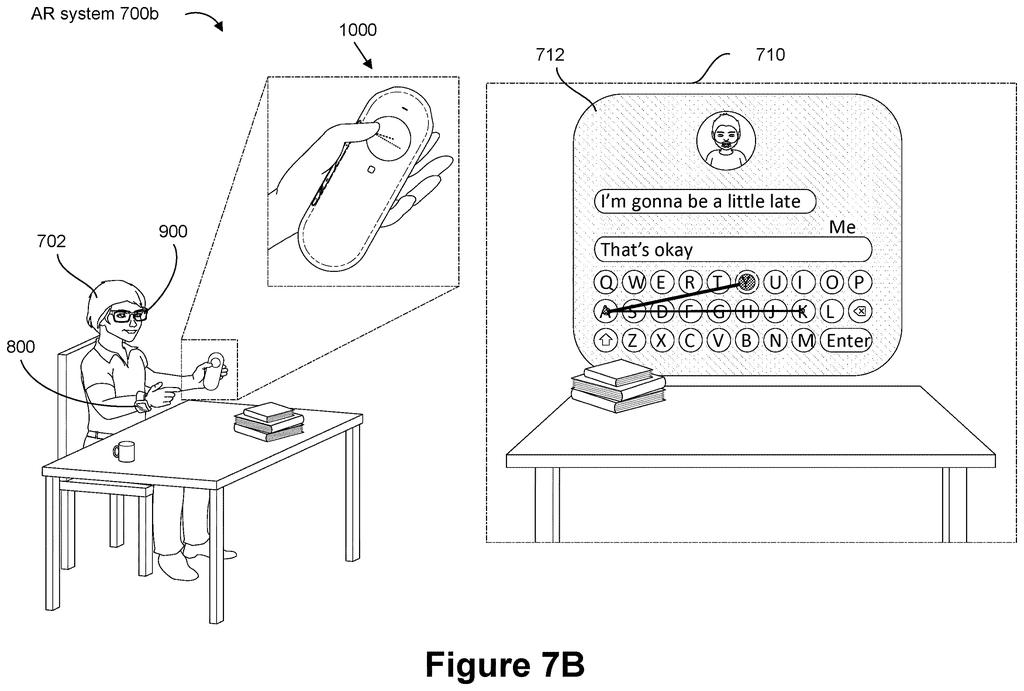
The patent describes a software system that coordinates two wearable devices: a pair of smart glasses and a smartwatch. When a user speaks a voice command directed at an AI model while wearing the glasses, the system kicks off a three-step process.
- Step 1 - Capture: The glasses pick up the voice command from the user.
- Step 2 - Query: The command is sent to an AI model, which generates a response to whatever the user asked.
- Step 3 - Display: A portion of that AI response is sent over to the paired smartwatch and shown on its display.
The key word in the claim is "a portion" of the information. A smartwatch screen is tiny, so the system presumably handles condensing or summarizing the AI's full response into something watch-sized. The patent doesn't specify exactly how that trimming works, but it implies the watch display is treated as a secondary, wrist-based output surface rather than a full interface.
The glasses and watch communicate over a wireless connection (the patent uses the phrase "communicatively coupled"), which in practice likely means Bluetooth.
What this means for Ray-Ban Meta glasses users
Meta already sells the Ray-Ban Meta smart glasses, which have a built-in AI assistant that responds by voice. The obvious limitation is that spoken answers in public are disruptive and expose what you're asking about. A watch-based display channel fixes both problems at once: you keep the hands-free input but get a private, visual output.
For anyone who wears both a Meta-style AI glasses product and a smartwatch, this patent points toward a tighter integration story, where the glasses and watch work as a single unit rather than separate gadgets. It also signals that Meta is thinking about what the output side of AI wearables looks like, not just the input side.
This is a genuinely practical idea, not a moonshot. The problem it solves (AI glasses giving spoken answers in public is awkward) is real and immediately obvious to anyone who has used the Ray-Ban Meta glasses. The solution is straightforward, and that's a point in its favor: simple system patents that fix a clear user experience problem tend to actually show up in products.
There are more where this came from
We read every patent application Big Tech publishes and send you the ones worth knowing. Plain English, free, every week.
The drawings
20 drawing sheets from US 2026/0211486 A1 · click any drawing to enlarge


Want this weekly breakdown for a company we don't cover? Patentlyze Pro →
Be the first to weigh in