
New Lens Material Patent Could Make Smart Glasses Half as Thick
The lenses in AR glasses are thick and heavy because standard plastics don't bend light efficiently enough. Meta is patenting a material that could fix that by packing tiny crystal particles into a polymer base to hit optical performance levels normally reserved for glass.
What Meta's crystal-composite lens material actually does
Imagine wearing a pair of glasses that doubles as a computer screen. The lenses have to do a lot of optical work, which usually means they end up thick, heavy, or both. That's one of the biggest reasons AR glasses still look awkward to wear all day.
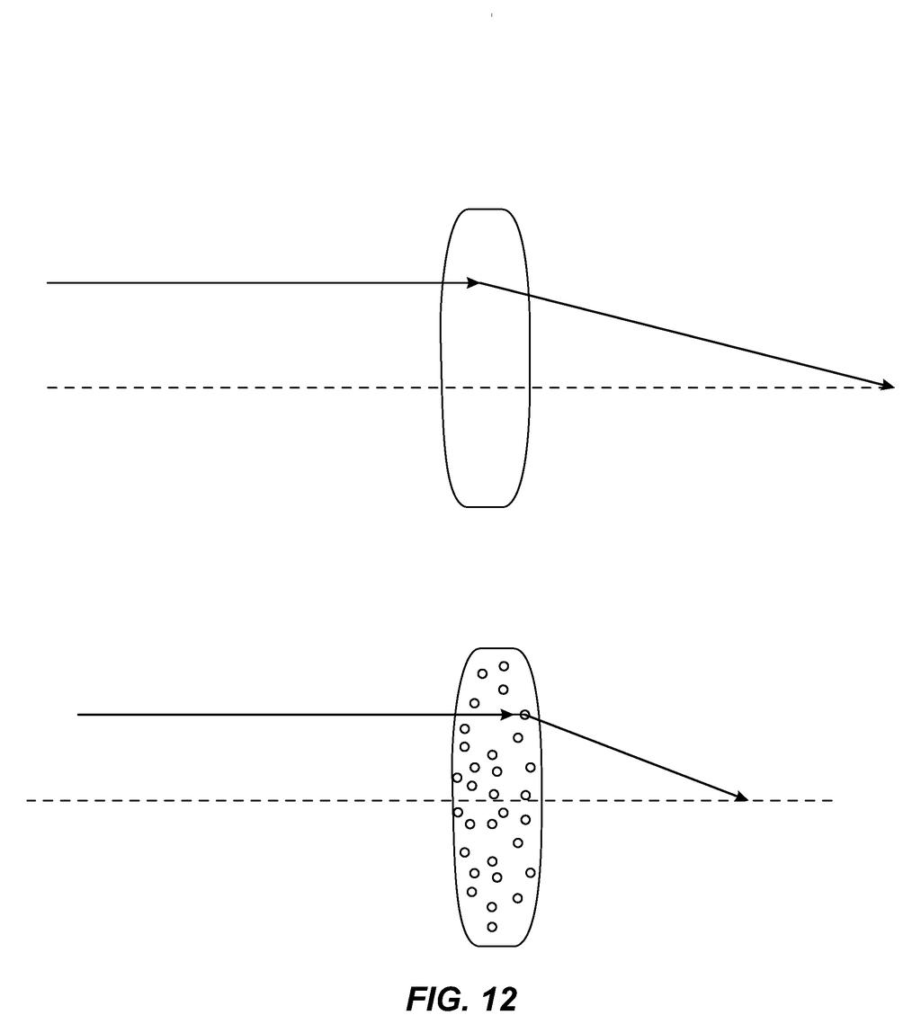
Meta's patent describes a new kind of lens material that tries to solve this. It mixes tiny particles of an organic solid crystal into a plastic base, creating a composite that can bend light far more sharply than regular plastic. The more sharply a material bends light, the thinner you can make the lens while still getting the same optical result.
The target range for this material's light-bending ability (called refractive index) is 1.7 to 2.7, which is higher than standard optical plastic (around 1.5) and closer to dense glass or specialized optical coatings. Hitting that range in a material that can still be molded and shaped like plastic is the core challenge Meta is trying to crack here.
How crystal particles raise the composite's refractive index
The patent claims a composite material built from two components: a polymer matrix (essentially a moldable plastic base) and particles of an organic solid crystal material dispersed throughout it.
The crystal particles make up between 10 and 90 percent of the composite by weight, which is a wide range that gives manufacturing teams flexibility. The key output is a refractive index (a measure of how sharply a material bends light) of 1.7 to 2.7 along at least one direction. For context, standard eyeglass plastic sits around 1.5 to 1.74, and achieving 1.7 or above usually requires heavier glass-based materials or exotic coatings.
Using organic crystal particles (carbon-based, rather than mineral-based) is significant because organic compounds are generally lighter and can be engineered at the molecular level more precisely. The goal appears to be a material that:
- Bends light as aggressively as glass-based optics
- Remains light enough to be worn on a face
- Can still be processed and shaped using standard manufacturing techniques for polymer optics
The patent sits under USPC class 385/129, which covers optical waveguides and fiber optics, suggesting this material is aimed at the waveguide lenses used in AR headsets, not ordinary eyeglass lenses.
What this means for the future of AR glasses design
The single biggest obstacle to mainstream AR glasses is the optics. High refractive index materials let designers make thinner, flatter lenses that still deliver a wide field of view, which directly affects how normal the glasses look and how comfortable they are to wear for hours. Every fraction of a point gained in refractive index is leverage toward a product that doesn't make you look like you're wearing a science experiment.
Meta has been publicly investing in making Ray-Ban smart glasses and its Quest headsets smaller. A manufacturable plastic-like composite that performs optically like dense glass would be a meaningful material advance for that roadmap, even if this patent only covers the material itself and not a finished product.
This is a materials science patent, not a product announcement, so temper expectations. But the specific refractive index targets Meta is claiming (up to 2.7 is extremely high for a polymer-based material) suggest this is genuine research pushing toward a real manufacturing capability, not a defensive filing. If it works at scale, it addresses one of AR's most stubborn physical constraints.
There are more where this came from
We read every patent application Big Tech publishes and send you the ones worth knowing. Plain English, free, every week.
The drawings
25 drawing sheets from US 2026/0219439 A1 · click any drawing to enlarge


Want this weekly breakdown for a company we don't cover? Patentlyze Pro →
Be the first to weigh in