
Nvidia Patent Describes Networked Data Centers That Train Robots Faster at Scale
Training a robot to do useful things in the real world takes an enormous amount of trial and error. Nvidia's new patent describes a way to run that trial and error across dozens of data centers at once, in a continuous loop that never really stops.
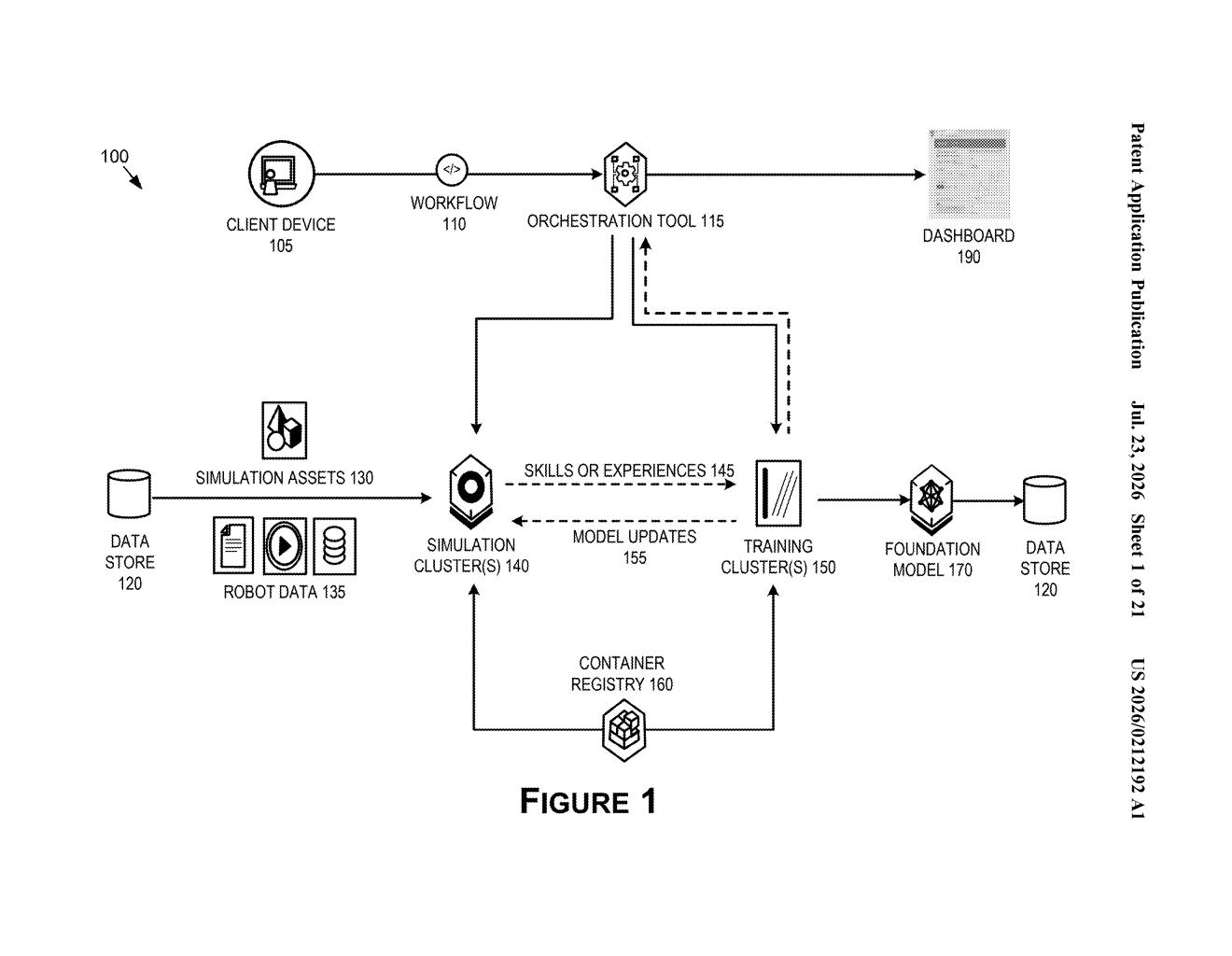
How Nvidia's robot training assembly line actually works
Imagine a giant research library surrounded by dozens of labs. Each lab runs experiments, sends results back to the central library, grabs the latest findings, and starts again. That's basically what Nvidia is patenting here, except the library is a data center and the labs are clusters of computers simulating robots doing tasks.
The system has two jobs running at the same time. One group of computers watches simulated robots try things (reinforcement learning, where the AI learns by doing and failing, like a video game character getting better through repeated attempts). A second group takes whatever the robots just learned and bakes it into the main AI model. Then both groups swap their latest work and start again.
The goal is to train AI for humanoid robots and other physical systems much faster than today's single-data-center setups allow. By spreading the work across many locations connected by fast links, Nvidia's design keeps every part of the pipeline busy all the time.
How the hub-and-spoke cycle keeps models improving
The patent describes a hub-and-spoke infrastructure for AI training. One central "hub" data center holds a networked file system (essentially a shared hard drive that all other locations can read from and write to simultaneously). Multiple "spoke" data centers connect to it over high-bandwidth links.
The workflow runs in two parallel tracks:
- Simulation clusters (in spokes or the hub) run many copies of a simulation environment where an AI agent (such as a robot) tries tasks and learns from outcomes. This is reinforcement learning, the same family of techniques that taught AlphaGo to play chess. The skills or experiences those simulations generate get written back to the shared file system.
- Training clusters simultaneously take those learned skills and apply them to the main foundation model (a large, general-purpose AI) using supervised learning, where the model is updated by example rather than trial and error. The improved model is then written back to the shared file system.
The two tracks feed each other in a continuous cycle. Simulations always grab the freshest model version; training always grabs the freshest simulation results. Nothing waits idle for the other side to finish. Nvidia describes this as a "cyclic workflow" designed to scale to many parallel jobs across geographically distributed clusters.
What this means for the race to train humanoid robots
Training a capable humanoid robot today is slow and expensive because simulation and model training tend to happen in sequence, not at the same time. Nvidia's design attacks that bottleneck directly. If the approach works as described, robot AI could be iterated much faster, meaning physical AI systems could pick up new skills in days rather than weeks.
Nvidia already sells the hardware (GPUs, networking gear) that this kind of infrastructure would run on, so this patent also reinforces Nvidia's position as the supplier of choice for anyone building large-scale robotics programs. Companies racing to deploy humanoid robots at scale, from warehouse operators to automotive manufacturers, would be the most direct audience for a system like this.
This is infrastructure-level IP, not a consumer product, but it matters. Nvidia is essentially patenting the factory blueprint for building robot brains at scale, and that blueprint is tightly coupled to its own hardware stack. If this approach becomes standard practice in the robotics industry, it gives Nvidia a durable architectural advantage that goes well beyond selling individual GPUs.
There are more where this came from
We read every patent application Big Tech publishes and send you the ones worth knowing. Plain English, free, every week.
The drawings
21 drawing sheets from US 2026/0212192 A1 · click any drawing to enlarge


Want this weekly breakdown for a company we don't cover? Patentlyze Pro →
Be the first to weigh in