
Apple Patents a Folded-Light Lens Design for Thinner VR Headsets
One of the biggest complaints about VR headsets is that they're thick and heavy. Apple is patenting a lens design that bounces light back and forth inside a slim optical stack, potentially shrinking the whole thing down.
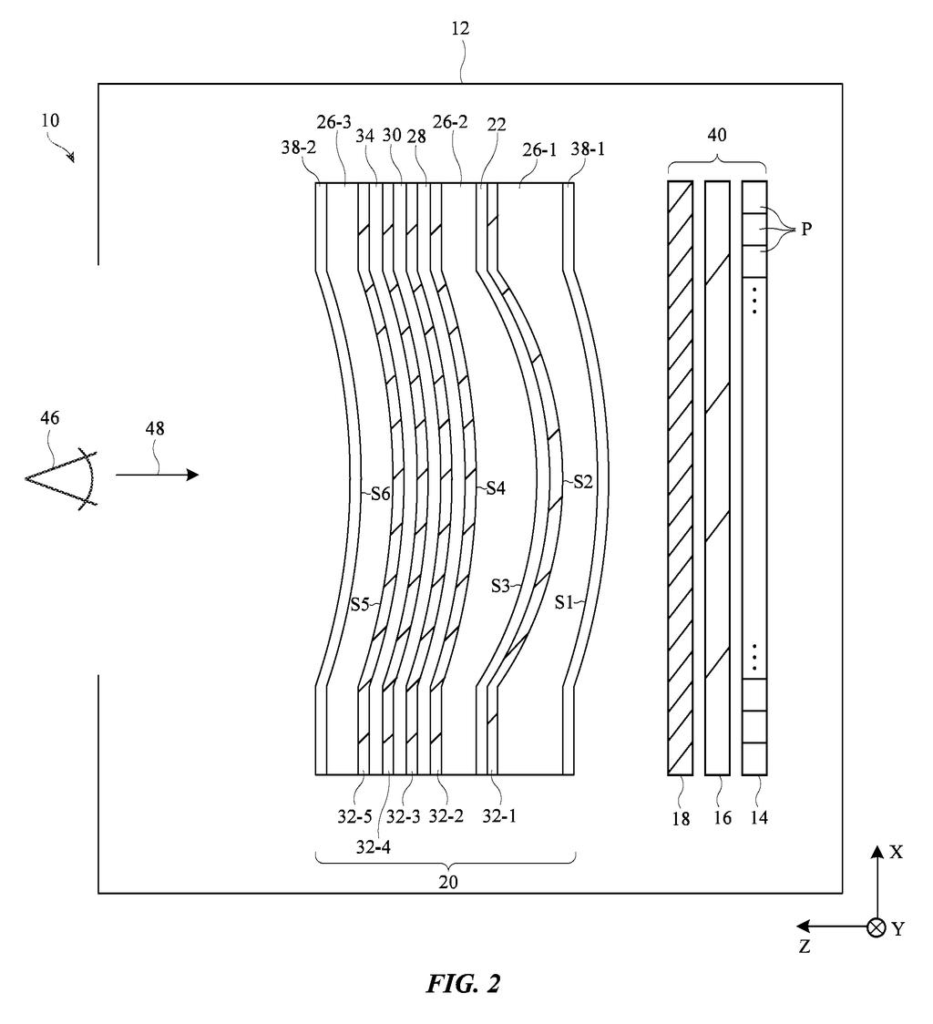
What Apple's bounced-light lens actually does
Imagine trying to fit a telescope inside a pancake. That's roughly the challenge Apple faces with the lenses in a headset like Vision Pro: good optics normally need physical depth, but wearable devices need to be as thin as possible.
Apple's patent describes a lens system that cheats this constraint by bouncing light multiple times inside a compact stack of glass and mirror layers. Instead of traveling in one straight shot from the display to your eye, light zigzags back and forth, covering the equivalent of a longer optical path inside a much shorter physical space.
The key ingredients are a specially curved lens element (convex on one side, more sharply concave on the other), a partially reflective mirror, and a reflective polarizer. Together, they control exactly where and how the light bounces so the image reaching your eye stays sharp and clear.
How mirrors and polarizers fold the light path
This is a catadioptric optical system, which is a fancy name for a design that uses both lenses (refraction) and mirrors (reflection) to bend and focus light. Most cameras use only lenses; telescopes often mix lenses and mirrors to stay compact. Apple is applying that same trick to headset displays.
The core piece is a lens element with asymmetric curvature: its outward-facing (convex) side has a gentler curve, while its inward-facing (concave) side curves more sharply. That asymmetry is engineered so the lens plays a specific role each time light hits it on the way in and on the way back after bouncing.
Between the lens layers sit two key optical components:
- A partially reflective mirror that lets some light pass through and bounces the rest back, like a one-way mirror in a police drama.
- A reflective polarizer that filters light by its orientation, only allowing certain light waves through after each bounce.
Apple also specifies an anti-reflective coating on the convex surface to cut down on stray light that would otherwise wash out the image. The patent covers two arrangements of these mirrors and polarizers, giving Apple flexibility in how the optical stack is assembled.
What this means for the bulk of Apple Vision Pro
The thicker a VR headset's lens block, the heavier and more uncomfortable it becomes over long sessions. Folded-light designs (sometimes called "pancake lenses") are already used in some competing headsets, and Apple appears to be refining the geometry to get sharper images with fewer visual artifacts. A well-executed version of this could make a future Vision product meaningfully lighter and easier to wear for hours.
For you as a user, the payoff is simple: a headset that doesn't make your neck ache after 20 minutes. The engineering tradeoff is that folded-light systems lose some brightness because each mirror bounce absorbs light, so Apple's choice of coatings and curvatures is doing real work to keep the image usable.
Pancake lens patents are becoming a standard move for any company serious about making wearables people will actually put on their faces, and Apple filing one signals they're iterating hard on Vision Pro's most obvious physical weakness. The specific asymmetric lens geometry and dual-configuration layout suggest this is closer to production engineering than blue-sky research.
There are more where this came from
We read every patent application Big Tech publishes and send you the ones worth knowing. Plain English, free, every week.
The drawings
4 drawing sheets from US 2026/0219507 A1 · click any drawing to enlarge


Want this weekly breakdown for a company we don't cover? Patentlyze Pro →
Be the first to weigh in