
Samsung Patents Technology That Keeps VR Video Smooth When 5G Networks Get Congested
When a 5G network gets congested, your AR or VR headset doesn't have to freeze entirely. Samsung is patenting a way to selectively throw out the least important video data first, so the experience degrades gracefully instead of crashing.
How Samsung keeps XR video smooth when the 5G network gets crowded
Imagine you're wearing an AR headset and the 5G network around you suddenly gets slammed with traffic. Right now, your device might just buffer, stutter, or drop frames at random. Samsung's patent is about giving the headset and the network a shared system for deciding which data to throw away first.
Every chunk of video sent to your headset gets tagged with an importance score. Low-importance data, think subtle background details, gets a short countdown timer. When that timer runs out and the network is still struggling, those packets get discarded. High-importance data, like the main objects in your field of view, gets a longer timer and survives longer.
The key idea is that the headset tells the network what it supports, and the network then sends back instructions on how to run this triage process. The two sides stay in sync so the headset always knows what the rules are, even when network conditions change.
How PSI timers decide which XR packets get dropped first
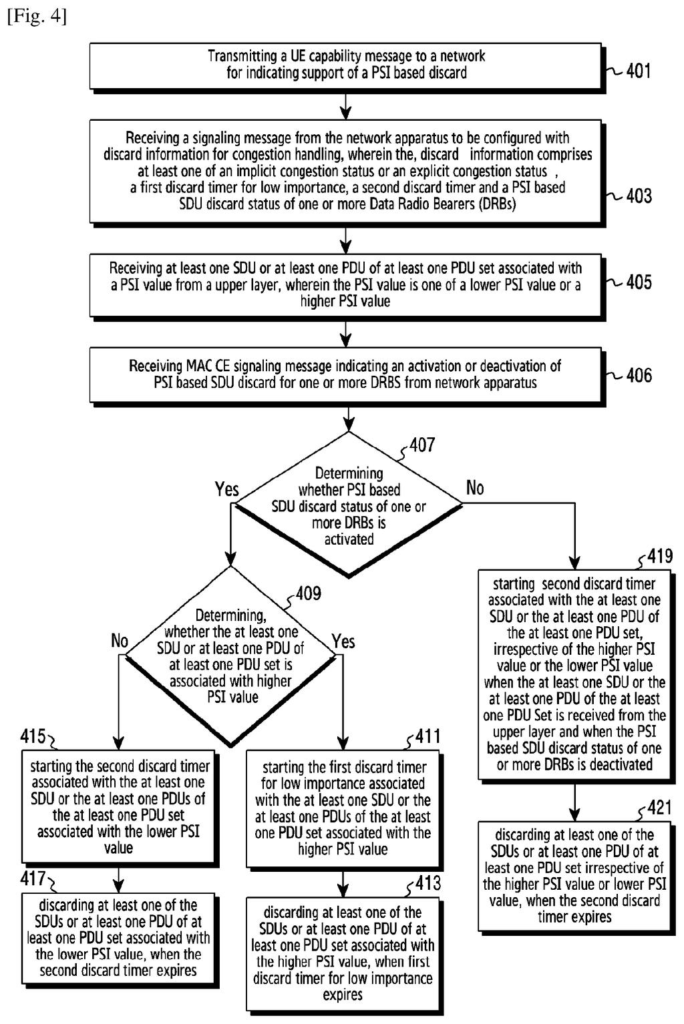
The patent describes a protocol-level handshake between a user equipment (UE), such as an XR headset, and a base station in a 5G or 6G network. The UE first sends a capability message telling the network it supports PSI-based SDU discard, where PSI stands for PDU Set Importance, essentially a priority score attached to each bundle of data packets.
Once the network acknowledges this and activates the feature, the UE receives configuration data that sets up two types of timers. A first discard timer is assigned to low-importance packet sets and is relatively short. A second discard timer applies to higher-importance data and runs longer. When either timer expires during congestion, the corresponding packet bundle is discarded rather than held indefinitely.
The system also handles the case where the PSI-based discard feature is deactivated mid-session, perhaps because congestion clears. In that scenario, the UE falls back to using only the second timer, ensuring it still has a controlled way to discard stale data without the importance ranking.
- UE advertises PSI-discard capability to the base station
- Base station sends back timer configuration and activation status
- UE runs short or long timers depending on packet importance
- Expired packets are dropped cleanly at the PDCP layer (the protocol layer that handles encryption and sequencing)
What this means for wireless AR and VR on future 5G networks
For extended reality devices on 5G, the difference between a jarring freeze and a graceful quality drop is everything. A system that randomly drops packets when congested creates visual glitches that can cause disorientation or nausea. A system that drops the right packets first keeps the core experience intact while sacrificing less critical visual detail.
This patent is also notable because it bakes the logic into the radio protocol stack itself, not into an app-level workaround. That means any XR application running on a compatible device would benefit automatically, without developers writing their own congestion workarounds. As 5G XR use cases grow, standardized packet-triage mechanisms like this one are likely to become table stakes in the spec.
This is genuinely useful infrastructure work for wireless XR, even if it reads like a dry standards filing. The problem it solves, graceful degradation of immersive video under network stress, is a real barrier to XR going mainstream on cellular. Samsung is clearly positioning itself at the protocol level, which is exactly where these things need to be solved.
There are more where this came from
We read every patent application Big Tech publishes and send you the ones worth knowing. Plain English, free, every week.
The drawings
4 drawing sheets from US 2026/0222355 A1 · click any drawing to enlarge


Want this weekly breakdown for a company we don't cover? Patentlyze Pro →
Be the first to weigh in