
Salesforce Patents a Dashboard for Ranking AI Models by Business Task
Picking an AI model for your sales team shouldn't feel like reading a research paper. Salesforce is patenting a tool that lets business users compare language models by the specific CRM job they need done, then sort the results by whichever performance measure matters most to them.
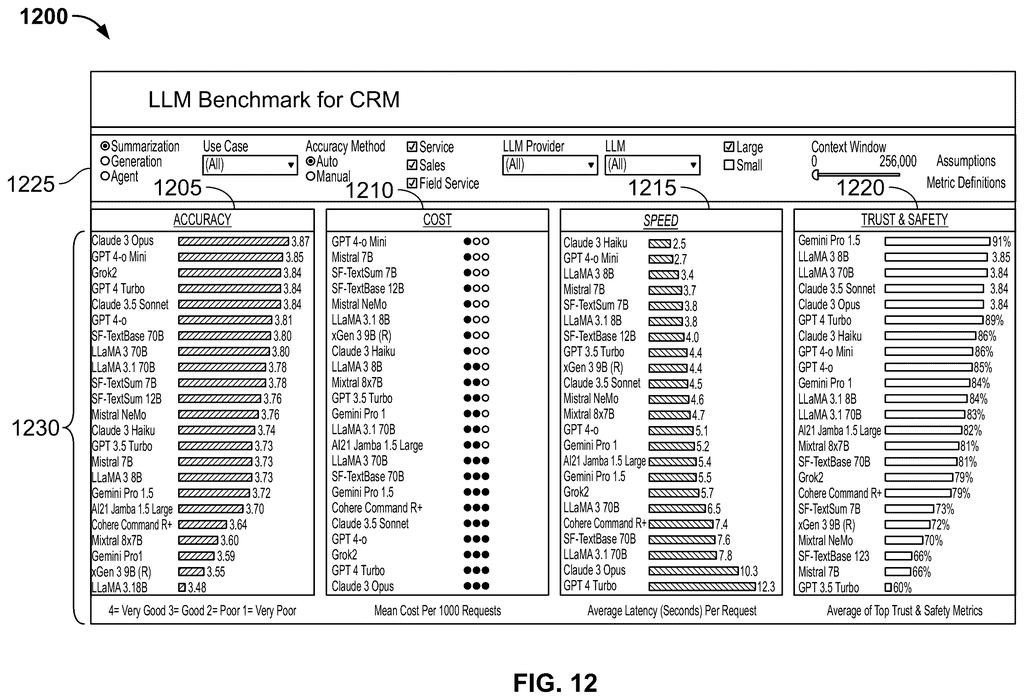
What Salesforce's AI comparison tool actually does
Imagine you're running a sales team and your company is trying to decide which AI tool to use for writing follow-up emails versus summarizing customer calls. Right now, comparing AI models usually means wading through technical reports full of scores that don't map to your actual work. Salesforce wants to fix that.
The patent describes a two-panel interface: on the left, you pick a business task, like drafting a quote or handling a support ticket. On the right, a list of AI models appears, each with scores tied to that specific task. You can then sort those models by whichever measure matters to you, whether that's accuracy, speed, or something else.
The result is a purpose-built scoreboard for AI models inside a CRM context. Instead of generic benchmarks, you get a ranked list tuned to your job, which makes the choice a lot more practical.
… reordering the listing that is displayed of the at least one LLM in accordance with the first selection of at least one object in the first panel and the second selection of the at least one metric in the second panel …
Translation: Sorting the AI models based on the task and performance yardstick you chose.
How the two-panel ranking system filters and sorts models
The patent describes a benchmark evaluation interface built around two synchronized panels inside a UI.
- First panel (use cases): Lists business tasks relevant to CRM work, such as generating sales outreach, summarizing customer history, or classifying support requests. Each task is an object that a user can click to filter the view.
- Second panel (models and metrics): Displays a set of large language models, each associated with one or more performance metrics. Metrics might include things like accuracy on a task, response quality scores, or speed benchmarks.
- Dynamic reordering: When a user selects a task in the first panel and then picks a metric in the second, the system reranks the list of AI models based on both choices simultaneously. Think of it like sorting a restaurant menu by cuisine type and then by price at the same time.
The underlying idea is that a model that scores well on general language tasks might rank poorly on, say, extracting deal values from unstructured emails. By tying benchmarks to specific CRM use cases, the interface surfaces rankings that are actually useful for business decisions rather than academic comparisons.
Techniques for generating benchmarks for evaluating and displaying a set of LLMs for use cases are provided.
Translation: Methods for creating scorecards that test and show AI models for specific jobs.
What this means for businesses choosing AI tools in CRM
For companies already inside Salesforce's ecosystem, this kind of tool could take a lot of guesswork out of AI adoption. Right now, choosing between AI models for a specific business function typically requires either an internal testing team or blind trust in vendor claims. A built-in, task-specific benchmark UI changes that dynamic by putting comparative data in the hands of the person making the purchasing or deployment decision.
It also signals that Salesforce is thinking seriously about positioning itself as the place where businesses evaluate AI, not just deploy it. If customers rank and choose models inside Salesforce's own interface, that creates a meaningful amount of lock-in and platform gravity.
This is a UI patent, not an AI research patent, and that's actually the point. Salesforce isn't claiming to build better models; it's claiming the interface for comparing them inside a CRM context. That's a strategic move: whoever owns the comparison layer influences which models get adopted at scale.
There are more where this came from
We read every patent application Big Tech publishes and send you the ones worth knowing. Plain English, free, every week.
The drawings
14 drawing sheets from US 2026/0228446 A1 · click any drawing to enlarge


Want this weekly breakdown for a company we don't cover? Patentlyze Pro →
Be the first to weigh in