
Qualcomm Patents a Display Trick That Keeps Partial Screen Updates Sharp
When only part of your phone's screen needs to refresh, a conflict can arise between the chip doing the image processing and the chip driving the display. Qualcomm's new patent describes a way to hand off resolution scaling duties on the fly to avoid that clash.
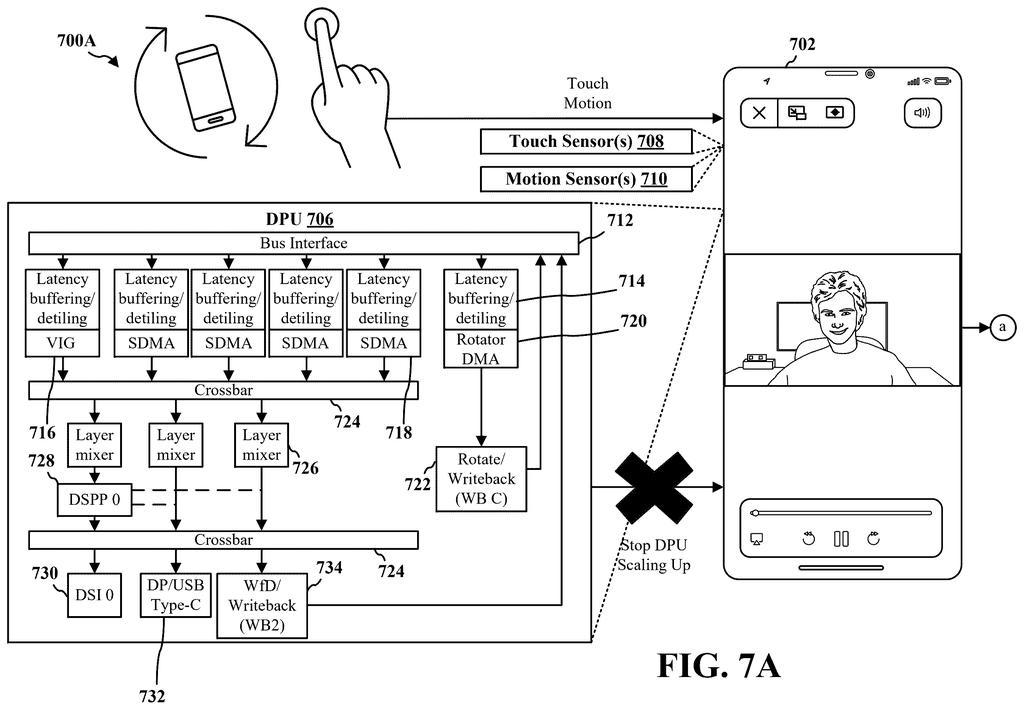
What Qualcomm's display scaling fallback actually does
Imagine your phone's notification bar updates while the rest of the screen stays still. That sounds simple, but it creates a behind-the-scenes problem: the main processor that normally handles image sharpening may not play well with a screen refresh that only covers one small region.
Qualcomm's patent describes a system where the phone detects that only part of the screen is about to update. Instead of letting the main display processor try to handle the resolution scaling (the process of adjusting the image to fit the screen's native pixel count), it hands that job to a smaller, dedicated chip built directly into the display hardware, called a display driver IC.
The result is that the image still gets scaled to the correct resolution, just by a different chip, one better suited to handle the job when only a slice of the screen is active. This is essentially a fallback plan so your display doesn't end up with a blurry or incorrectly sized image during those partial updates.
… determine, based on the detection that the partial frame update is to occur, to switch a scaling for the frame from a display processor to a display driver integrated circuit (DDIC); …
Translation: The system decides to shift the scaling duty away from the main processor when only part of the screen changes.
How the processor hands off scaling to the screen chip
Modern phone displays often involve two separate processors working together. There's the display processor (part of the main SoC, or system chip) that handles image quality work like resolution scaling, and there's the DDIC (Display Driver Integrated Circuit), a chip embedded in or near the screen panel itself that controls how pixels actually light up.
Normally, the display processor does the scaling, taking a frame rendered at one resolution and converting it to the screen's native resolution. But when a partial frame update occurs (only a portion of the screen changes, like a scrolling list or a status bar tick), that shared workflow can break down. The display processor may not be in a position to scale correctly when it's only receiving a fragment of the full frame.
Qualcomm's patent describes a processor that:
- Detects that a partial frame update is coming
- Decides to switch the scaling job away from the display processor
- Sends a signal to the DDIC telling it to handle the resolution conversion instead
The DDIC then scales the partial frame to the correct output resolution on its own. It's a fallback path, one that kicks in precisely because partial updates are a special case the normal pipeline isn't designed for.
The processor may output, for the DDIC and based on the detection that the partial frame update is to occur, an indication that the DDIC is to scale the frame to a second resolution.
Translation: It then sends a signal telling the display driver chip to resize the image to the target resolution.
What this means for phone displays and battery life
Partial screen updates are increasingly common on phones with always-on displays, high-refresh-rate panels, and power-saving modes that try to avoid redrawing the whole screen unnecessarily. Without a clean handoff like this, a partial update could produce a frame at the wrong resolution, causing visual glitches or forcing the system to do a full-screen refresh anyway, wasting battery.
For Qualcomm, this matters because its Snapdragon chips power a huge share of Android flagship phones. Getting the display pipeline right at this level of detail is the kind of work that shows up as fewer dropped frames and better battery life on your phone, even if you'd never know the patent existed.
This is genuinely unglamorous chip-level plumbing, but it's exactly the kind of thing that separates a polished display experience from one that occasionally glitches during power-saving partial refreshes. If Qualcomm ships this in a future Snapdragon display subsystem, users won't notice, which is the whole point.
There are more where this came from
We read every patent application Big Tech publishes and send you the ones worth knowing. Plain English, free, every week.
The drawings
15 drawing sheets from US 2026/0229200 A1 · click any drawing to enlarge


Want this weekly breakdown for a company we don't cover? Patentlyze Pro →
Be the first to weigh in