
New Patent Makes AI Models Give Consistent, Reproducible Results
Ask an AI the same question twice and you might get two different answers. Google's latest patent targets exactly that problem, describing a way to make a machine learning model produce the exact same output every time you feed it the same input.
Why Google wants AI to give the same answer twice
Imagine a doctor using an AI tool to scan an X-ray for signs of cancer. They run the scan once and get a result. They run it again on the same image and get a slightly different result. That inconsistency is a real problem in AI systems that use randomness internally to vary how they process data.
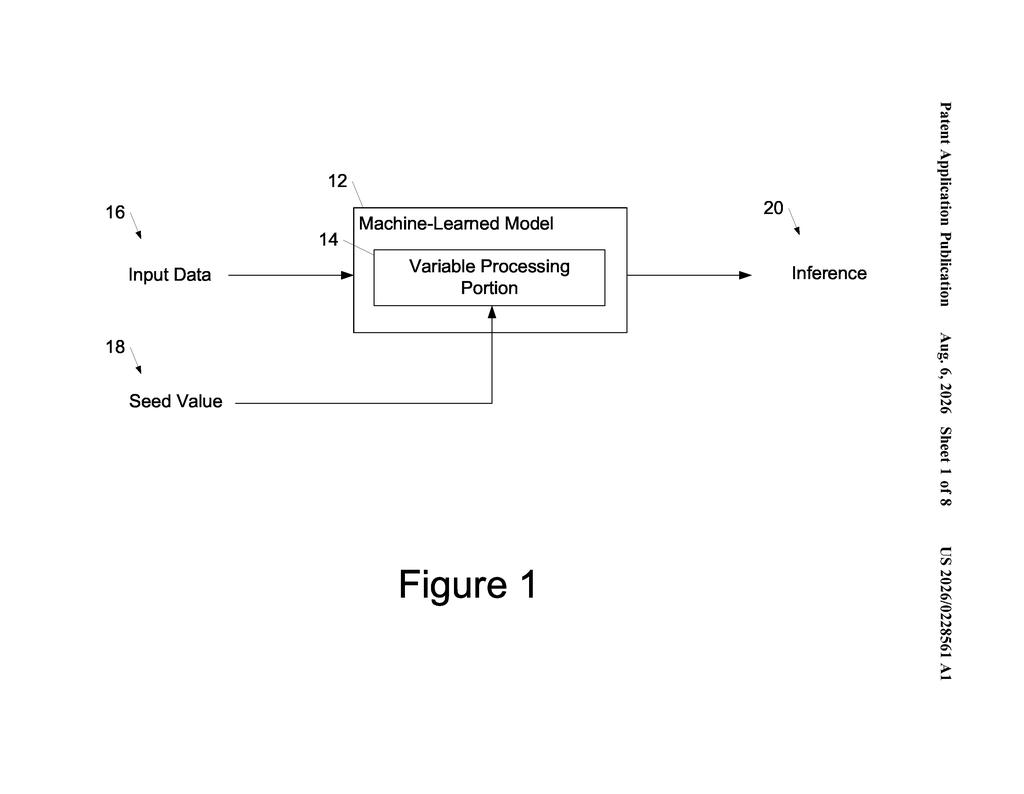
Google's patent describes a fix: attach a seed value (essentially a number that sets a fixed starting point) to the input data before it goes into the AI model. That seed acts like a lock on the model's random choices, forcing it to make the same decisions every single time it sees that input.
The result is an AI system whose outputs are deterministic, meaning predictable and repeatable. For anyone who needs to audit, verify, or reproduce an AI's conclusions, that's a meaningful property to have built in from the start.
… one or more seed values deterministically control which of the plurality of different processing operations are applied by the machine-learned model when processing the input data …
Translation: Specific seed values lock down how the model processes data to ensure identical results every time.
How seed values lock down an AI model's choices
Most modern AI models have components that introduce randomness during inference (the step where the model actually processes new data and produces a result). Techniques like dropout (where the model randomly ignores some of its own internal connections to avoid over-fitting) or stochastic routing (where different processing paths are chosen at random) mean the model can behave differently on the same input across multiple runs.
Google's system adds a seed value alongside the input data at inference time. The model's variable processing components read this seed and use it to deterministically select which operations to apply. Change nothing except the seed, and you get a different but still reproducible output. Keep the seed constant, and you get the identical result every time.
The patent describes the architecture as having a variable processing portion within the machine-learned model, one that is specifically designed to accept this seed-based control. Key components include:
- A machine-learned model with multiple possible processing pathways
- A seed-value input that travels alongside the data
- Logic that maps seed values to specific processing operations in a fixed, reproducible way
- An output layer that returns inferences generated under those locked conditions
The inventors on this filing include researchers associated with Google's medical AI work, which strongly suggests the use case goes beyond general-purpose models.
… a machine-learned model has a variable processing portion that is configured to variably apply one or more of a plurality of different processing operations when processing an input …
Translation: The AI contains flexible sections that can handle inputs in multiple different ways.
What repeatable AI results mean for high-stakes fields
Reproducibility is one of the biggest unresolved complaints about deploying AI in regulated industries. In medical imaging, drug discovery, or financial risk assessment, an AI that gives a different answer each time it runs the same data is nearly impossible to audit or certify. Google's approach gives developers a practical handle on that problem without stripping out the probabilistic techniques that make these models accurate in the first place.
For everyday users, the impact is indirect but real. If this kind of deterministic control becomes standard, AI tools in your doctor's office or insurance company are more likely to be formally validated, because regulators can actually test them consistently. It also makes debugging much easier: when an AI makes a mistake, engineers can replay the exact sequence of decisions that led to it.
This is unglamorous infrastructure work, but it addresses a real and often-ignored problem. The inventor list ties it to Google's medical AI research, and that context makes it genuinely significant. Reproducibility is a regulatory prerequisite for clinical AI, and a clean, seed-based solution is a lot more practical than overhauling entire model architectures.
There are more where this came from
We read every patent application Big Tech publishes and send you the ones worth knowing. Plain English, free, every week.
The drawings
8 drawing sheets from US 2026/0228561 A1 · click any drawing to enlarge


Want this weekly breakdown for a company we don't cover? Patentlyze Pro →
Be the first to weigh in