
Sony Files Patent for a Zoom Lens That Stays Sharp From Wide to Telephoto
Sony is patenting a zoom lens structure that carefully choreographs how internal glass elements move during zooming, with one specific goal: keeping image quality consistent from wide-angle shots all the way to telephoto reach.
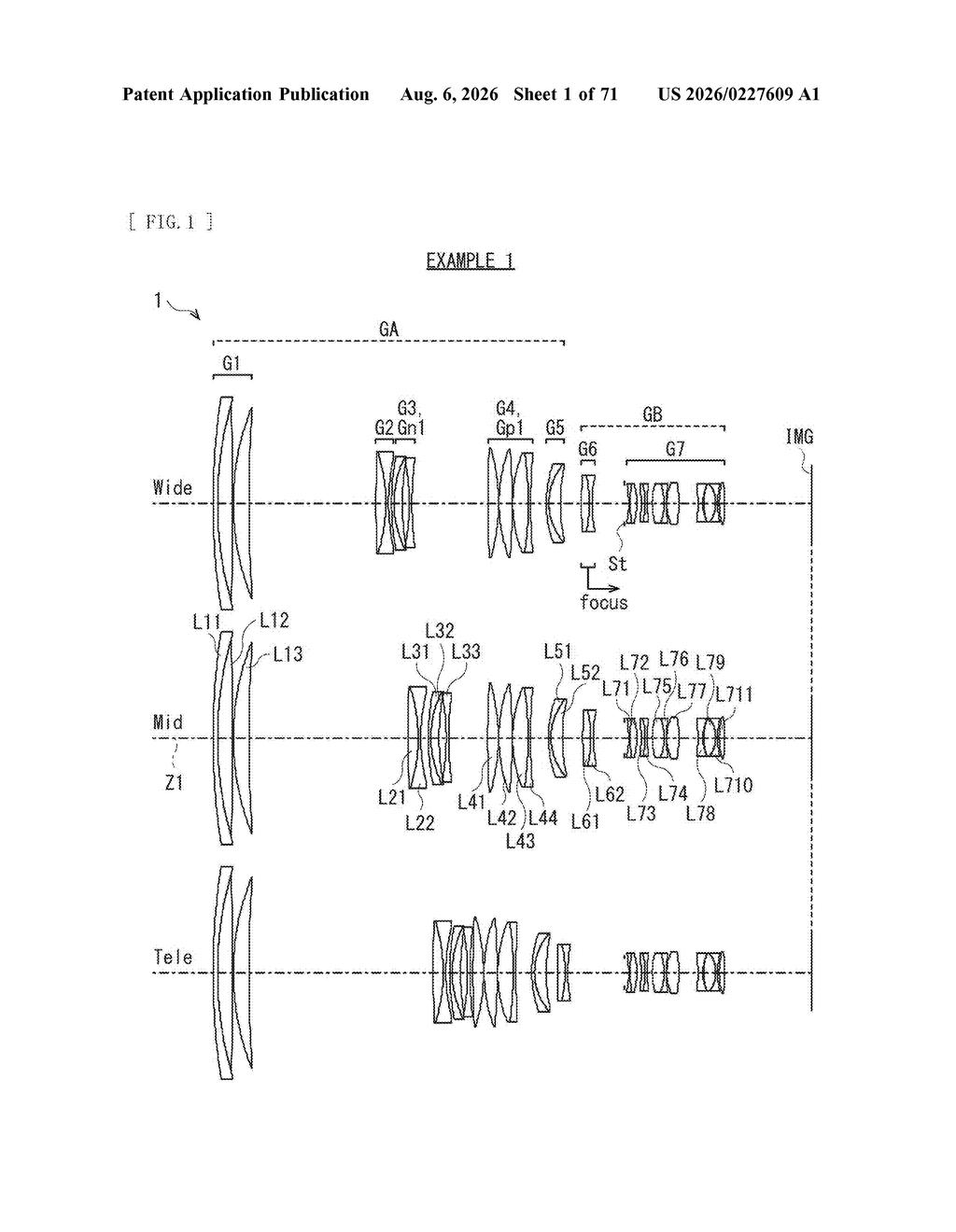
What Sony's zoom lens patent actually changes
Imagine a zoom lens as a stack of glass groups that slide toward or away from each other to change how zoomed-in your shot is. The tricky part is keeping the image sharp and well-exposed at every zoom level, not just at the extremes.
Sony's patent describes a specific arrangement of these glass groups. One group at the front stays locked in place no matter what zoom level you choose. Behind it, negative and positive lens groups move in a carefully timed relationship: as you zoom toward telephoto, the negative group pulls away from the front, while a compensating positive group closes in behind it. That interplay is what keeps light paths from going haywire.
There's also a mathematical condition baked into the design, a ratio involving the focal lengths at wide and telephoto ends, that Sony says the lens must satisfy to hit the right optical balance. In plain terms, it's a recipe for a zoom lens that doesn't trade off quality at one end to perform at the other.
… a focus lens group disposed on a side closest to the object, the focus lens group moving in an optical axis direction upon focusing from an infinity object to a short-distance object …
Translation: The focusing elements shift forward or backward when you switch between distant views and close-ups.
How Sony's lens groups shift to control zoom quality
The patent lays out a zoom lens architecture made up of two main sections: a front-side lens group and a rear-side lens group. The rear section contains a dedicated focus lens group that moves along the optical axis when you shift focus from far-away subjects to close-up ones.
Inside the front section, three types of lens groups work together:
- First positive lens group: sits closest to the subject and never moves during zooming; it anchors the system.
- Negative lens group(s): move during zoom and bend light inward; the strongest one must be at its greatest distance from the fixed front group when the lens is at full telephoto.
- Second positive lens group(s): also move during zoom; the strongest one sits behind the strongest negative group and must be at its closest to that negative group at full telephoto.
The patent also specifies a conditional expression: the focal length of the fixed front group divided by the geometric mean (a mathematical middle-ground) of the wide-angle and telephoto focal lengths must fall between 0.2 and 0.455. That range is the engineering sweet spot where the lens performs well across its full zoom range without the optical compromises that typically appear at either end.
A zoom lens according to the present disclosure includes: a front-side lens group; and a rear-side lens group that includes a focus lens group disposed on a side closest to the object …
Translation: The optical design splits internal glass elements into front and rear sections to manage zoom and focus.
What this means for Sony cameras and imaging gear
Sony makes some of the most widely used camera systems in professional and consumer photography, including the Alpha mirrorless lineup. A zoom lens architecture that controls image quality more precisely across a wide zoom ratio would matter for any Sony camera body that uses interchangeable lenses, particularly in the telephoto zoom category where optical quality tends to degrade as zoom increases.
For you as a photographer or videographer, the practical outcome of a design like this would be sharper, more consistent images whether you're shooting at 24mm or 200mm, without needing to swap lenses. That said, this is a foundational optics patent, the kind that influences future lens families rather than pointing to a single near-term product announcement.
This is a core optics engineering patent, not a flashy consumer feature. It's the kind of filing that shapes a lens lineup over years rather than generating headlines. If you follow Sony's camera lens roadmap closely, it's worth tracking, but for most readers it's background infrastructure work.
There are more where this came from
We read every patent application Big Tech publishes and send you the ones worth knowing. Plain English, free, every week.
The drawings
71 drawing sheets from US 2026/0227609 A1 · click any drawing to enlarge


Want this weekly breakdown for a company we don't cover? Patentlyze Pro →
Be the first to weigh in