
Salesforce Patents Technology That Routes Tasks to the Correct Automated Assistant Instantly
When you ask a business AI tool to do something, how does it actually decide which skill to use? Salesforce is patenting a method that peeks inside the AI model itself to make that call more reliably.
How Salesforce's AI agent picks which job to do
Imagine you hired an assistant who is trained to do dozens of different jobs: write emails, look up customer records, schedule meetings, generate reports. Every time you give them a new request, they have to figure out which of their skills applies. If they pick wrong, things go sideways fast.
Salesforce is working on a system where the AI agent doesn't just read your words to figure out what to do. Instead, it looks at a kind of internal fingerprint the model produces while processing your request, and uses that pattern to match your input to the right task.
The result, in theory, is an AI agent that's less likely to route your request to the wrong tool or misinterpret what you need, even when your phrasing is ambiguous or unusual. For businesses running large AI pipelines where the wrong task choice causes real errors, that kind of precision matters.
… extracting a representation of the input from an attention layer of the at least one agent LLM; determining a value space representation based on the extracted representation; and identifying a task from the plurality of tasks to be performed by the agent LLM based on the value space representation and an embedding corresponding to the task.
Translation: It looks inside the AI model's inner workings to figure out exactly which job needs to be done next.
How the attention layer and value space drive task selection
The patent describes a technique for routing requests inside an AI agent service (a system where a large language model handles many different tasks, like answering questions, searching databases, or triggering workflows).
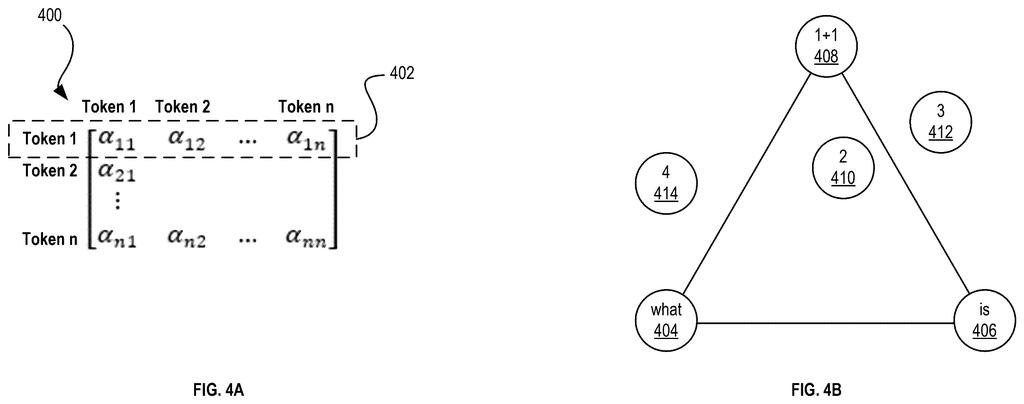
Instead of deciding which task to run based purely on text matching or prompt keywords, the system pulls a representation of the input from an attention layer (a part of the neural network that determines which words or concepts are most relevant to each other). That internal signal is then converted into a value space representation, which the patent describes as a convex hull (think of it as drawing the tightest geometric shape around a cluster of data points in a high-dimensional space).
The system then compares that shape to stored embeddings (compact mathematical descriptions of each available task) and picks the closest match. Key steps include:
- Extracting the input's internal representation from inside the LLM
- Building a geometric value-space summary of that representation
- Comparing it against task embeddings to identify the best match
- Routing the agent to execute the identified task
The underlying idea is that the model's own internal activations carry richer, more reliable information about intent than surface-level text alone.
An agent service can perform effect detection using a convex hull representation of an input.
Translation: The system uses geometric shapes to analyze what a user's request is trying to achieve.
What this means for enterprise AI agent reliability
Enterprise AI agents are only as useful as their routing logic. A customer service bot that sends billing complaints to the wrong workflow, or a coding assistant that triggers a database query when you wanted a code explanation, creates more work than it saves. Salesforce's approach tries to solve this by using the model's internal geometry rather than just what the words say on the surface.
For you as a business user, this could translate to AI tools that feel less brittle and require less hand-holding when your requests don't follow the exact phrasing the model was trained on. It also has implications for how Salesforce might build more autonomous, multi-task agents inside products like Agentforce.
This is a solid, technically specific patent on a real problem in production AI systems: task routing inside multi-capability agents breaks in ways that are hard to debug. Using internal model geometry rather than surface text is a genuinely interesting approach, though it remains to be seen how well convex hull comparison scales as the number of supported tasks grows. Worth watching for anyone building or buying enterprise AI agent platforms.
There are more where this came from
We read every patent application Big Tech publishes and send you the ones worth knowing. Plain English, free, every week.
The drawings
7 drawing sheets from US 2026/0228506 A1 · click any drawing to enlarge


Want this weekly breakdown for a company we don't cover? Patentlyze Pro →