
Apple Patent: Mic Listens to Room Noise to Keep Dialogue Audible
Ever cranked up the volume on a podcast because a truck drove by, only to get blasted when things went quiet again? Apple's new patent describes a system that handles that automatically, by listening to the room and adjusting speech and background audio independently.
What Apple's adaptive dialogue boost actually does
Imagine you're watching a TV show and someone in your house starts running the dishwasher. The dialogue suddenly feels harder to hear, so you grab the remote and bump the volume. But then the dishwasher stops, and now the show's music is uncomfortably loud. It's a small but genuinely annoying cycle.
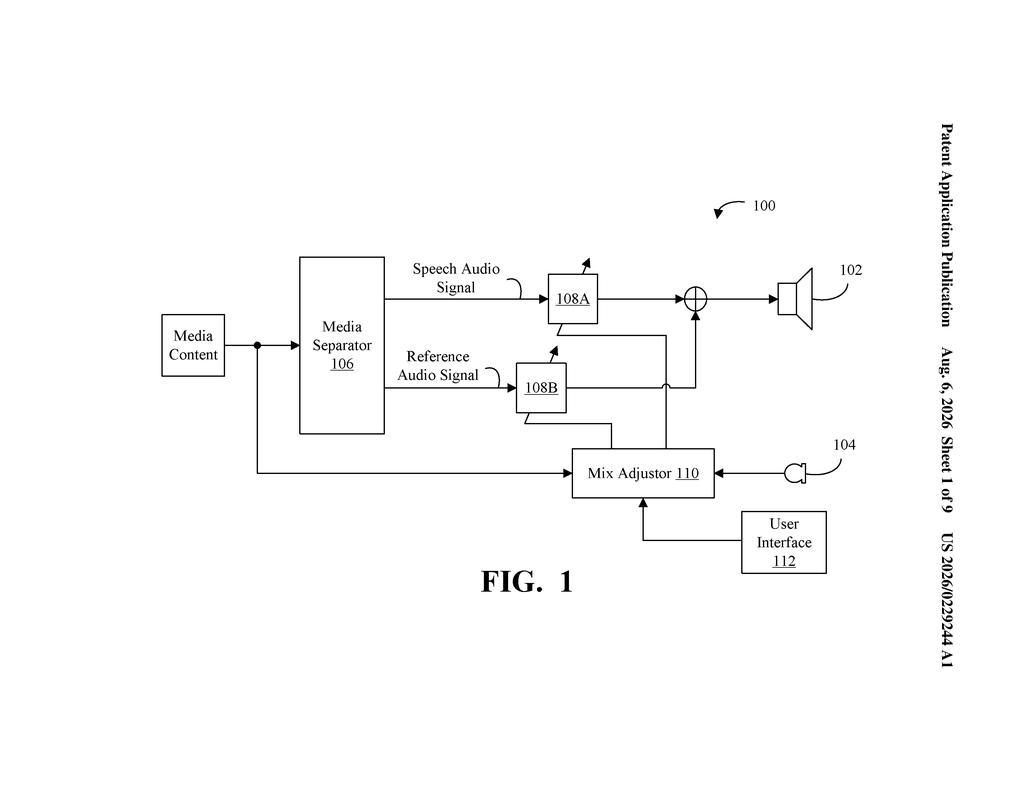
Apple's patent describes a system that would handle this for you. A microphone picks up what's happening in your environment, and the device uses that information to adjust two separate audio tracks: one for speech (dialogue, narration, vocals) and one for everything else (music, sound effects, ambient noise in the recording). When your surroundings get louder, speech gets turned up. When things quiet down, the balance shifts back.
The key idea is that speech and non-speech audio are treated as separate controls, not one single volume knob. That means the system can keep voices clear without making your action movie's soundtrack feel like a concert.
… adjust amounts of the speech audio signal and the reference audio signal based on the ambient signal to produce an adaptive playback signal to drive the speaker.
Translation: It changes the volume levels of the voices and background sounds depending on room noise.
How the system splits speech from background audio
The patent describes a hardware-plus-software system built around three components: a speaker, a microphone, and a processor.
The processor receives two distinct audio signals from whatever media is playing:
- Speech audio signal: the portion of the content that contains voices, dialogue, or narration
- Reference audio signal: everything else, including music, sound effects, and ambient noise baked into the recording
At the same time, the microphone captures what Apple calls an ambient signal, a real-time picture of the sound field around the user. Think of it as the device constantly asking, "How noisy is it in here right now?"
The processor then uses that ambient signal to adjust the balance between the speech and reference signals before combining them into a final output (the "adaptive playback signal") that drives the speaker. The louder or more complex the environment, the more the system can favor speech clarity. The adjustments happen dynamically, so the listener doesn't need to touch any controls.
This is distinct from simple volume normalization or loudness leveling. Those approaches treat the whole audio mix as one block. This system operates on separated audio streams, which gives it much finer control over what the listener actually hears.
… a microphone to pick up a sound field in an environment of a user, and a processor configured to: receive i) a speech audio signal including the speech portion, and ii) a reference audio signal including the non-speech portion; …
Translation: The device uses a built in microphone to listen to your surroundings and separate dialogue from background music.
What this means for AirPods and Apple TV viewers
Apple already ships a feature called Dialogue Boost on Apple TV 4K and in AirPods settings, which manually prioritizes voices in content. This patent points toward making that kind of adjustment automatic and continuous, responding to your environment in real time rather than relying on you to enable a setting.
For anyone who watches TV in a busy household, listens to podcasts in noisy commutes, or uses hearing aids alongside consumer audio devices, this kind of adaptive behavior could make a meaningful difference in daily usability. It also fits squarely into Apple's broader push to position AirPods as a health and hearing-assistance platform, where intelligibility of speech is as important as audio fidelity.
This is a practical, well-scoped patent that solves a real and common annoyance. It's not a moonshot, but it's the kind of incremental audio intelligence that Apple tends to actually ship. Given that Dialogue Boost already exists as a manual feature on Apple TV and AirPods, an automatic, microphone-aware version feels like a natural next step, and one that would be hard for competitors to replicate without similar hardware integration.
There are more where this came from
We read every patent application Big Tech publishes and send you the ones worth knowing. Plain English, free, every week.
The drawings
9 drawing sheets from US 2026/0229244 A1 · click any drawing to enlarge


Want this weekly breakdown for a company we don't cover? Patentlyze Pro →
Be the first to weigh in