
Sony Files Patent to Accurately Reproduce Camera Colors Across Any Display
Colors look different on your camera screen than they do in real life, and different again on your TV or monitor. Sony is patenting a system that automatically figures out the best set of color patches to compare, so the gap between what a camera captures and what a display shows gets as small as possible.
What Sony's color-matching calibration system actually does
Imagine you photograph a red sweater, then look at it on your TV and it looks more orange. That mismatch is a real problem in photography, film production, medicine, and anywhere color accuracy matters. The root cause is that cameras speak one color language (RGB, the values for red, green, and blue light) while calibration tools and displays speak another (called XYZ, a scientific standard for how human eyes actually perceive color).
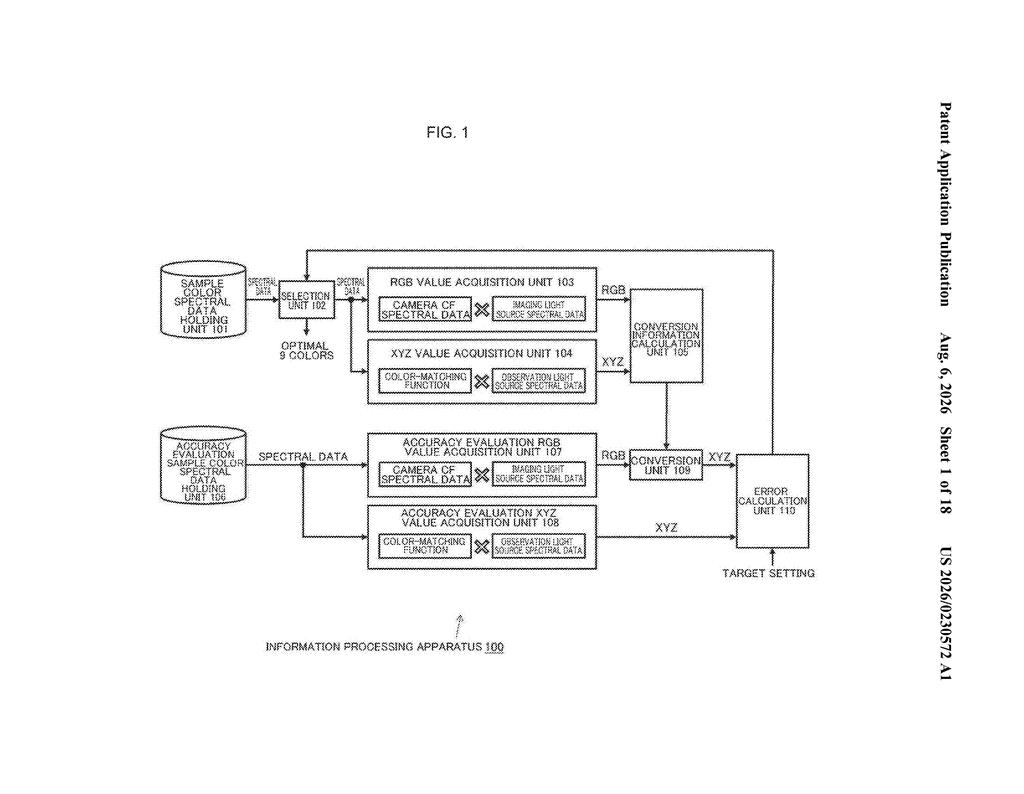
Sony's patent describes a system that bridges that gap. It starts with a large library of color swatches, picks a smaller working set of them, photographs those swatches with a camera in one environment, then measures how those same colors look to the human eye in a viewing environment. From that data it builds a translation table, a kind of color dictionary, between the camera's output and what a person actually sees.
The clever part is the feedback loop. After the system builds its first translation table, it checks how accurate that table is, then uses that error score to swap in better color swatches and try again. Over a few rounds, it converges on the combination of sample colors that produces the most accurate translation.
… reproduces, on an observation side, the color of a subject on an image capturing side …
Translation: It aims to match the colors captured by a camera to how they actually look elsewhere.
How the system picks and refines its color sample set
The patent describes an iterative color calibration pipeline with five main components:
- Selection unit: Picks r colors from a larger library of n candidate color swatches. Because measuring every possible color is impractical, the system works with a manageable subset.
- First acquisition unit: Records the RGB values a camera produces when it photographs those selected swatches under real-world imaging conditions (specific lighting, lens, sensor settings).
- Second acquisition unit: Records the XYZ values (the perceptual color standard used in colorimetry, roughly matching how the human visual system works) for those same swatches as seen in the target viewing environment.
- Conversion information calculation unit: Uses both sets of measurements to compute a conversion matrix or similar mapping function that translates camera RGB output into perceptually accurate XYZ values.
- Error calculation unit: Evaluates how accurate that mapping is, essentially testing how wrong the color translation would be across the sample set.
The key innovation is that the error score feeds back into the selection unit, which then chooses a different or refined set of color swatches and repeats the process. This iterative loop keeps running until the system finds the combination of sample colors that minimizes conversion error, without needing to measure every color in the original library.
… calculate conversion information for converting RGB values into XYZ values, based on the RGB values acquired by the first acquisition unit and the XYZ values acquired by the second acquisition unit …
Translation: It figures out the math to translate camera colors into standard color values.
What this means for cameras, displays, and color-critical work
Color calibration today often relies on fixed, standardized color charts (like the classic Macbeth ColorChecker). Those work reasonably well on average but may not be optimal for every camera, every light source, or every display. Sony's approach treats sample selection as a variable to optimize rather than a fixed given, which in principle means better calibration accuracy without requiring more measurements.
For most consumers, this would be invisible infrastructure. But for industries where color fidelity is non-negotiable, such as broadcast production, medical imaging, product photography for retail, and digital cinema, a system that adaptively finds the best calibration samples could reduce costly color-correction work downstream. If Sony builds this into future cameras or post-production software, it could tighten the link between what a camera captures and what an audience actually sees.
This is a focused, technically specific patent in a mature area of imaging science, not a broad strategic play. The iterative sample-selection idea is genuinely interesting from an engineering standpoint, but the patent's scope is narrow enough that it reads more as a calibration refinement than a category shift. Worth tracking if you follow Sony's imaging hardware roadmap, but easy to skip otherwise.
There are more where this came from
We read every patent application Big Tech publishes and send you the ones worth knowing. Plain English, free, every week.
The drawings
18 drawing sheets from US 2026/0230572 A1 · click any drawing to enlarge


Want this weekly breakdown for a company we don't cover? Patentlyze Pro →
Be the first to weigh in