
Apple Patent May Help 5G Phones Connect to Stronger Signals More Quickly
Your phone normally has to measure every possible antenna beam before picking the best one for a 5G connection. Apple's new patent describes a way to skip most of that work by letting AI predict which beams will be good, before the phone ever measures them.
What Apple's AI beam-prediction system actually does
Picture your phone standing in a crowded stadium, trying to connect to a 5G tower. The tower has dozens of narrow radio beams pointed in different directions, and your phone has to scan through them to find the ones with the strongest signal. Right now, that scanning takes time and drains your battery.
Apple's patent describes a system where the phone only measures a subset of those beams, then uses an AI model to predict how the unmeasured beams would perform. It reports those predictions back to the network as if they were real measurements. When the network tells your phone to switch to one of those predicted beams, the phone flags it as either "known" (it can confidently pick the right receiving angle) or "unknown" (it can't, so the network handles the transition more carefully).
The practical idea is fewer measurements, faster switching, and a smarter handoff between 5G beam states without burning extra battery scanning beams your phone will never use.
… generate, for transmission to the network, a measurement report corresponding to the first set of beams, wherein second measurements for a second set of beams are predicted from first measurements of the first set of RS …
Translation: The device reports signal measurements to the network and predicts the quality of other beams based on that data.
How the phone predicts beams it hasn't measured yet
The patent centers on a component called a Transmission Configuration Indicator (TCI) state, which is essentially the antenna configuration your phone uses to talk to a 5G base station. Switching TCI states is how a phone "follows" a moving beam as you walk around.
Normally, the phone measures reference signals (known pilot tones the tower broadcasts) across a whole set of beams, then reports the results so the network can pick the best one. This patent proposes measuring only a first set of beams directly, then running an AI inference step to predict signal quality for a second set of beams that weren't measured at all.
The clever part is a two-track outcome when the network orders a beam switch to one of those predicted (unmeasured) beams:
- Known condition: the phone has the AI capability to figure out the best receive angle on its own, so the switch proceeds smoothly.
- Unknown condition: the phone lacks that capability, so the network is told explicitly and can apply a fallback procedure, like ordering a fresh scan.
This capability-flag mechanism means the system degrades gracefully on older or lower-end hardware that doesn't support the AI prediction feature, keeping the protocol backward-compatible across different device generations.
… process, based on signaling from the network, a command to switch an active transmission configuration indicator (TCI) state to a target TCI state associated with the second set of beams …
Translation: The device follows network instructions to switch over to a better beam connection.
What this means for 5G speed and battery life
5G millimeter-wave connections are fast but finicky. The beams are narrow, and phones can lose lock on them when you move even a few feet. Faster beam switching directly translates to fewer dropped connections and lower latency in dense environments like airports or stadiums. By cutting the number of beams a phone has to physically measure, this approach could also reduce the radio activity that eats into battery life.
For Apple, this kind of AI-at-the-modem work fits a broader pattern of pushing more intelligence into the cellular radio layer. As Apple develops its own in-house 5G modem (the C1 chip has already appeared in iPhone 16e), having patented techniques that squeeze more performance out of fewer measurements becomes a real differentiator in modem efficiency comparisons.
This is genuinely interesting as a sign of where Apple's modem ambitions are heading. Predicting beam quality with AI rather than brute-force scanning is a real engineering problem in dense 5G deployments, and the capability-flag design shows careful thinking about real-world device diversity. It's not a flashy consumer feature, but it's exactly the kind of low-level radio efficiency work that separates good modems from great ones.
There are more where this came from
We read every patent application Big Tech publishes and send you the ones worth knowing. Plain English, free, every week.
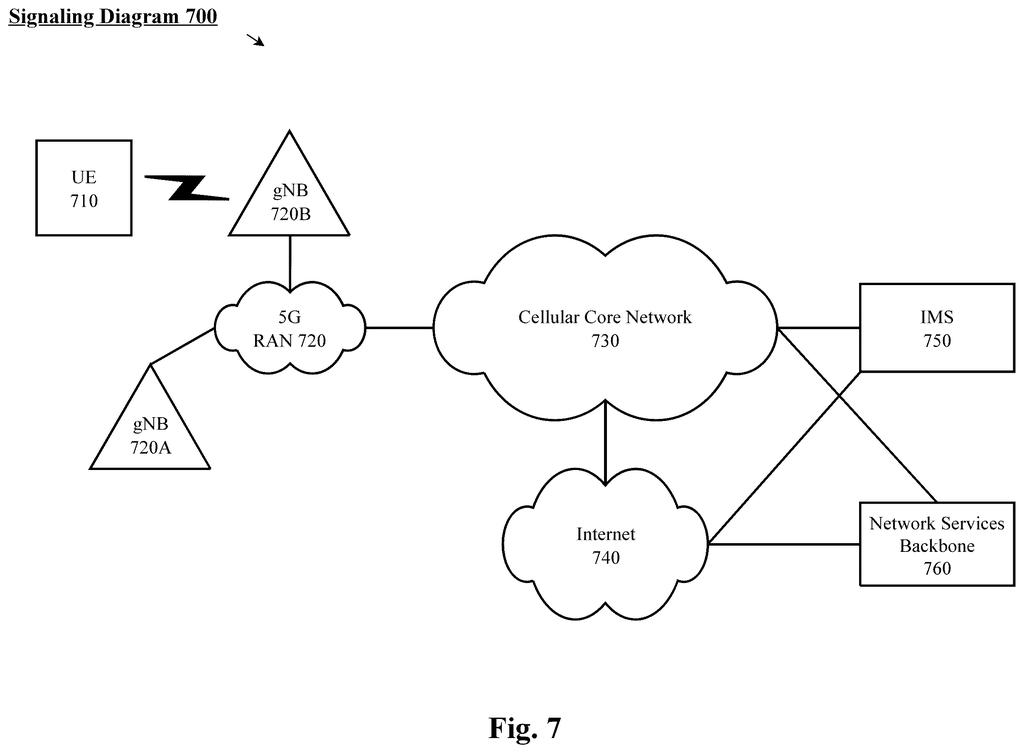
The drawings
6 drawing sheets from US 2026/0230287 A1 · click any drawing to enlarge


Want this weekly breakdown for a company we don't cover? Patentlyze Pro →
Be the first to weigh in