
Apple Patents a Lock Screen Clock That Changes Shape Around Your Content
Apple's lock screen clock could soon physically reshape itself, squishing or stretching, to make room whenever other content rearranges on the display, all without ever disappearing from view.
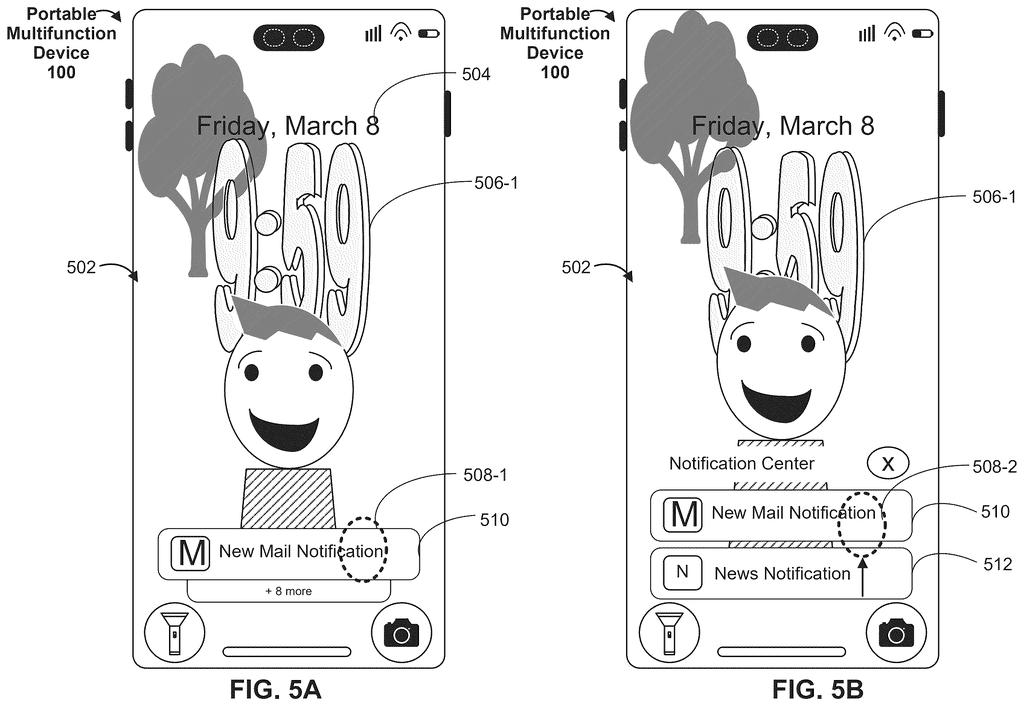
What Apple's self-reshaping lock screen clock actually does
Today's iPhone lock screen keeps the time in one fixed spot and one fixed shape. If a notification slides in or content rearranges, the clock pretty much just moves out of the way. Apple wants to change that.
This patent describes a lock screen where the time display actually changes its proportions in response to whatever else is happening on screen. If content below the clock shifts position, the clock could get taller and narrower, or shorter and wider, fitting the new layout without vanishing. The time always stays visible; it just adapts its shape to the space it has left.
Think of it like water filling a container: the clock stays on screen no matter what, but its visual footprint flexes around the content next to it. It's a subtle change, but one you'd likely notice every time you glance at your phone.
… changing an aspect ratio of the indication of the current time of day while maintaining display of the indication of the current time of day in the first user interface, based on the change in the spatial arrangement of the first content.
Translation: The clock numbers will stretch or shrink to fit around your photo or other items on the screen.
How the clock's aspect ratio responds to content shifts
The patent describes a wake screen (the display you see when your device first lights up) that shows two things at once: some block of content, and a live clock showing the current time.
When a specific trigger event occurs, such as a notification arriving, a widget expanding, or a user interaction, two things happen simultaneously:
- The content block rearranges its position on screen.
- The clock display changes its aspect ratio (the ratio of width to height) to accommodate the new layout, while staying visible the whole time.
The key technical detail is that the clock doesn't simply move or hide. Its shape changes proportionally based on how the surrounding content has shifted. If content expands downward and crowds the clock horizontally, the clock might become taller and thinner to survive in the remaining space.
Apple's claim language is broad enough to cover any "computer system" with a display and input devices, which means this behavior could apply to iPhone, iPad, Apple Watch, or even Mac lock screens. The system is reactive: the aspect-ratio change is explicitly based on the change in spatial arrangement of the other content, so the two transformations are linked, not independent.
displays, via the one or more display generation components, a change in a spatial arrangement of the first content in the first user interface; and, displays, via the one or more display generation components, a change to the indication of the current time of day …
Translation: The system automatically moves your content and adjusts the clock display when it detects a specific user action.
What this means for iPhone and Apple Watch lock screens
For everyday iPhone users, this could make the lock screen feel noticeably more polished. Right now, iOS lock screen widgets and clocks can feel like they're fighting each other for space. A clock that gracefully reshapes itself, rather than getting pushed off or hidden, would let Apple pack more information onto the wake screen without the display feeling cluttered.
From a patent-strategy view, claim 1 covers a fairly specific but still broad behavior: any system that links a clock's aspect ratio change to a content rearrangement on the same screen. That's not trivially narrow. If granted, it could give Apple a meaningful claim over this particular interaction pattern across its whole device lineup. Apple's lock screen design has been a focus of iteration since iOS 16, and this filing fits that pattern of incremental but real refinement, sitting alongside the steady flow of new Big Tech patents covering display behavior and UI animation on mobile devices.
Claim 1 is deceptively broad. It doesn't specify a particular device, a particular trigger event, or even a particular direction of reshaping. Any system that changes a clock's aspect ratio in sync with a content rearrangement on the same screen would fall inside it, so if granted, that scope could act as a design fence around the whole category of adaptive lock-screen layouts. Whether Apple enforces it aggressively is another question, but the claim covers enough ground that other platform makers designing adaptive time displays would have reason to look twice.
There are more where this came from
We read every patent application Big Tech publishes and send you the ones worth knowing. Plain English, free, every week.
The drawings
67 drawing sheets from US 2026/0236135 A1 · click any drawing to enlarge


Want this weekly breakdown for a company we don't cover? Patentlyze Pro →
Be the first to weigh in