
Qualcomm Patents a Way for AR Headsets to Negotiate Their Own Workload With the Network
Running augmented reality on a headset is expensive in two ways: battery and bandwidth. Qualcomm's new patent lets the headset and the wireless network negotiate, in real time, who handles which piece of the computation.
How Qualcomm's AR headset-network handshake works
A person wearing AR glasses walks into a crowded stadium. The headset is already straining to render virtual overlays while the Wi-Fi is packed. Something has to give, and right now neither the headset nor the network has a good way to tell the other what it can handle.
Qualcomm's patent tackles that gap directly. The idea is to let the device send assistance information to the network, essentially a short status report about what the headset needs and what it can manage on its own. The network (or a server on the other end) reads that report and sends back a decision: process the graphics locally, offload them to the cloud, or split the work somewhere in between.
For you as the person wearing the headset, the goal is that the experience stays smooth even as conditions change, without any manual adjustment on your part. The device and the network figure it out together.
… a user equipment (UE) may transmit radio access network (RAN) assistance information associated with an extended reality (XR) split perception …
Translation: The headset sends network data about how it is handling extended reality graphics.
Inside the RAN assistance and split-selection loop
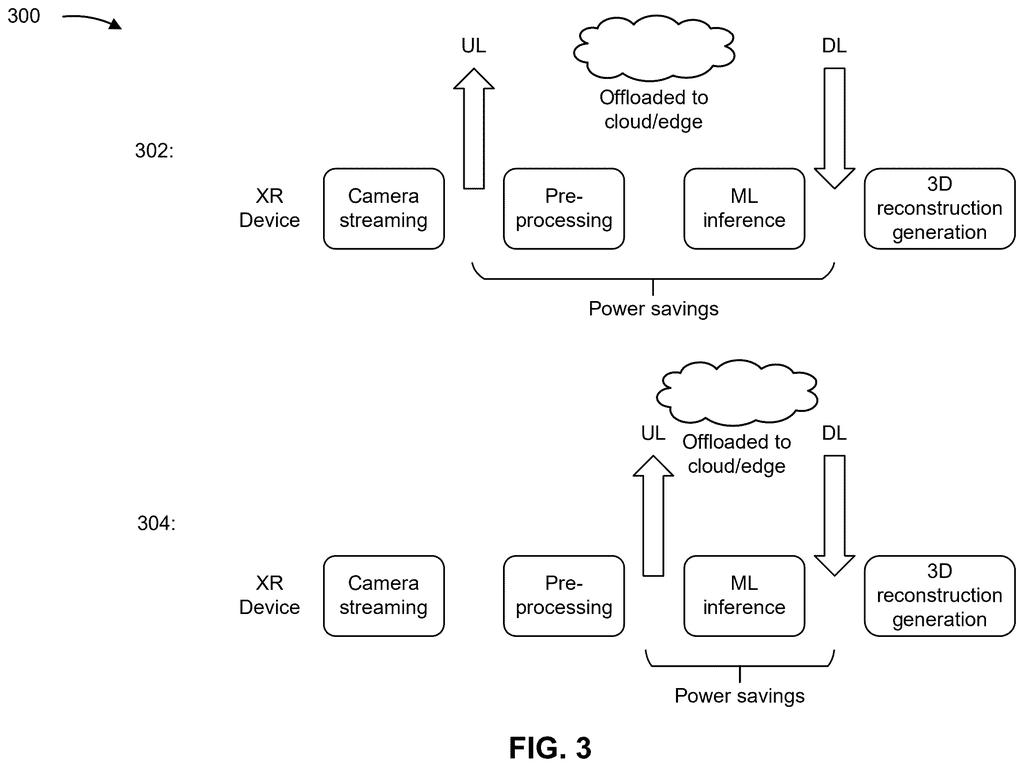
The patent centers on a concept called XR split perception. In extended reality (XR) systems, the heavy lifting of rendering 3D graphics can happen in several places: entirely on the device, entirely on a remote server, or split across both. Each option has tradeoffs in latency (how fast images update), battery drain, and data usage.
What Qualcomm proposes is a formal signaling layer between the device and the radio access network (RAN), the cell towers or wireless infrastructure the device connects to. The device transmits RAN assistance information, a structured message describing its current state and the XR session's requirements.
Based on that information, the network (or an edge server coordinating with it) selects a split or offload option and sends that choice back to the device. The device then adjusts its rendering pipeline accordingly.
- Transmit phase: the headset sends capability and load data to the RAN.
- Selection phase: the network picks the best processing split given current conditions.
- Indication phase: the chosen option is signaled back to the device so it can act on it.
… receive, based at least in part on the RAN assistance information, an indication associated with a selected split or offload option for the XR split perception …
Translation: The device gets instructions on whether to process graphics locally or send them to the network.
What this means for wireless AR and XR glasses
AR and mixed-reality headsets are power-constrained by design. Every watt saved on rendering is a watt that goes toward sensors, display brightness, or just longer battery life. By letting the network make the offloading decision rather than hard-coding it into the device, Qualcomm's approach means the split can adapt as signal quality changes, as the server load shifts, or as the user moves between environments.
The tradeoff is real, though: this only works if the network infrastructure on the other end is actually capable of making those decisions and acting on them fast enough to matter. That is a significant assumption about 5G edge-computing buildout that is still very much in progress. For readers following the broader category of interesting tech patents around wireless XR, this filing reflects how much of the AR headset problem is actually a network problem in disguise.
The design bet here is that the network is a smarter arbitrator than the device alone, and that bet costs something specific: the whole system breaks down if edge infrastructure is slow or absent, turning the negotiation loop into dead weight. In dense urban areas with mature 5G deployments, that trade probably reads as worth it. Everywhere else, a headset that locks in a fixed local-processing mode might actually deliver a steadier experience. Whether Qualcomm's signaling layer pays off depends almost entirely on how fast carriers build the edge compute that makes the other side of that conversation possible.
There are more where this came from
We read every patent application Big Tech publishes and send you the ones worth knowing. Plain English, free, every week.
The drawings
10 drawing sheets from US 2026/0238697 A1 · click any drawing to enlarge


Want this weekly breakdown for a company we don't cover? Patentlyze Pro →
Be the first to weigh in