
Qualcomm Patents a Way to Teach One AI Encoder to See Through Every Camera at Once
Getting a computer to stitch together views from six cameras at once is hard enough. Qualcomm's new patent proposes a way to do it with a single shared AI model that still knows exactly which camera it's looking through.
What Qualcomm's multi-camera perception system actually does
Every time a self-driving car processes its surroundings, cameras mounted at the front, sides, and rear each send a separate video feed to the onboard computer. The system has to understand all of them at the same time and combine them into one coherent picture of the world.
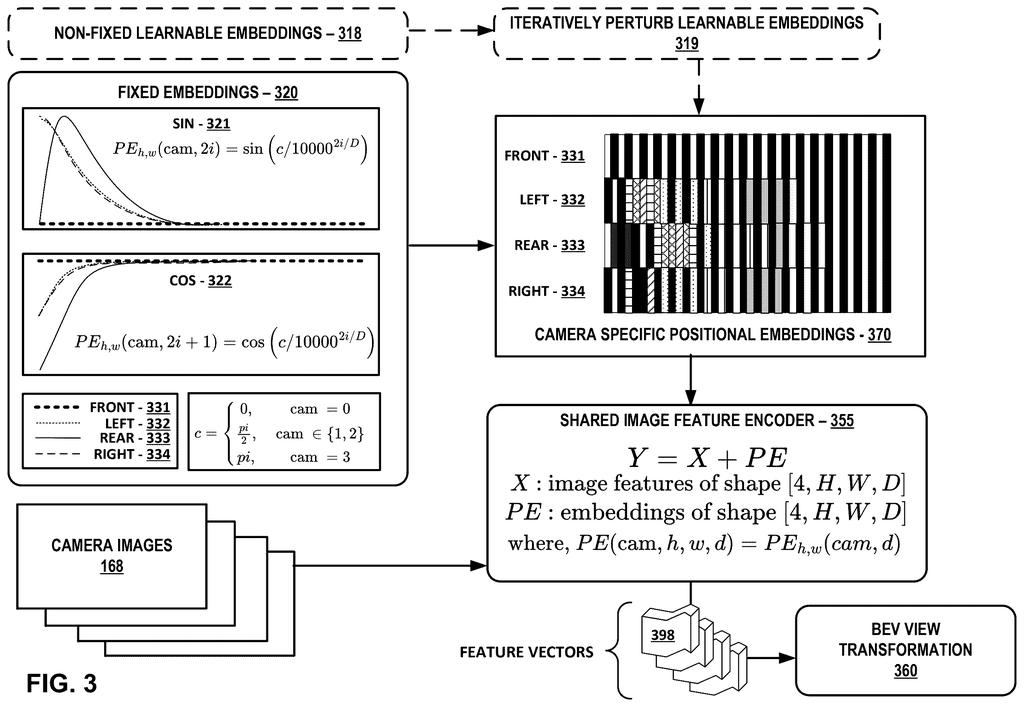
Qualcomm's patent describes a smarter way to handle that pile of images. Instead of running a separate AI model for each camera (expensive and slow), the system uses one shared model that's given a small piece of extra information for each image: a label, essentially, that says "this image came from the left-side camera" or "this came from the rear camera." Those labels are called camera-specific positional embeddings.
With that context baked in, the single model can process every camera's feed without getting confused about where each image came from. The result is a combined understanding of the scene, which the system then uses to spot obstacles, lane markings, or other objects, all while using far less computing power than running a separate model per camera.
… generate respective feature vectors from each of the multiple camera images with a shared image feature encoder using camera-specific positional embeddings associated with different respective cameras …
Translation: The system uses one AI model to process footage from many cameras by tagging each image with its specific camera location.
How camera-specific embeddings guide a shared encoder
The patent centers on what's called a bird's-eye-view perception system, the kind used in autonomous vehicles and advanced robotics to build a top-down map of surroundings from multiple cameras that each see only a slice of the world.
The core invention is a shared image feature encoder paired with camera-specific positional embeddings. An encoder (think of it as a pattern-recognition engine) normally extracts a compact numerical description, called a feature vector, from an image. Running one encoder per camera is accurate but wasteful. Qualcomm's approach uses a single encoder for all cameras, but feeds it a unique positional tag for each camera's image. That tag encodes where the camera sits physically and how it's oriented, so the encoder always knows the geometric context of what it's seeing.
The output is a set of feature vectors, one per camera, that carry both visual information and spatial identity. Those vectors are then passed to a downstream perception task, which could mean:
- Detecting and classifying objects (cars, pedestrians, cyclists)
- Estimating drivable space and lane boundaries
- Building a real-time occupancy map of the area around a vehicle
By sharing weights across cameras instead of duplicating the model, the system reduces memory use and compute load, both critical constraints on automotive-grade chips like those Qualcomm targets with its Snapdragon Ride platform.
The processing circuitry is configured to obtain image data including a current set of multiple camera images from multiple cameras. According to such an example, the apparatus may also generate respective feature vectors from each of the multiple camera images …
Translation: The device collects video from several cameras at once and converts the visual data into a format the AI can understand.
What this means for self-driving and robotics perception chips
For autonomous vehicles, perception latency and chip area are real bottlenecks. A vehicle with six to eight cameras can't afford to run eight separate heavy AI models in real time; that would demand more power and silicon than most production hardware allows. A single model that still understands camera geometry cuts that cost significantly, which is the kind of trade-off that determines whether a feature ships in a mid-range car or only in expensive prototypes.
Qualcomm occupies an interesting position here: it sells the chips and increasingly the AI software stack that runs on them, so a more efficient perception architecture directly improves the appeal of its automotive platform. Patentlyze covers plain-English patent summaries across automotive AI and chip design, and Qualcomm's filings in this space show a consistent push toward doing more perception work on a single, shared model rather than a constellation of specialized ones.
The problem this patent attacks is real and expensive: multi-camera perception on constrained automotive hardware is one of the hardest engineering bottlenecks in production self-driving systems today. The approach, adding lightweight camera-identity tags to a shared encoder, is elegant in proportion to that problem. It doesn't require a new training paradigm or exotic hardware; it slots into existing neural network workflows and pays off immediately in memory and compute savings. That match between problem scale and solution simplicity is what makes this filing more than an incremental tweak.
There are more where this came from
We read every patent application Big Tech publishes and send you the ones worth knowing. Plain English, free, every week.
The drawings
4 drawing sheets from US 2026/0237189 A1 · click any drawing to enlarge


Want this weekly breakdown for a company we don't cover? Patentlyze Pro →
Be the first to weigh in